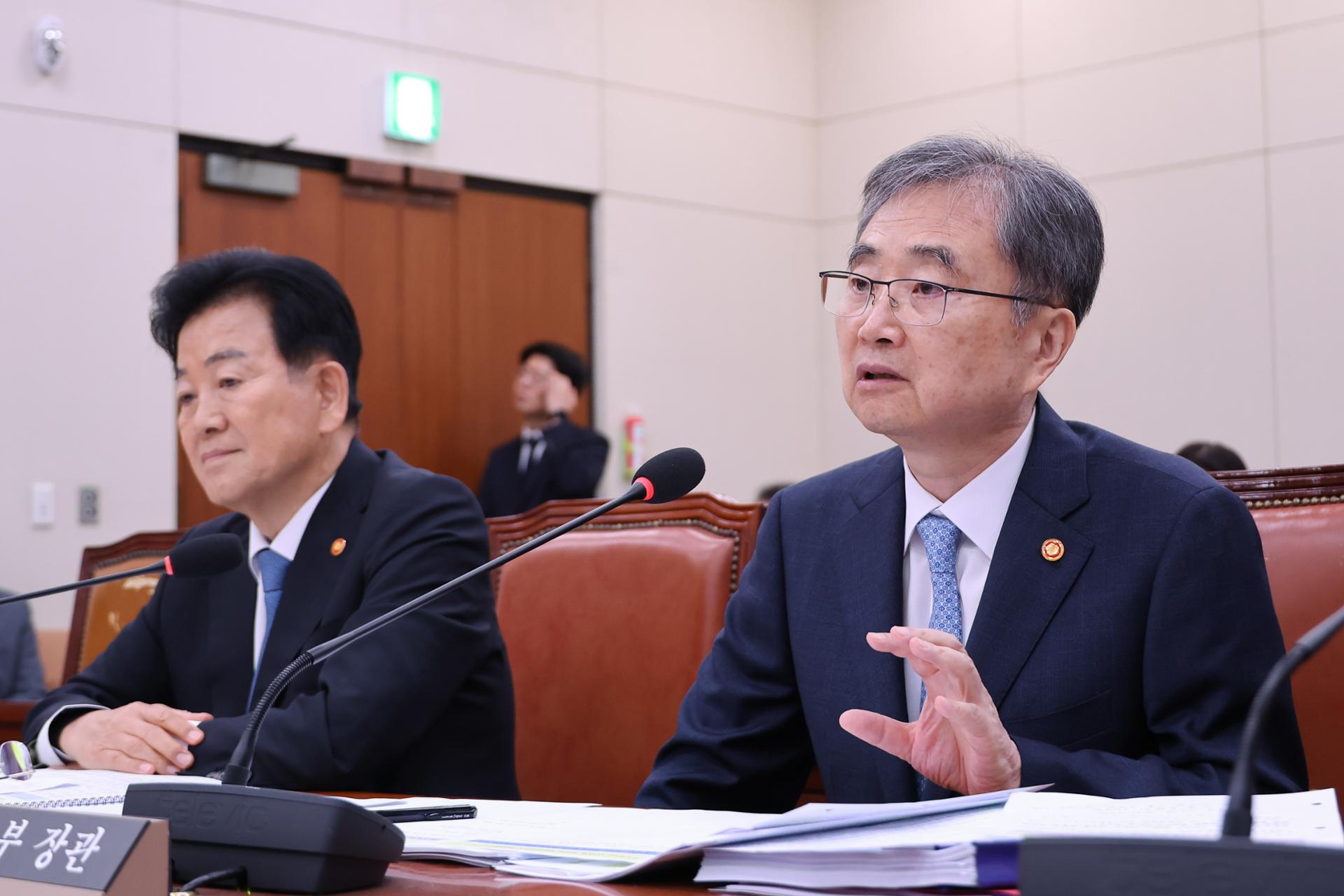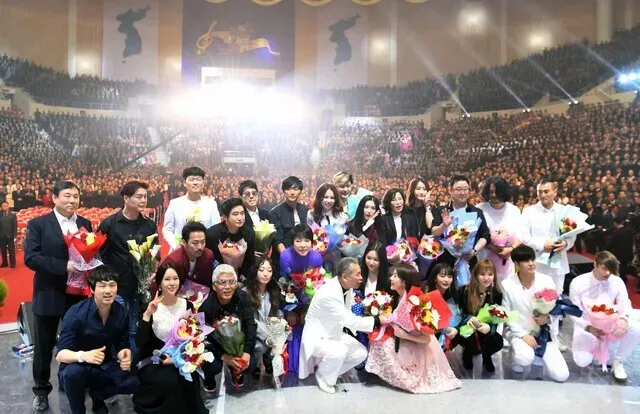
Artists from the two Koreas that participated in a joint performance titled “We Are One” in Pyongyang’s Ryugyong Jong Ju Yong Gymnasium on April 4, 2018, pose for a photo. (pool photo)
Did the DPRK* choose to redefine the inter-Korean relationship as that between “two states hostile to each other” out of fear that the inflow of South Korean culture and ideas would lead to regime collapse and reunification through absorption by its southern neighbor? Or did Pyongyang develop hostility toward Seoul and seek to embed this hostility in public and social life? This question of causality is crucial not only for properly understanding the reality in the DPRK but also for devising inter-Korean policy.If it’s the former, there is little to be done other than wait for a change in the DPRK. This is because no matter how much South Korea says it has no intent to induce instability in the DPRK or pursue reunification by absorption, the government in Pyongyang fears that bilateral exchanges and cooperation could result in South Korean culture and ideology flowing in. Yet if it’s the latter, South Korea has a significant opportunity to drive change by looking at itself, as improving relations with the DPRK — which has severed ties with Seoul and is reinforcing that position institutionally — will require a new approach.Analyses by many media outlets and experts focus on the DPRK’s fear factor. The argument is that by declaring the two Koreas to be separate and hostile states, Pyongyang seeks to block and control the exposure of its populace to the Korean Wave, or Hallyu, and their consequent longing and envy for South Korea. Giving weight to this view is the DPRK’s declaration of a related policy in late 2023, following the enactment of the Rejecting Reactionary Ideology and Culture Act in 2020, the Youth Education Guarantee Act in 2021 and the Pyongyang Cultural Language Protection Act in 2023. DPRK leader Kim Jong-un elevated this perspective to the level of certainty in his report to the 9th Congress of the Workers’ Party of Korea in late February this year. “From the very beginning, the successive ruling forces of the ROK did not want genuine reconciliation and unity with us, but have worked hard to spread their culture within our country by abusing the opportunities for reconciliation and cooperation in a sinister attempt to bring about its change and the final collapse of its social system,” he said. Observers, however, caution against jumping to conclusions, as there is ample room for alternative interpretations when tracing the trajectory of inter-Korean relations and the DPRK’s choices. The purpose of the DPRK’s ban on South Korean culture clearly lies in internal crackdowns and control. But the theory of the two hostile states gives rise to another potential interpretation. The early 2000s saw Hallyu begin to seep into North Korea, both officially and unofficially. The regime cracked down on the Korean Wave entering through channels branded as illegal and punished residents who possessed or distributed it, but many in the country were nonetheless exposed to such content. The defection to South Korea by many DPR Koreans was also a source of envy. Despite this, Pyongyang under Kim Jong-il and Kim Jong-un did not sever inter-Korean relations.The shift to hostility toward South Korea started in 2018. Before the inter-Korean summit on April 27 that year in the truce village of Panmunjom, a South Korean performing art troupe of approximately 190 members held two major performances in Pyongyang. This contingent included many famous singers and K-pop acts such as Cho Yong-pil, Lee Sun-hee, Choi Jin-hee, YB, Kang San-eh, Paik Ji-young, Jung In, Ailee, Kim Kwang-min, Seohyun and Red Velvet. In September that year, then-President Moon Jae-in, who was in Pyongyang for the summit, delivered a seven-minute speech at the Rungrado 1st of May Stadium in front of 150,000 DPR Koreans. The event was broadcast live on television there, allowing much of the population to see it. After giving his address, Moon said he had “grown confident in denuclearization,” indicating that this was the core theme of his address. All this goes to show that the Kim Jong-un regime was open to South Korea at the time and even extended a warm welcome.Immediately afterward, however, unusual signs began appearing. Representatives from civic organizations who visited Pyongyang in October 2018 said the DPRK’s attitude toward the South had turned inexplicably strange. Was it due to sudden fear stemming from the spread of the Korean Wave? That is impossible to confirm, but another clue lies in a personal letter sent by Kim Jong-un to US President Donald Trump immediately after the Pyongyang summit, which included a line about “excluding” the Moon administration. Though the exact reason is unknown, the DPRK leader reportedly felt confused because what he heard from Washington differed from what he was told by the Moon administration, which had positioned itself as a mediator. Starting in the second half of 2019, Kim Jong-un began unleashing vitriol against South Korea, calling the Moon administration’s overtures “remarks that make the boiled head of a cow provoke a side-splitting laughter.”In January 2020, the DPRK effectively sealed its borders to prevent the spread of COVID-19. This lockdown lasted for nearly four years, resulting in the near disappearance of not only official cultural exchanges but also the spread of Hallyu, which used to flow in through the Sino-North Korean border. Why, then, did Pyongyang enact a series of laws around that time to prohibit and punish the influx and spread of South Korean culture and ideas?One clue could be in a statement dated June 13, 2020, from Kim Jong-un’s sister, Kim Yo-jong, who was then first deputy director of the Propaganda and Agitation Department of the Workers’ Party, six months prior to the enactment of the Reactionary Culture and Ideology Rejection Act. “I feel it is high time to surely break with the south Korean authorities,” Kim Yo-jong said, declaring that the DPRK would “soon take a next action.” Shortly thereafter, the DPRK destroyed the inter-Korean liaison office in Kaesong, removed the South Korea section from the daily Rodong Sinmun and began erasing traces of inter-Korean summits.Over time, the Kim regime went from being inviting to being confused, disappointed, and hateful toward the Moon administration, eventually culminating in the declaration of inter-Korean relations to be “completely fixed into the relations between two states hostile to each other and the relations between two belligerent states, not the consanguineous or homogeneous ones any more.”This means that while this stance became official during the Yoon Suk-yeol administration in late 2023 — which, it should be noted, made no effort to disguise its open hostility toward the DPRK —inter-Korean relations had already taken a turn for the adversarial by 2020. This trend shows that the DPRK did not choose to define relations with South Korea as hostile because it was afraid of Hallyu, but instead imposed a ban on South Korean culture precisely because it wanted to reinforce the idea that there was no changing the fact that South Korea was fundamentally hostile to it. It is plausible that Kim’s comments during the ruling party congress in February were made to support its belief that, regardless of who is in the Blue House, South Korea’s invariable goal is unification through absorption. The biggest problem lies in the “prescription.” When experts diagnose the DPRK’s declaration of inter-Korean relations as hostile as stemming from a fear of Hallyu, their suggested course of action is for Seoul to simply wait for a change in circumstances within the DPRK. By a “change in circumstances,” they are generally referring to the economic development-focused Kim Jong-un regime suddenly coming to its senses and realizing that economic progress is only possible via improved inter-Korea relations and thus seeking to improve relations with South Korea. However, this recommended course of action is both contradictory and incredibly fanciful. First off, arguing that the DPRK chose to regard South Korea as a hostile state because it is afraid of the impact of Korean culture, only to then claim that it will restart inter-Korean exchange and cooperation when its economy falls on hard times, is far from logically sound. Moreover, even though Kim Jong-un shed tears over the hardship his people had to endure due to the failure of his economic development strategy in 2020-2021, he did not waver in his decision to impose the ban on South Korean cultural content. One point worth noting is that even when the Kim Jong-un regime blamed itself for the failure of the country’s economic strategies, it published results quite different from those of external assessments. In July 2021, the DPRK stated that the “annual average growth rate of GDP in 2015-2019 [was] 5.1%” in the voluntary national review it submitted to the UN Economic and Social Council’s high-level political forum. That figure is 6 percentage points higher than the Bank of Korea’s estimate for the same period. The DPRK also reported an average annual grain production of approximately 5.67 million tons in 2016-2020, which is about 1.05 million tons more than the estimate by South Korea’s Rural Development Administration for the same period. It is likely that the disparity between the numbers reported by the DPRK and estimates by other countries grew even wider in 2021-2025, when the Kim Jong-un regime claimed that it had exceeded the goals set at a party congress in January 2021. The DPRK stated that its gross domestic product in 2023 was 1.4 times higher than in 2020. Calculated as an annual average growth rate, this amounts to a surge of 11.9%. Applying this figure to the following two years widens the gap between the DPRK’s results and the BOK’s estimates to around 10%. While the Rural Development Administration’s average annual estimate for the DPRK’s grain production during this period is 4.74 million tons, Pyongyang reported that its grain production in 2021 was 5.5 million tons, claiming that it exceeded its target by 3% in 2023 and 7% in 2024. It also reported that it experienced a bountiful harvest in 2025. It is also worth monitoring that the diet of people in the DPRK has become diversified — no longer is it limited to simply grains, but it now includes meat, seafood, various processed and luxury foods, as well as vegetables and fruits. This is where we can see how the mainstream South Korean perspective on the DPRK becomes distorted. Many praised Kim Jong-un for being honest when he admitted to the failure of his economic policy. However, when he toots his own horn to say that his policies have reaped great achievements, there is a strong tendency to dismiss such claims or to simply state that one cannot take Kim “at his word.” This has significant policy implications, as it undermines the notion that the DPRK will eventually come to depend on South Korea after experiencing economic hardship, revealing it to be little more than wishful thinking. During the WPK congress in February and the Supreme People’s Assembly in late March, Kim said, “We successfully carried out several-year development plans for the first time in decades [and] laid down foundations for boosting production in the economic field.” Not only has it made improvements to its self-reliant economic foundation, but its economic cooperation with China and Russia is also gaining momentum. This suggests that the DPRK is more likely to achieve sustained economic growth than be incapacitated by another economic crisis. While I may be rushing to conclusions here, I believe that the DPRK’s decision to define its relationship with South Korea as a “hostile” one between two separate states reflects the country’s confidence rather than its anxieties. While it still has a long way to go, it has improved its economy and the quality of life of its people, acquired a “self-defensive nuclear deterrent” through the strengthening of its nuclear capabilities, and believes that its strategic position in an increasingly multipolar world is being reinforced by its stronger ties with China, Russia, and others. The DPRK no longer has to worry too much about unification through absorption. If that is the case, then why does the Kim Jong-un regime keep claiming that South Korea intends to pursue unification through absorption regardless of who is in power here? Instead of being an expression of fear, one could argue that this is more of an attempt to impress upon the DPRK’s citizens the reason the Kim Jong-un regime abandoned unification with its compatriots on the Korean Peninsula and instead chose to treat South Korea as a hostile state. In doing so, it seeks to establish its national identity as a socialist state severed from the capitalist nation of South Korea. No matter how much we insist that we have no intention of achieving unification through absorption, our voices will only fall on deaf ears. Furthermore, the DPRK’s “two hostile states” approach relies on perilous logic: it seeks to justify the use of nuclear weapons in the event of a crisis by announcing that South Korea should not be considered a “consanguineous” state nor be treated as a country to hold unification talks with. Under these circumstances, it is extremely difficult to formulate an effective policy for how Seoul should approach Pyongyang. However, as I have consistently argued in previous columns, we need to have a sincere and open discussion about changes we in South Korea need to make — more specifically, recognizing the DPRK’s statehood and ruling out the possibility of unification through absorption in a way that is tangible rather than simply rhetorical. Of course, there’s no guarantee that the DPRK will respond positively even if we make these changes. However, these changes will benefit us, whether the DPRK responds or not. If we redirect the vast human and material resources devoted to absorption-based unification plans — rooted in our historical claim to the territory north of the DMZ — toward addressing domestic challenges, it could bring about great change. This is why I once again want to emphasize the importance of embracing the concept of a “post-North Korea” — in other words, letting go of preconceived notions of North Korea to accept the DPRK for what it is, and aiming to benefit both ourselves and inter-Korean relations. Based on these two attitudes, I believe it is now time to adopt an approach based on change. By Cheong Wook-Sik, director of the Hankyoreh Peace Institute and director of the Peace NetworkPlease direct questions or comments to [english@hani.co.kr]