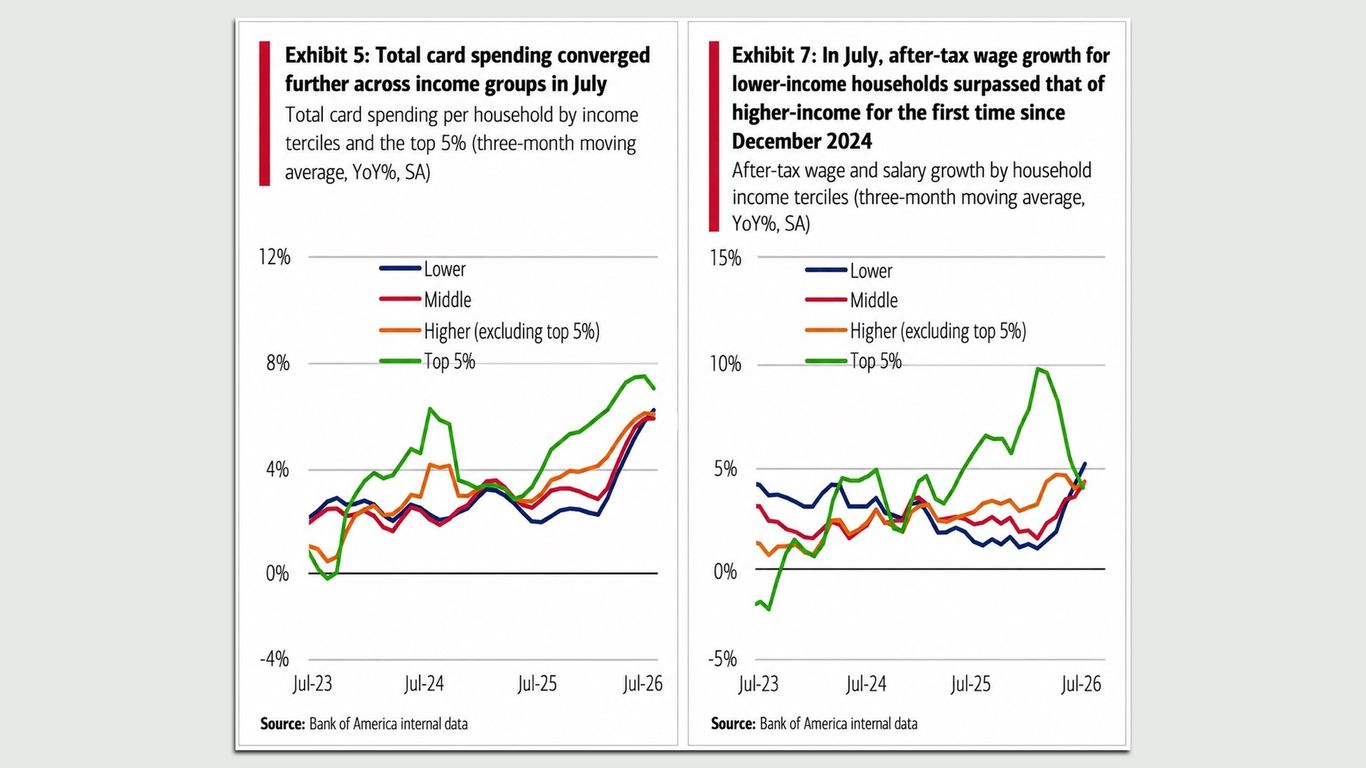
More than 49 percent of all consumer spending in the United States is now performed by the top 10 percent of U.S. earners—meaning that nearly half of U.S. consumption originates from around one-tenth of the population, with the rest of the country in relative stagnation.
This pattern has become described as a K-shaped economy: the idea that economic life has stopped reflecting shared experiences and instead reflects divergent ones. Is the so-called Cantillon Effect responsible for this economy? Is the K-shaped economy also a global phenomenon? What are its political effects?
Those are just a few of the questions that came up in my recent conversation with FP economics columnist Adam Tooze on the podcast we co-host, Ones and Tooze. What follows is an excerpt, edited for length and clarity. For the full conversation, look for Ones and Tooze wherever you get your podcasts. And check out Adam’s Substack newsletter.
Cameron Abadi: To the extent that there is a single engine of this K-shaped divergence in the U.S. economy, some refer to the so-called Cantillon Effect—the suggestion that the post-financial crisis policy toolkit, when there were zero interest rates plus quantitative easing, has played a big role. What exactly is the Cantillon Effect, and is it responsible for the K-shaped economy that we’re talking about?