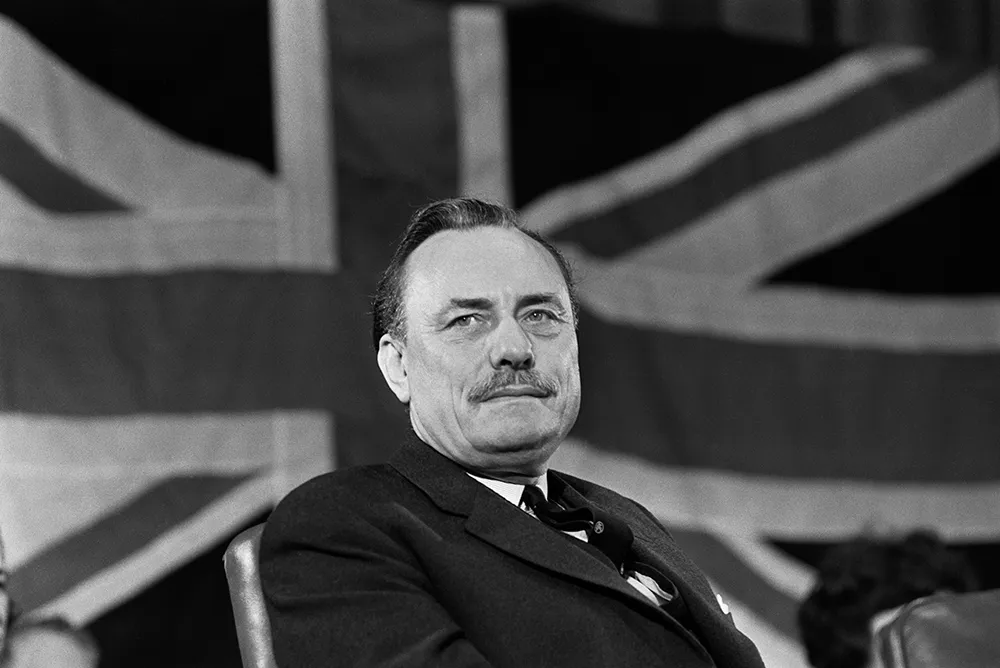
Despite a career of nearly half a century in public life, Enoch Powell is generally remembered for one utterance only: the so-called ‘Rivers of Blood’ speech he made in Birmingham on 20 April 1968, in which he voiced his opposition to the race relations legislation being taken through parliament by the then Labour government. Powell was the Conservative opposition’s defence spokesman. His speech threw the leader of his party, Edward Heath, into a profound panic, and he sacked Powell immediately, initiating decades of assertions that Powell was racially prejudiced.
Powell always said – entirely honestly – that he never made a speech about race: just speeches about immigration policy and his profound disagreement with how it was usually managed. In the Birmingham speech, he had explicitly quoted the words and detailed some experiences of his constituents in Wolverhampton South-West. His argument was not rooted in a racist idea of the inferiority of other cultures – Powell was sufficiently intelligent and experienced to know such thoughts were idiotic – but in an idea of the dangers of imposing upon some communities a culture unlike the one that had always prevailed there. It was a speech, as he clearly said, about the failure to achieve integration across the country. Unfortunately for him, that was a part of the speech to which few chose to listen. What resonated were the hostile remarks of constituents; Powell’s decision to relate them damaged him not just for the rest of his life, but well beyond the grave. To generations of Britons since 1968, including many who have never bothered to read the speech, he was quite simply a rabble-rousing bigot and racist, and no further enquiry was needed.