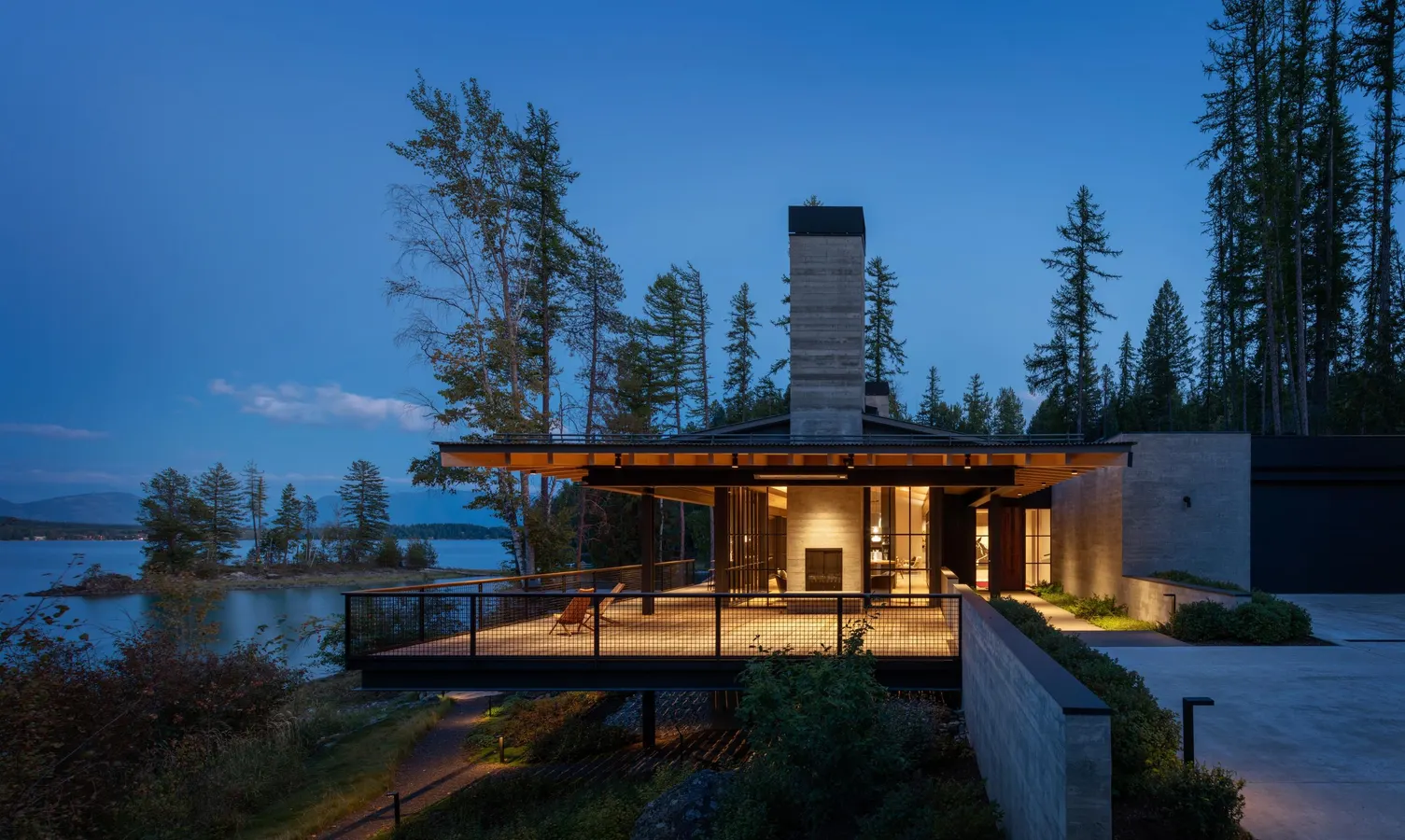
ESSENTIALSFirm Name: Olson KundigPrincipal: Tom KundigHeadquarters: Seattle, WashingtonAccolades: Forbes Architecture’s “America’s Top 200 Residential Architects,” 2025; Forbes Architecture’s “America’s Best-in-State Residential Architects,” 2025; Forbes Architecture’s “America’s Top Hospitality Architects & Designers,” 2026.House Name: Montana Beach HouseLocation: Whitefish, MontanaSite Specifics: A wooded 1.7-acre parcel bordering Whitefish Lake Area & Layout: 6,500 square feet; 6 BR, 5 BAArchitectural Photographer: Aaron Leitz (aaronleitz.com)Over the course of 60 years, Seattle-based Olson Kundig has persevered as a leading purveyor of what might be called muscular modernism. Their Mondrian-like compositions feature kinetic planes that rise, slide and pivot (sometimes assisted by hand-turned cranks), blurring the boundaries between interior and exterior, the manmade and the natural—as in this airy pavilion that appears to float above the shore of Montana’s Whitefish Lake.FRED ALBERT, Forbes Deputy Editor, Architecture: In terms of scale, scope and identity, how does this project fit into your overall body of residential work?TOM KUNDIG, design principal: Like all of our residential work, this project started with the site. Here, that meant keeping the house low and quiet along the beach. From certain angles it almost disappears into the beach and hillside. That sense of belonging is central to how we think about houses. It’s also very much a family home, designed to work when it’s just a couple of people there, but expanding to hold kids and grandkids, so it balances intimacy and generosity. That tension—between being quiet in the landscape and full of life when everyone’s home—is really where it sits within our broader body of work. ALBERT: Creatively, from a design problem-solving viewpoint, what are a few of the most satisfying solutions that came together here? KUNDIG: Getting the massing right—keeping it low and stretched so it feels calm against the water—was critical. That restraint is satisfying because it allows the landscape to lead. Second is the internal flow as you move from the most public spaces to the more private areas. There’s a clear transition from social to quiet. The primary suite and family bedrooms are set apart, and the upper level reinforces that separation, giving the house a sense of order without feeling rigid. That organization also helps the building step back into the hillside, breaking down the scale so it feels appropriate to the site. The overall character of the house is deeply rooted in Montana: the materials, the proportions, the way it sits gently on the site—it’s almost like it grew there.ALBERT: What’s next for the studio?KUNDIG: In the residential arena, we have active projects around the world and up and down the coasts. The non-residential part of the portfolio continues to grow. We’re doing more sports venues and museums, which are always exciting. Resorts are also becoming a bigger part of the practice, with projects like One&Only Moonlight Basin, which recently opened in Big Sky, Montana. Overall, the scope of our work is broadening, but it’s always grounded in the same principles and core DNA of Olson Kundig.ABOVE: “The home stretches horizontally along Whitefish Lake,” observes Kundig, “its expansive glazing glowing at dusk and revealing a series of warm, interconnected gathering spaces anchored by board‑formed concrete walls and natural stone terraces.”Aaron LeitzABOVE: “Exposed fir timbers intersect a 60-foot-long skylight in the home’s central volume—designed to evoke the hull of a boat—while an east-facing wall of glass opens the main dining and kitchen space to Whitefish Lake,” Kundig says.Aaron LeitzABOVE: An oval reclaimed-oak counter anchors the lounge and bar area at the far end of the great room. “An operable awning window opens the space to fresh air and views of the lake,” notes Kundig.Aaron LeitzABOVE: “Floor‑to‑ceiling windows in the guest suite frame head‑on views of Whitefish Lake and the surrounding mountains,” Kundig says. “An extended deck reinforces the home’s immersion within its lakeside setting.”Aaron LeitzABOVE: Set between the primary suite and the guest house, a covered porch frames island views beyond, creating a protected outdoor gathering space. “A timber trellis and sliding glass panels blur the threshold between interior living and the surrounding forested landscape,” explains Kundig.Aaron LeitzABOVE: “A hot tub at the edge of the covered porch and breezeway emphasizes the home's four-seasons experience,” Kundig says. A sliding cover can extend over the hot tub, providing additional seating area.Aaron LeitzABOVE: “Set into the hillside, the bunkhouse offers a rec room and guest suites for visiting family and friends, organized around a private ground‑level courtyard,” Kundig says. “Upper‑level glazing captures elevated views toward the lake and surrounding mountains.”Aaron LeitzOlson KundigOlson KundigMore from America’s Top ArchitectsForbesAmerica’s Top Architects: A Lake Michigan Retreat by Chicago’s Wheeler KearnsBy Richard OlsenForbesForbes House of the Week: Tropical ModernBy Richard OlsenForbesForbes House of the Week: Big Sky CountryBy Richard OlsenForbesForbes House of the Week: New England RenewalBy Richard OlsenForbesForbes House of the Week: A Tahoe Cabin’s ConsciousnessBy Richard OlsenForbesForbes House of the Week: At Sag Harbor’s Cutting EdgeBy Richard OlsenForbesForbes House of the Week: Rocky Mountain High ArtBy Richard OlsenForbesForbes House of the Week: A Carmel-by-the-Sea CottageBy Richard OlsenForbesForbes House of the Week: Enlightened in L.A.By Richard OlsenForbesForbes House of the Week: Sedona’s High Desert RadianceBy Richard OlsenForbesForbes House of the Week: Texas Hill Country HavenBy Richard OlsenForbesForbes House of the Week: Big Island BreakawayBy Richard Olsen
Forbes House of the Week:
Houses from Forbes “America's Best Architects” 2025 lists
863 words~4 min read