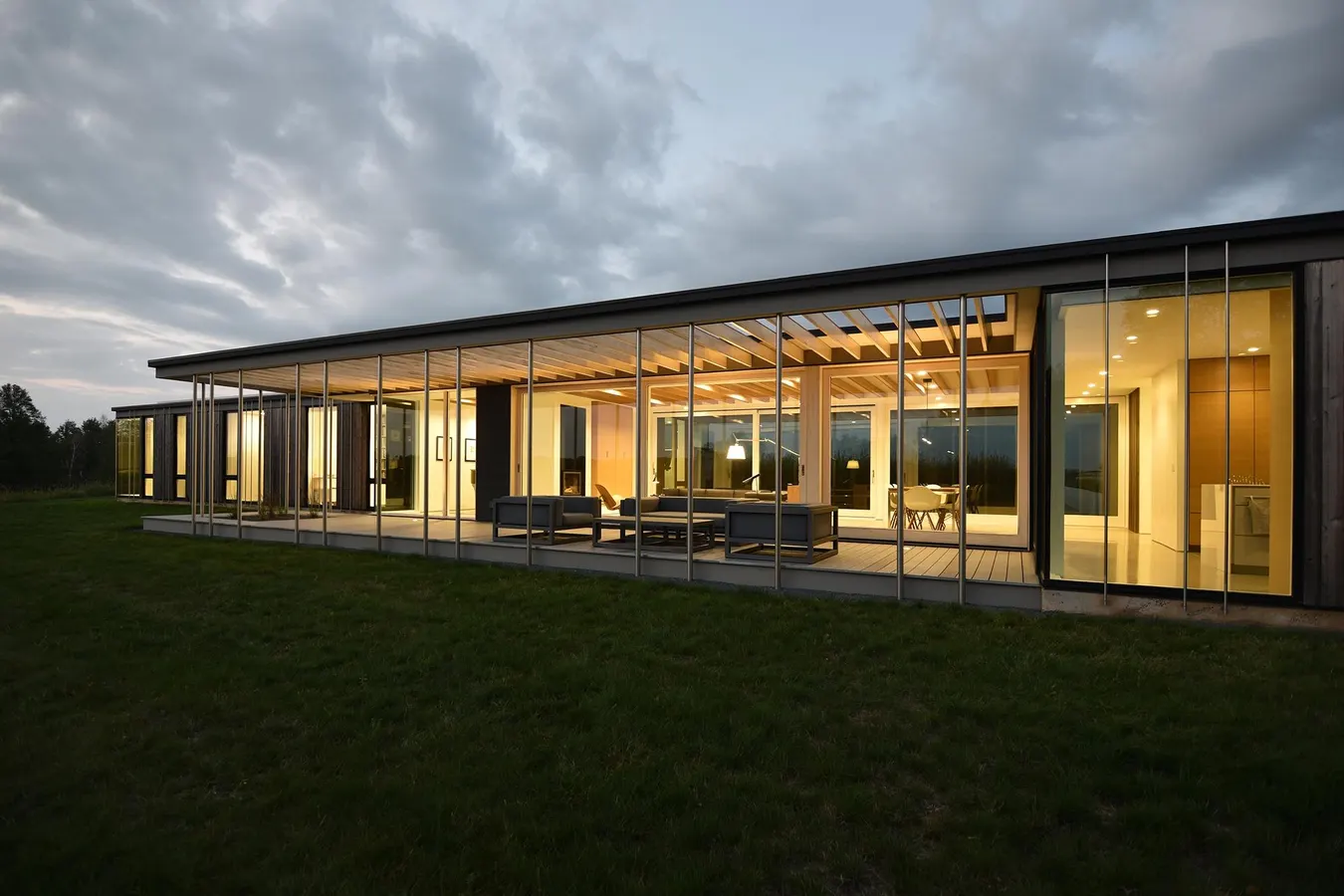
ESSENTIALSFirm Name: Johnsen Schmaling ArchitectsPrincipal: Brian Johnsen, Sebastian SchmalingHeadquarters: Milwaukee, WisconsinAccolades: Forbes Architecture’s “America’s Top 200 Residential Architects,” 2025; Forbes Architecture’s “America’s Best-in-State Residential Architects,” 2025House Name: Kettle Moraine HouseLocation: Campbellsport, WisconsinSite Specifics: More than 50 acres of restored native prairieArea & Layout: 3,342 square feet, 3 BR, 3 BAArchitectural Photographer: John J. MacaulayTwenty thousand years ago, glaciers plowed through Eastern Wisconsin, forming a tapestry of hills, ridges and depressions known as the Kettle Moraine. Asked to design a house on a parcel of prairie land in the area, architect Sebastian Schmaling took his cue from nature, dividing the home into three parallel strips that echo the strands of earth left by the glaciers. The tripartite layout helps define living spaces within the open plan, while the gaps between the volumes form a courtyard and patio. Like much of the firm’s work, the glass-walled house slinks discreetly into its setting, observing its surroundings without upstaging them.FRED ALBERT, Forbes Deputy Editor, Architecture: In terms of scale, scope and identity, how does this project fit into your overall body of residential work? SEBASTIAN SCHMALING: The Kettle Moraine House aligns closely with our ongoing interest in highly site-responsive residential work that prioritizes clarity of form and materiality and develops a symbiotic relationship with its surroundings. Like many of our rural projects, it engages the landscape as a primary generator of the architecture, using sectional strategies and careful siting to minimize visual impact while maximizing experiential richness. The project underscores our studio’s commitment to architecture as a precise and carefully calibrated intervention within a larger environmental continuum.ALBERT: Creatively, from a design problem-solving viewpoint, what are a few of the most satisfying solutions that came together here? SCHMALING: One of the most satisfying aspects of the project is the way the building embeds into the sloping terrain, using the long concrete retaining wall in front not only as infrastructure, but as a spatial and experiential device that choreographs arrival. The splitting of the program into parallel bars, and the resulting glazed central void, establishes a core space with expansive views into the landscape and uninterrupted sight lines throughout the house. On the north side, the stretching clerestory window draws daylight deep into the partially sunken spaces while creating a subtle nocturnal presence that references regional barn typologies. ALBERT: What's next for the studio? SCHMALING: We have a growing portfolio of work around the United States, with projects underway in Utah, Virginia, Michigan, Pennsylvania and California. This geographic range offers an opportunity to recalibrate our design approach in response to distinct environmental conditions. We see each project as a chance to reinterpret our core ideas through the lens of place, climate and local building culture. At the same time, working across multiple regions allows us to deepen our technical expertise and refine strategies related to enclosure, material performance and sustainability. As these projects move from design into construction, they represent an important next phase in broadening our studio’s reach while maintaining its commitment to precise, site-driven architecture. ABOVE: Seen from the front, the house almost disappears into its setting. “A long, board-formed concrete wall extends into the site’s gentle topography and carefully choreographs the final approach toward the house,” Schmaling says. “The wall retains the rising terrain along its backside, allowing the building to partially embed itself in the ground to minimize its visible profile.”John J. MacaulayABOVE: “The board-formed concrete wall guides visitors to a five-foot-wide glass pivot door that leads into the entry vestibule and frames views through the house of the landscape beyond,” Schmaling says.John J. MacaulayABOVE: Large lift-slide doors connect the main living space with the terraced, north-facing entry courtyard that mediates between floor grade and the elevated prairie plane in front. “Exposed wood beams articulate a coffered ceiling and extend to the outside as a trellis over the patio,” says Schmaling.John J. MacaulayABOVE: “The interior is marked by white walls and gray polished-concrete floors, establishing a quiet, minimal canvas,” Schmaling says. “This deliberate austerity heightens the presence of the landscape itself, turning each aperture into a living tableau that shifts with the light and seasons.”John J. MacaulayABOVE: The rear of the house is oriented to the south to capitalize on views and solar gain, which Schmaling helped regulate with a trellis and outstretched eaves that shade the interior in summer but allow light to penetrate in winter. A heat recovery ventilation system and on-demand hot-water pump system also reduce energy demands, while stormwater from the roof is directed to rain gardens to reduce soil erosion.John J. MacaulayABOVE: “A slender roof beam outlines the patio’s edge, its weight carried by a cadence of ultra-thin stainless-steel columns that echo the thin silver lines of the nearby birch grove,” Schmaling says.John J. MacaulayABOVE: “The project included the restoration of more than 50 acres of abandoned farm fields into native prairie, rehabilitating the land’s original biodiversity and turning it into a new sanctuary for wildlife and birds,” explains Schmaling. The architect retained the ruins of an old barn out front, noting, “It’s a graceful memento of the land’s former agricultural use.”John J. MacaulayJohnsen Schmaling ArchitectsMore from America’s Top ArchitectsForbesAmerica’s Top Architects: A Lake Michigan Retreat by Chicago’s Wheeler KearnsBy Richard OlsenForbesForbes House of the Week: Tropical ModernBy Richard OlsenForbesForbes House of the Week: Big Sky CountryBy Richard OlsenForbesForbes House of the Week: New England RenewalBy Richard OlsenForbesForbes House of the Week: A Tahoe Cabin’s ConsciousnessBy Richard OlsenForbesForbes House of the Week: At Sag Harbor’s Cutting EdgeBy Richard OlsenForbesForbes House of the Week: Rocky Mountain High ArtBy Richard OlsenForbesForbes House of the Week: A Carmel-by-the-Sea CottageBy Richard OlsenForbesForbes House of the Week: Enlightened in L.A.By Richard OlsenForbesForbes House of the Week: Sedona’s High Desert RadianceBy Richard OlsenForbesForbes House of the Week: Texas Hill Country HavenBy Richard OlsenForbesForbes House of the Week: Big Island BreakawayBy Richard Olsen
America’s Top Architects: A Prairie House By Wisconsin’s Johnsen Schmaling Architects
Houses from Forbes' “America's Top Architects” 2025 lists
969 words~4 min read