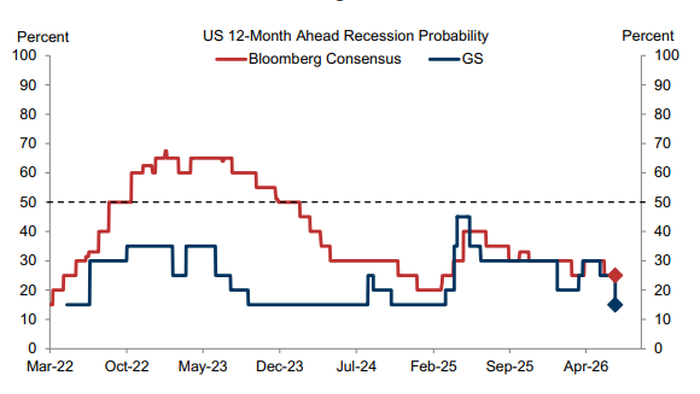
Goldman Sachs is sounding a cautious note on the U.S. economy, raising its inflation forecast and trimming its growth outlook in response to surging oil prices caused by disruptions to the Strait of Hormuz. But even as recession risks climb, most of Wall Street’s base case remains slower growth — not an outright downturn.In its weekly U.S. economics update published on Tuesday, Goldman said it now expects Brent crude to average $105 per barrel in March and $115 in April before retreating to $80 by year-end, assuming roughly six weeks of Hormuz supply disruptions. On the back of that revised oil outlook, the bank raised its headline PCE inflation forecast by 0.2 percentage points to 3.1% by December 2026 and nudged its full-year GDP growth estimate down to 2.1%. Goldman also raised its recession probability by 5 percentage points — to 30% — while stressing that a recession is still not its base case.One relative reassurance: Goldman does not expect the oil shock to durably unhinge inflation expectations. Even major energy shocks in recent history did not produce lasting shifts in where consumers and businesses expect prices to settle, the bank noted, though it flagged post-pandemic inflation psychology as a risk worth watching.
Goldman raises recession odds to 30% on higher inflation, lower GDP outlook as oil prices surge | Fortune
Goldman said it expected six weeks of Hormuz disruption, with Brent crude averaging $105 per barrel in March and $115 in April before retreating to $80.
636 words~3 min read