The prosaic and unimaginative 35-word Preamble to the draft of the Constitution of India prepared by Benegal Narasingha Rau, former British colonial civil servant and constitutional adviser to the Constituent Assembly, and presented by Rau to the Drafting Committee in October 1947 merely contained an apolitical, anodyne administrative statement: “We, the people of India, seeking to promote the common good, do hereby, through our chosen representatives, enact, adopt, and give to ourselves this Constitution.”
Rau’s draft borrowed an approach common to the preambles of then-prevailing constitutions in which the act of “the people” is seen as basically administrative in nature — granting agreement and approval, adopting and enacting the constitution. For example, the preamble to the world’s oldest major living written constitution, the 1787 United States Constitution, says “We, the people… do ordain and establish this Constitution.” The 1901 Australian Constitution says “the people... have agreed to unite”.
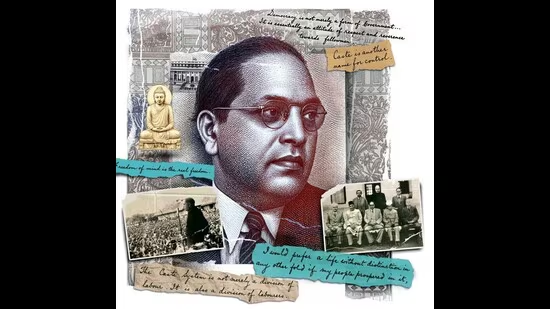
As Chair of the Drafting Committee, Dr. B.R. Ambedkar rejected the approach of the Rau draft and produced a dramatically different new preamble in 1948, which infused the Preamble and the Constitution as a whole with profound normative content which, to this day, defines the essential character of the Constitution. The production of this new draft preamble by Dr. Ambedkar is recounted in Aakash Singh Rathore’s interesting book, Ambedkar’s Preamble: A Secret History of the Constitution of India (Vintage Books, 20 January 2020).