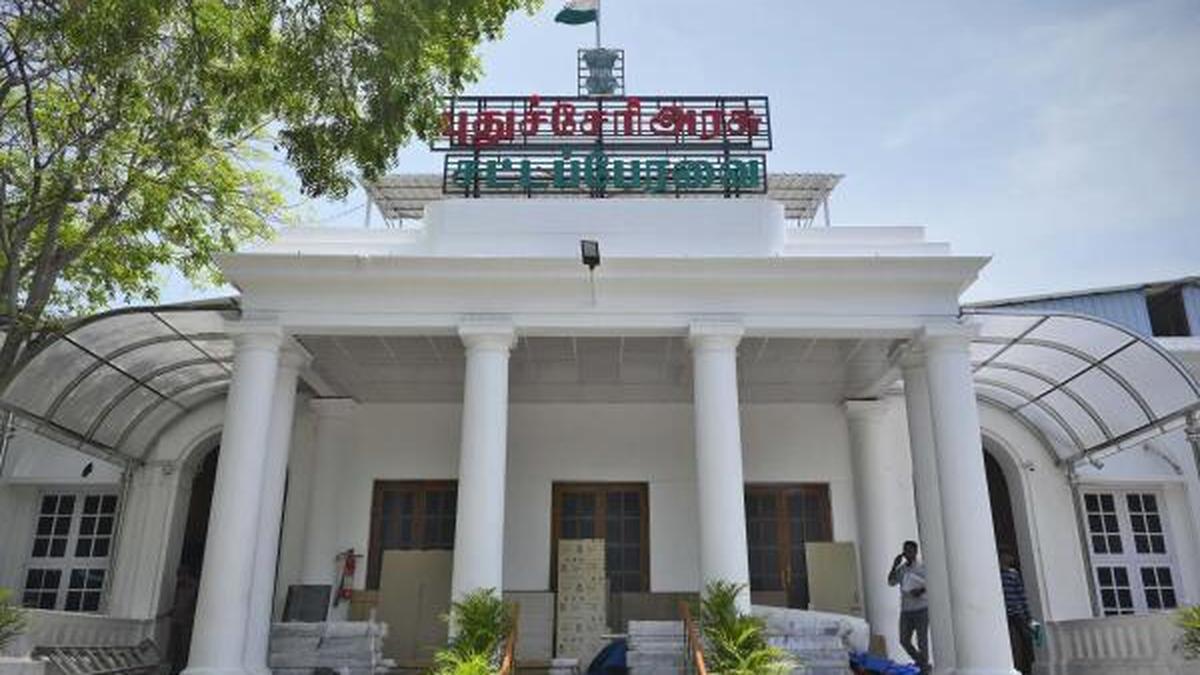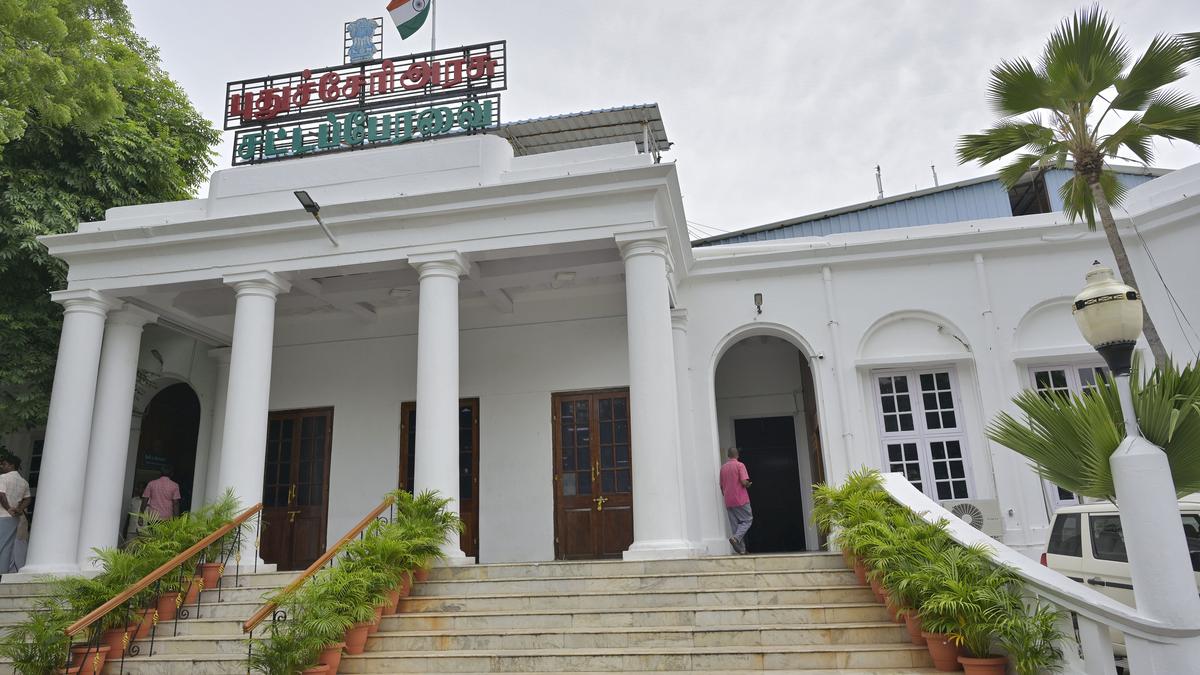
Puducherry Legislative Assembly. File
| Photo Credit: S.S. Kumar
The Comptroller and Auditor General (CAG) audit report for 2023-2024, while highlighting the growing debt of the Puducherry government, also points out certain positive aspects of the Union Territory’s (UT) finances, such as its repayment profile and debt sustainability.The report points out that the UT’s outstanding loan liability has steadily increased from ₹9,449 crore in 2019-20 to ₹13,084 crore in 2023-24, rising year-on-year: ₹10,886 crore in 2020-21, ₹12,594 crore in 2021-22, ₹12,640 crore in 2022-23, and ₹13,084 crore in 2023-24.Officials said the highest loans during the five-year period mentioned in the report were taken in 2020-21 (₹2,529 crore) and 2021-22 (₹2,516 crore) to overcome the fiscal stress caused by COVID-19.Though the figure of outstanding liabilities of ₹13,084 crore was huge, considering the limited scope of revenue mobilisation or flexible manoeuvrability available with the Puducherry administration and the channelling of resources used towards debt servicing, the government could find solace from the report that it could bring down the debt to Gross State Domestic Product (GSDP) ratio to an acceptable/standard level, officials said.Debt to GSDP ratioGoing by the finer details available in the report, the UT’s debt to GSDP percentage was 23.48, as against the prescribed limit of 25%. In fact, the debt to GSDP ratio had gone up from 25.54% in 2019-20 to 28.04% in 2020-21. The ratio of 26.30 reported in 2021-22 then decreased to 24.17 in 2022-23. The data showed that the UT has consistently maintained the debt to GSDP ratio over three years, pointing to good debt management.“The positive trend on the ratio indicates that the territory was in a stable position to repay its debt. The revenue balance shows a positive trend, and ratio of interest payment to revenue receipts also shows a decreasing trend, which is a good indicator for debt sustainability,” an official said.However, the concern was about debt financing, which mostly pertains to borrowed funds. During the five-year period of 2019-24, 57.02% of public debt receipts were utilised for the repayment of debt taken in previous years. In 2023-24, as against the borrowing of ₹1,269 crore, debt repayment was against ₹957 crore, leading to lesser funds available for the creation of capital assets.The CAG said funds borrowed should be ideally used to fund capital and development works. Using borrowed funds for meeting current consumption and repayment of interest on outstanding loans was not suitable. The audit agency has also pointed out low flow of funds for capital expenditure over the years. The report said, as against the capital expenditure of ₹327 crore incurred during 2019-20, the amount spent on the account in 2023-24 was ₹439 crore, which constituted only 4.18% of the total expenditure, indicating the government’s lack of prioritisation of infrastructure development.For improving the UT’s financial position, the government should mobilise own resources and strengthen the machinery for the collection of arrears of revenue to reduce the dependency on borrowing. The government should borrow based on its requirements only. Published - September 24, 2025 06:20 pm IST