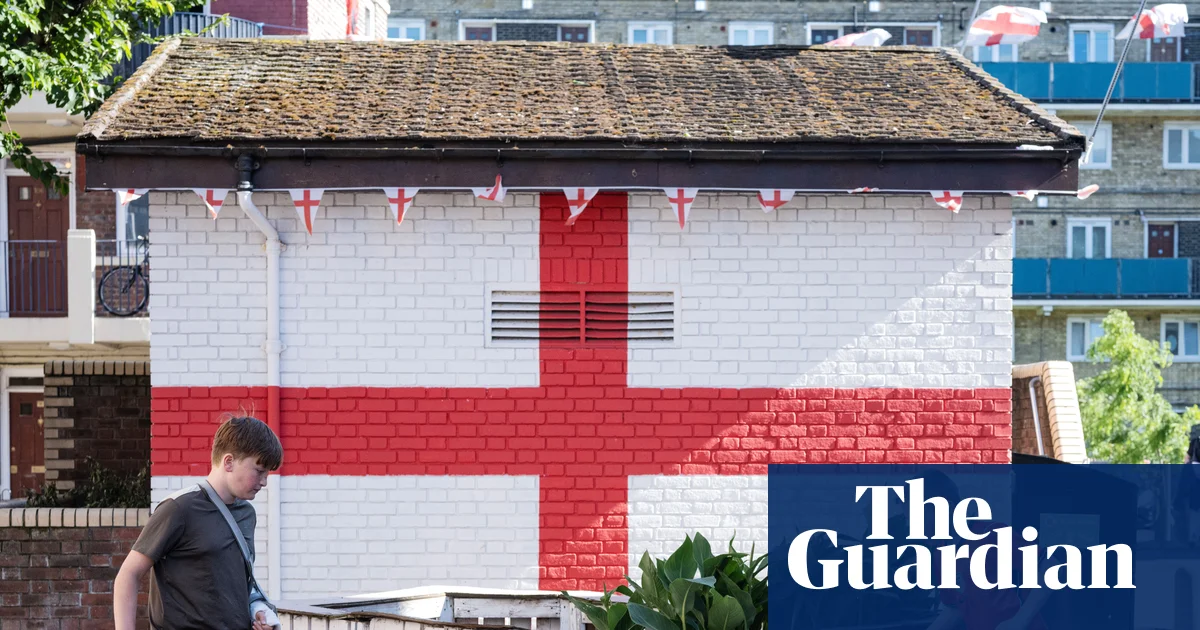
As toxic nationalism spills over into our shared spaces, the England shirt is freighted with meaning for better or worse
T
he crosses of St George are flying all around me. Fair to say the opening line of Three Lions ’98 hits a little differently in 2025. The crosses of St George are being daubed on an Islamic centre in Basildon. The crosses of St George are being used to deface a Chinese takeaway in York. The crosses of St George are draped over men shouting at a three-star hotel from a mini-roundabout. The crosses of St George are retailing for about £2.36 on Temu, depending on whether you want them car-window sized, or big enough to write the words “GET OFF MY LAND” in the white spaces.
Keir Starmer has declared that he is “a supporter of flags”. Alas, at the time of writing the prime minister’s position on other items of tactile fabric remains unclear. What does he think about blankets? Does he endorse or condemn the dishcloth? Not to be outdone, the home secretary, Yvette Cooper, disclosed that she has St George’s bunting on display at home. “I would put them up anywhere,” she confirmed, which – anatomically speaking – is not an image any of us needed right now.
Naturally it barely requires saying at this point that the recent wave of flag onanism is a thinly disguised trap laid by the resurgent far-right, a way of sneaking its toxic politics into our shared public spaces under the guise of broad-church patriotism. It’s just a flag. How can you get triggered by a flag? How can any right-thinking citizen possibly object to this most simple expression of collective pride? Albeit an expression largely being expressed by a few lone individuals in the dead of night, which is when all great expressions of collective pride traditionally occur.