HomeAI · summaries
Storia in 2 fonti
Flies use directional memory to track a scent
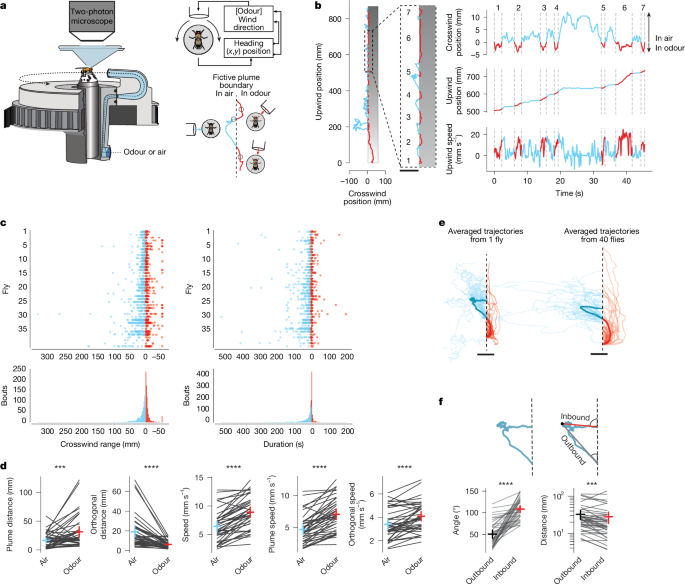
Odors can reveal distant or hidden food sources, mates, and other important targets, but odor plumes are turbulent and fragmented, often reaching animals as brief, disconnected puffs of scent. Fruit flies solve this challenge by tracking a drifting odor plume along its edge, by repeatedly weaving in and out of a plume, rather than heading straight through the middle of it. Each time a fly crosses the plume’s boundary, it stores a directional memory of the plume’s edge, letting it steer back to that area even if they lose contact with the odor. The behavior depends on the fly’s central complex, a brain region used by insects for spatial navigation, showing that odor tracking is not simply reflexive but can rely on an internal spatial memory.
Confronto fonti
2 prospettive sulla stessa storiaTimeline cronologica
- ·
nature.com
A vector-based strategy for olfactory navigation in Drosophila - Nature
Using a virtual reality system, experiments in Drosophila show that flies use memory mechanisms to navigate along the boundary of an odour plume and track the source of a smell.
- ·
eurekalert.org
Flies use directional memory to track a scent
Odors can reveal distant or hidden food sources, mates, and other important targets, but odor plumes are turbulent and fragmented, often reaching animals as brief, disconnected…