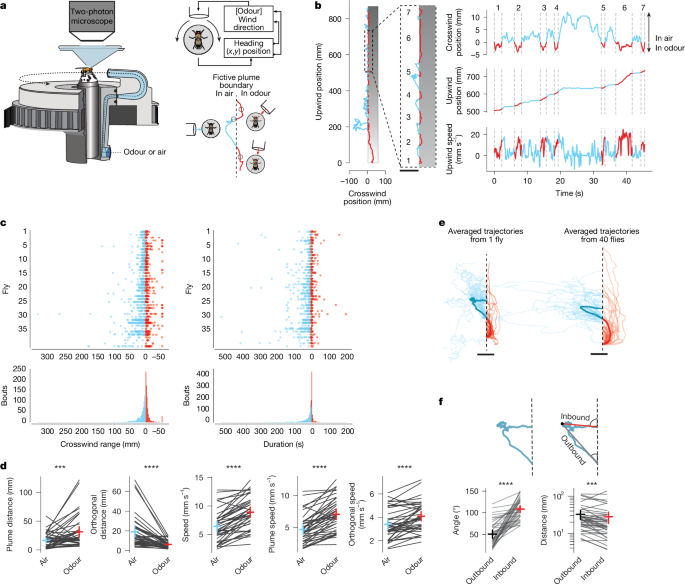
MainNavigating within a complex environment is a ubiquitous requirement for all animals, driving the evolution of diverse behavioural strategies tailored to the structure and stability of sensory landscapes1. In many instances, a simple chain of sensorimotor reflexes can be used to guide animals towards or away from a salient object using only immediate sensory cues1,7. However, when sensory signals are intermittent or unreliable, animals might instead need to navigate towards goals that cannot be continuously sensed, requiring memory of their position or direction. Insects, for example, are thought to use a vector-based navigational strategy in which they integrate both distance and directional information to guide them towards a stored location8,9. This approach is exemplified by the navigational feats of central place foragers, such as ants and bees, which can wander far from their nests and return efficiently even in a mostly featureless environment9,10. However, whether similar vector-based strategies can be used to steer through more dynamic sensory environments, such as an odour plume wafting from its source, has remained unclear7,11.Odours are among the most salient signals that insects use to guide navigation2. Plume tracking in insects has been proposed to rely on a mainly reflexive strategy, in which animals surge upwind after encountering an odour and cast crosswind after losing contact with the plume to re-encounter it3,4,5,12. However, the dynamic nature of olfactory plumes often requires animals to track using only intermittent odour encounters11,13 separated by vast stretches of clean air that offer no immediate sensory information to point them back to the plume. Memory mechanisms could allow animals to bridge across these fragmented odour experiences. Here we investigate this possibility by developing a virtual-reality paradigm for plume navigation and show that Drosophila store the direction required to return to the plume as an angular goal that is continuously updated as they track along the plume’s border. Consistent with the notion that a plume is not a fixed spatial landmark, flies appear to store only the direction towards its boundary, not their distance from it. Our results suggest that elements of an evolutionarily conserved navigational toolkit14 can be flexibly deployed in different sensory contexts, allowing flies to use odours as chemical signposts to track long distances towards a remote source.Flies track a plume along its boundaryOne fundamental challenge to elucidating the behavioural algorithms that underlie plume navigation is that odours are invisible and often carried along turbulent airflow11,13, limiting experimental access to an animal’s true sensory experience. To overcome this, we developed a closed-loop olfactory paradigm that allows tethered Drosophila to navigate virtual chemical landscapes. In this system, the heading of a fly walking on an air-supported ball is yoked to the rotation of a nozzle carrying a constant airstream, enabling the fly to control its orientation relative to a wind source blowing from a constant allocentric direction15,16 (Fig. 1a and Supplementary Video 1). High-speed mass flow controllers dynamically control the concentration of odour infused into the airstream at each moment depending on the fly’s position within this virtual world, allowing us to construct plumes with precise spatial structures. Flies walk in complete darkness, such that aside from proprioceptive feedback to stabilize their trajectories, the wind direction provides the only external directional cue available to orient them.Fig. 1: Flies track a plume along its boundary.a, Left, schematic of the closed-loop virtual-reality system. A tethered fly walks on an air-supported ball while its heading controls the angular position of a nozzle delivering a constant airstream, with or without odour. Top right, the fly’s fictive position determines the odour concentration. Bottom right, nozzle position as the fly crosses the fictive plume boundary (dashed line). The trajectory is red inside the plume and blue outside it. b, Left, example trajectory of a fly tracking an odour corridor with an ascending gradient (10–100% ACV over 1 m); red inside the plume, blue outside. The boxed segment is expanded on the right. Scale bar, 25 mm. Right, crosswind position, upwind position and upwind speed for the inside and outside bouts in the expanded segment. c, Distributions of crosswind distance (left) and duration (right) for inside (red) and outside (blue) bouts. Each dot is one bout; n = 40 flies. d, Average behavioural metrics for bouts inside (red) or outside (blue) the plume. Plume distance and orthogonal distance refer to distance travelled along, and orthogonal to, the longitudinal plume axis. Thin lines, per-fly averages; thick lines with error bars, mean ± s.e.m. across flies. n = 40 flies. e, Aligned inside (red) and outside (blue) trajectories. Left, all trajectories (thin) and scaled average (thick) for the fly in b. Right, scaled averages for 40 individual flies (thin lines) and across-fly average (thick). Scale bars, 10 mm. f, Top, schematic of outbound (black) and inbound (red) segments of an outside trajectory, defined relative to the farthest-crosswind point (Methods). Bottom, quantification of the angles and path lengths (log scale) between each segment and the plume. Thin lines, per-fly averages; thick with error bars, mean ± s.e.m. n = 40 flies. ***P < 0.001; ****P < 0.0001. See Supplementary Table 1 for full statistics and sample sizes. The schematic in a is adapted with permission from ref. 15 (Cell Press).We reasoned that memory mechanisms facilitating navigation might be most apparent using a stationary plume, the stability of which allows flies to accumulate predictive information about its structure. We therefore first investigated how flies track a 50-mm-wide fictive ‘corridor’ of the appetitive food odour apple cider vinegar (ACV) aligned to the wind direction (Fig. 1b)—a simplified chemical landscape that nevertheless captures key features of the slowly dispersing surface plumes that walking flies encounter in nature when close to their source17. The corridor was bounded on both sides, such that if a fly walked laterally in one direction or the other, it would exit the plume and the ACV concentration would dissipate rapidly (Fig. 1a,b and Extended Data Fig. 1a–c). Owing to the approximately 500-ms delay for odour entering the airstream to reach the fly’s antenna, the lateral boundaries of the plume were not perfectly sharp but decayed within about 5 mm, depending on the fly’s walking speed (Extended Data Fig. 1b). A shallower gradient ran along the corridor’s longitudinal direction, such that a fly experienced a steadily increasing concentration of ACV (10–100% over 1 m) as it walked upwind, mimicking the sensory feedback of approaching the odour source.Previous descriptions of plume tracking suggest that flies navigate this corridor through odour-gated anemotaxis—surging upwind after contacting the odour, while remaining within the plume’s boundaries1,3,4,5,18. However, we found that flies reliably ascended the length of the plume by tracking along a single edge, through repeating two behavioural motifs: after entering the corridor, they counter-turned rapidly to exit it, and once outside the plume they performed a more circuitous exploration before re-entering (Fig. 1b and Supplementary Video 2). We call this behaviour ‘edge tracking’. Although this strategy is reminiscent of previous descriptions of insects tracking the borders of surface plumes18 or odour patches19, the precision of our experimental paradigm offers an inroad to examine how flies use this boundary information for navigation.During edge tracking, flies travelled inside the plume only briefly (mean 4.9 s, n = 755 bouts), instead spending significantly more time outside the odour corridor as they ascended upwind along its boundary (Fig. 1c). Nevertheless, most of their progress occurred during these brief inside bouts (Fig. 1b,d). On average, flies also progressed upwind when they walked outside the plume (Fig. 1b,d), but these trajectories were much more variable in both distance and duration, with some excursions extending hundreds of millimetres orthogonal to the plume’s boundary before returning (Fig. 1c,d). Flies typically tracked along a single edge, walking within the plume’s lateral margin (mean 10.4 mm) and rarely crossing the plume’s width to the other edge (<4%, n = 793 bouts). Most flies that initially encountered an ACV corridor tracked its edge spontaneously for hundreds of millimetres (Extended Data Fig. 1d,e), underscoring the robustness of this strategy.Animals can use perceived changes in odour concentration to localize an odour source1. However, flies tracked corridors of a constant odour concentration (20% ACV) as effectively as they did those with an increasing longitudinal gradient, and even tracked corridors in which the longitudinal gradient was reversed, such that they encountered a progressively lower ACV intensity as they advanced upwind (Extended Data Fig. 2a). On average, fly trajectories were indistinguishable across these plumes (Extended Data Fig. 2b). Flies thus do not rely on gradual changes in odour concentration along the plume’s length to edge track, suggesting that the plume’s lateral boundary—where odour gradients are steepest—is the more salient spatial cue. Consistent with this, flies readily tracked plumes with a Gaussian lateral profile characteristic of time-averaged plumes20, concentrating their trajectories along the isocline of steepest concentration change (Extended Data Fig. 3). This behaviour aligns with the sensitivity of Drosophila olfactory pathways to concentration derivatives21,22 and suggests that, even when plumes lack sharp edges, flies track an effective boundary defined by maximal lateral contrast.Insects have been proposed to track the boundaries of surface plumes using bilateral comparisons of their sensory appendages23,24,25. In our assay, however, plume boundaries are not defined spatially but arise from rapid temporal changes in odour concentration, resulting in nearly synchronous odour delivery to both antennae (Extended Data Fig. 4a). To assess whether flies use transient sensory asymmetries for edge tracking, we expressed the optogenetic activator CsChrimson in most olfactory sensory neurons using the Orco promoter, allowing for simultaneous activation of both antennae as flies crossed into a 660-nm light corridor (Extended Data Fig. 4b). In the absence of wind, Orco>CsChrimson flies preferentially remained within the light corridor (Extended Data Fig. 4c,d)—consistent with the intrinsically appetitive nature of broad olfactory sensory neuron activation24,26—but progressed minimally along the plume’s length (Extended Data Fig. 4e). However, adding a closed-loop wind source led Orco>CsChrimson flies to advance upwind along the boundary of the light corridor using a similar behavioural strategy to edge tracking (Extended Data Fig. 4c,f,g). Flies thus do not seem to require a bilateral comparison of olfactory input to localize the plume’s boundary. Rather, they rely on wind direction and the steep change in odour concentration at the lateral boundary to edge track.Returns to the plume are not randomDuring edge tracking, the wind provides the sole external landmark available to flies to orient themselves but provides no information to guide returns back to the plume. Nevertheless, although many flies in our paradigm adhered closely to the plume’s edge, with only transient outside excursions, others occasionally performed long trajectories that carried them hundreds of millimetres away (Fig. 1c). During these long excursions, flies were immersed in clean air for tens of seconds before returning to the edge, frequently along shorter, more directed paths (Fig. 1c,e), suggesting that they retain information about the direction of the plume. Consistent with this, outside trajectories were asymmetrical, with flies leaving the plume at a shallow angle, but returning angled almost perpendicularly to the plume’s edge along shorter, more direct paths (Fig. 1e,f).The observation that flies take lengthy excursions away from the plume and make directed returns suggests that their outside exploration is not random. To examine this, we decomposed a fly’s outside trajectories into their elementary run lengths and turn angles (Extended Data Fig. 5a,b), and then randomly drew from these experimental distributions to generate synthetic trajectories built from the same path statistics. Simulated trajectories could reliably return to the plume’s boundary (Extended Data Fig. 5d) but were highly circuitous, with significantly longer path lengths compared with those of real flies (Extended Data Fig. 5f). Moreover, the segments away from and back to the plume were equivalent in length, in contrast to the more directed returns real flies display (Extended Data Fig. 5e). Incorporating the intrinsic upwind bias that flies exhibit resulted in simulated trajectories that ascended the plume but remained highly inefficient (Extended Data Fig. 5c,e), consistent with the fact that returning to a vertical odour corridor depends on progress in only the crosswind—not the upwind—direction. Edge tracking therefore does not adhere to the statistics of a random search process—rather, the directed returns that flies perform suggest that they rely on a memory of past plume encounters to guide efficient trajectories back to the boundary.Flies track diverse plume geometriesTransient shifts in wind direction can cause a plume to meander, such that it no longer aligns with the wind direction or points to the odour source18,27. Reflexively surging upwind after encountering an odour would inevitably cause animals to walk out of a meandering plume, suggesting that it could be advantageous to track the boundary of a plume rather than to follow the wind direction28. To examine this possibility, we constructed a set of ‘tilted’ plumes of constant ACV concentration, in which the longitudinal axis of the odour corridor was offset from the wind direction by 45° or 90° (Fig. 2a–c). We found that flies robustly tracked the boundaries of tilted plumes for hundreds of millimetres, even for the 90° plume, which required individuals to choose a left or right crosswind direction and advance along it, moving orthogonal to the wind with minimal backtracking. Indeed, flies even tracked a 90° plume along a diminishing concentration gradient (Extended Data Fig. 2c,d), underscoring that their progression along the plume’s edge appears to rely on an internal sense of direction and not on the instantaneous odour concentration.Fig. 2: Flies track plumes that are not aligned with the wind.a–c, Flies track plumes with different orientations relative to the wind. For each, we show a representative trajectory (red, starting position denoted by black circle) and occupancy as a function of distance to the plume. a, Vertical plume (n = 40 flies). b, 45° plume (n = 21 flies). c, 90° plume (n = 20 flies). d, Representative trajectory of a fly navigating a ‘jumping’ plume in which the plume shifts 20 mm rightwards each time the fly exits. Scale bars, 100 mm (a–d). e–h, Left, aligned and averaged inside and outside trajectories for each plume orientation; thin lines, scaled averages for individual flies; thick line, mean across flies. Right, distributions of entry and exit angles (mean heading in the 0.5 s before and after crossing the plume boundary); thin lines, averages for individual flies; thick line, mean across flies. e, Vertical plume (n = 40 flies). f, 45° plume (n = 21 flies). g, 90° plume (n = 20 flies). h, Jumping plume (n = 24 flies). Scale bars, 10 mm (e–g); 20 mm (h). i, Representative trajectories after the plume vanishes during an outside bout for 0°, 45° and 90° plumes. The plume boundary is indicated by the black line, with inside bouts in red and outside bouts in grey. The black arrowhead marks the point of the plume’s disappearance, with the subsequent 2-min trajectory in blue. For each plume, the top polar plot shows the distributions of the average heading as flies walk in wind in the 2 min preceding tracking (pre; black) and the average entry angle during tracking (blue). The bottom polar plot shows the average heading at the indicated times after plume disappearance; each dot is one fly. 0°, n = 12; 45° n = 11; 90° n = 6. Scale bars, 100 mm. j, Comparison of the average entry angle during tracking (innermost circle) and travel direction at the indicated times after plume disappearance for flies in i. Each circle reflects a time bin; mean ± s.e.m. NS, not significant; ***P < 0.001. Statistical details and sample sizes are in Supplementary Table 1.Flies tracked the boundaries of both 45° and 90° tilted plumes using a similar behavioural strategy as was observed for vertical plumes (0°): after entering the odour corridor, they rapidly reoriented to steer upwind, and after losing contact with the plume, they performed directed returns back to the plume’s boundary (Fig. 2e–g and Extended Data Fig. 6a–g). Across plume geometries, flies preferentially exited in the upwind direction, leading them to track tilted plumes almost exclusively along their upwind edge. Nevertheless, both entry and exit angles varied systematically depending on the plume’s orientation. For example, to exit a vertical plume, flies must steer laterally away from the upwind direction. By contrast, flies could exit the 45° and 90° plumes using a large range of upwind angles, yet typically biased their exits in the direction that they were progressing along the plume’s length (Fig. 2e–g and Extended Data Fig. 6a,e–g). Entry angles depended even more strongly on the plume’s orientation, reflecting the fact that animals must walk in a crosswind direction to return to a vertical plume, but downwind to return to a 90° plume. Inside trajectories were shorter in tilted plumes than in vertical plumes (Extended Data Fig. 6b), because flies exited more rapidly when steering upwind within the odour. Outside trajectories were on average the same length despite the fact that flies had to counter their intrinsic upwind drive6,16,29 to return to the tilted plume’s boundary (Extended Data Fig. 6b,d). Nevertheless, flies tracked all plume geometries with a similar efficiency (Extended Data Fig. 6c).Comparing simulated trajectories—built from the experimental distributions of run lengths and turn angles—with the paths of real flies underscored the importance of plume-orientation-dependent biases for effective tracking (Extended Data Fig. 5f–h, left). As observed for a vertical plume, simulated outside trajectories lacking an upwind bias could return to the boundary of a 45° or 90° plume, although much less efficiently than real trajectories. However, incorporating the upwind bias that real flies display outside the plume (Fig. 1b,d) resulted in simulated trajectories that strayed far away from the boundary and often failed to return (Extended Data Fig. 5f–h, right), emphasizing that successful tracking requires countering this upwind drive. Flies thus adapt their outside trajectories depending on the geometry of the plume.Across plumes, return trajectories became more efficient over the first few successive excursions, suggesting that prior experience may contribute to a directional memory to guide a fly’s returns (Extended Data Fig. 7). This effect was not apparent for vertical plumes, where re-encounters can often occur by chance. To directly assess whether flies rely on a memory of the plume’s direction, we allowed flies to track a 45° plume for 10 min before removing it while they were on an outside excursion (Fig. 2i). Before the plume vanished, most flies exited and re-entered it more than three times, which we reasoned was sufficient for them to form a directional memory given their rapid experience-dependent improvement. Consistent with this, after the plume’s disappearance, flies headed in the same direction that they had previously used to return to the plume and maintained this bias, even as it carried them hundreds of millimetres away from the location of their last plume encounter. These directional biases were distinct from the upwind bias that flies generally showed before encountering the plume (Fig. 2i,j).One implication of storing a directional bias to the edge is that it should allow flies to track dynamic plumes that shift over time. Indeed, flies could readily track a ‘jumping’ plume, in which each time a fly exited the plume’s edge, we jumped the plume 20 mm in the opposite direction (Fig. 2d,h and Supplementary Video 3). Successful tracking required flies to both bias their returns towards the plume’s boundary and walk even further to re-encounter it, resulting in significantly longer trajectories than for stationary plumes (Extended Data Fig. 6b,d,h). Notably, unlike the local search elicited by the loss of a discrete reward, such as a sugar droplet30, flies did not dwell around the locations of their last plume encounters, suggesting that edge tracking relies on a directional but not a positional memory.Compass signals support edge trackingOur behavioural analyses suggest that flies rely on a directional memory of the plume’s boundary to bias their outside trajectories and direct their returns. We reasoned that the central complex—a conserved spatial navigation centre in insects9—provides an ideal neural substrate for encoding and storing this directional memory. A core spatial signal encoded in the Drosophila central complex is a fly’s heading direction, which is represented as a single bolus of activity that rotates around topographically organized EPG neurons in the ellipsoid body31. This neural compass can be anchored to stable sensory landmarks, such as the sun32,33 or a wind source34, to allow animals to maintain an accurate representation of their heading in the world.To examine the activity of EPG neurons during edge tracking, we performed two-photon functional calcium imaging of their axon terminals within the protocerebral bridge, a linear neuropil that receives two duplicated copies of a fly’s heading direction (Fig. 3a). During edge tracking, the EPG phase remained faithfully aligned to the fly’s heading direction (Fig. 3b,c), underscoring their ability to use a wind source as a directional landmark34. The amplitude and width of the boluses of EPG activity were comparable throughout the course of an edge-tracking trial, indicating that this heading signal remains yoked to the wind and unchanged by the presence of odour (Fig. 3d).Fig. 3: EPG neurons represent a fly’s heading and are required for edge tracking.a, Schematic of the central complex neuropils innervated by EPG neurons. Adjacent EPG neurons in the ellipsoid body project to glomeruli in the left and right protocerebral bridge. b, Representative recording of EPG activity as a fly tracks a 10-mm plume. Left, trajectory with inside bouts (red) and outside bouts (blue). Middle, heat map of EPG activity (ΔF/F0) across the 16 protocerebral bridge glomeruli as indicated by the schematic at the top. Right, alignment of estimated EPG phase (grey) with the fly’s heading (black) during the same trial; the timing of odour bouts is depicted in red at the far right. c, Heat map representing the correspondence between a fly’s heading and estimated EPG phase during edge tracking. n = 16 trials from 9 flies. d, Amplitude of phase-aligned activity bumps in the left and right protocerebral bridge during edge tracking, in odour (red) and in air (blue). n = 16 trials from 9 flies. e, Representative trajectory of an EPG>GtACR1 fly tracking a jumping plume in the absence (left) and presence (right) of optogenetic inhibition (LED on throughout the trial). f, Top, comparison of average outside trajectories for EPG>GtACR1 flies with EPG neurons silenced (LED on, left) or active (LED off, right). Bottom, distance travelled upwind between plume re-encounters (left) and number of successful return trajectories (right), shown for EPG>GtACR1 and UAS-GtACR1 control flies, with and without optogenetic inhibition. Thin lines, individual flies; thick lines, mean ± s.e.m. EPG>GtACR1 (n = 12 flies); UAS-GtACR1 (n = 6 flies). NS, not significant; **P < 0.01. Statistical details and sample sizes are in Supplementary Table 1. Scale bars, 10 mm (b); 50 mm (e); 20 mm (f).An animal’s current heading is thought to be integral to Drosophila navigation because this signal acts as a reference for other spatial variables, such as the fly’s travelling direction35,36, and is compared with a stored goal direction to guide steering behaviour6,37,38,39,40. To assess whether edge tracking relies on EPG activity, we silenced these neurons using the light-gated anion channel GtACR1 while flies tracked a jumping plume, in which successful navigation requires them to maintain a persistent bias to return to the plume’s shifted edge (Fig. 2d,h). Flies in which EPG neurons were silenced no longer made directed returns to the plume’s boundary, and instead frequently wandered away in the upwind direction, leading to fewer and less-efficient returns (Fig. 3e,f). LED illumination did not affect tracking in control flies, supporting the specificity of this manipulation (Fig. 3f). EPG neuron activity—and the stable heading representation it conveys—thus appears to be necessary for effective edge tracking, suggesting that navigating structured chemical landscapes depends on core elements of the central complex circuitry.A behavioural model of edge trackingWe next investigated which spatial cues flies might use to form or update a memory of the plume’s direction during edge tracking. Although flies could enter or exit an odour corridor over a 180° range, they consistently adopted a narrow range of angles that depended on the plume’s geometry (Fig. 2e–h and Extended Data Fig. 6e–h). We therefore hypothesized that each time a fly crossed the plume’s boundary, it stores its current heading relative to the wind direction as an angular memory that could guide subsequent trajectories.To formalize how flies might generate and update these angular memories, we developed a switching state-space model41,42, in which simulated flies alternate between ‘leaving’ and ‘returning’ states as they progress along a plume’s boundary (Fig. 4a). These states do not correspond directly to epochs inside or outside the plume, although the transition rates between them depend on the presence of odour (Extended Data Fig. 8a,b). The model generates a velocity vector through an auto-regressive process, with a correlation timescale and noise level determined by the current state. Notably, the velocity vector is biased by the memory of previous exit angles (for the leaving state) or previous entry angles (for the returning state), and these are updated each time the simulated fly crosses the odour boundary. The updated memory is a linear combination of its past entry or exit memory and current heading. We used variational inference to extract the latent leaving and returning states, and latent goal directions, and to learn the parameters that determine the velocity and memory updates from the trajectories of individual flies tracking different plume geometries (Extended Data Fig. 8g and ‘Model’ in Methods). Model parameters varied across individuals, matching the heterogeneity that flies display in their outside trajectories, with some individuals adhering closely to the plume’s boundary and others taking longer and more-circuitous excursions before returning (Extended Data Fig. 8c–f). From these fits, we computed average model parameters to simulate fly trajectories and reveal how leaving and returning goal directions emerge from repeated plume encounters (Fig. 4b).Fig. 4: A behavioural model of edge tracking suggests that flies update entry-angle memories rapidly with experience.a, Components of the switching state-space model mapped onto a schematized trajectory of a fly tracking a vertical plume (grey). In the leaving state (orange), the fly relies on its exit-angle memory (mexit) updated at each plume exit (black arrow). In the returning state (blue), it relies on its entry-angle memory (mentry) updated at each plume entry (red arrow). b, Representative simulated trajectories for plumes of different orientations relative to the wind. For each, two individual trajectories (dark lines) are shown alongside an overlay of 25 trajectories (semi-transparent). c, Comparable efficiency of simulated and real fly trajectories revealed by plotting total path length versus perpendicular distance from the plume boundary for all outside bouts across 72 flies (grey) and 75 simulations (blue) tracking 0°, 45° and 90° plumes. The first outside bout was excluded for both real and simulated flies, given the lack of an entry-angle memory before the first return. d, Histograms comparing metrics across 72 flies (grey) and 75 simulations (blue) for 0°, 45° and 90° plumes. Y axis values show normalized counts such that area under curve is 1. e, Left, trajectory of a naive fly given two 45° plume segments, showing that, without training, flies continue in the direction needed to re-enter the first segment. Right, a single operant training session (Methods), in which odour was delivered when the fly spontaneously walked between –90° and –135°, enables the fly to track an oppositely oriented 45° plume. f, Model simulations of the same experiment as in e. Scale bars, 50 mm (e,f). g, Crosswind component of entry-angle memory as a function of odour encounters during operant training, inferred from real (left) or simulated (right) fly trajectories. Memory is a velocity vector indicating the goal, so its units are mm s−1. Mean ± s.d.; n = 29 simulations; n = 10 flies. h, A single operant training trial enhances the ability to track a 45° plume segment oriented in the opposite direction. Number of plume re-encounters per metre of the second plume segment for both real (left) and model (right) flies. **P < 0.01, ***P < 0.001. Statistical details and sample sizes are in Supplementary Table 1. The schematics in a,e are adapted with permission from ref. 15 (Cell Press).The model requires that we initialize the memory vectors at the beginning of a simulation. Without information about the prior experience of a given fly, we set the initial exit memory to be upwind with a narrow randomly chosen crosswind component (Methods), consistent with the upwind bias that flies exhibit as they leave the plume (Fig. 2e–h and Extended Data Fig. 6e–h). The memory of the entry angle was initialized as a null vector—aligned with the assumption that flies have no prior information about which direction to return before encountering a plume, but that an angular goal is established and reinforced with repeated plume encounters. Simulations based on this model reproduced the experimental statistics of edge tracking across different plume geometries (Fig. 4b–d and Extended Data Fig. 9). Removing the entry-angle memory from the model significantly impaired edge tracking across all plume orientations, underscoring that this angular memory is essential for flies to advance efficiently along the plume’s boundary (Extended Data Fig. 10a,e). By contrast, tracking did not require continuous updating of the exit-angle memory, although simulations in which the exit memory was purely upwind or resampled at each exit showed impaired performance in some plume geometries (Extended Data Fig. 10c–e). Perturbations of the model thus reveal that entry- and exit-angle memories differentially contribute to edge tracking: entry angles dynamically instruct an angular goal to guide returns to the plume’s boundary, whereas exit angles define a stable steering bias.Edge tracking of dynamic plumesTo gain experimental evidence that the entry-angle memory can be rapidly updated, we examined how flies adapt their trajectories when the plume geometry changes abruptly. We provided flies with a plume consisting of two 45° segments oriented in opposite directions relative to the wind (Fig. 4e and Extended Data Fig. 11a). Successfully tracking both segments requires distinct entry-angle memories around 90° apart. After tracking the first (+45°) plume segment, most flies showed a persistent directional bias in the downwind direction, analogous to the bias observed when the plume disappeared (Fig. 2i). Consequently, flies rarely re-encountered or tracked the second (−45°) segment (Fig. 4e and Extended Data Fig. 11b,c), consistent with the notion that they require additional experience to update their stored goal direction. We therefore introduced an operant ‘training’ session after flies tracked the first +45° plume segment, by delivering odour when they spontaneously walked in the direction required to enter the second plume’s boundary (for example, −90° to −135°; Fig. 4e and Extended Data Fig. 11a). A single operant session was sufficient to significantly improve tracking of the second plume segment (Fig. 4e,g,h), with no further enhancement from additional training. By contrast, training in the direction required to enter the first plume segment (+90° to +135°) had no effect (Extended Data Fig. 11b,c). Model simulations indicate that the entry-angle memory can shift after only a few successive odour encounters, although memory updating was slower than inferred from real behavioural trajectories (Fig. 4f,g and Extended Data Fig. 10f), implying that the model’s fixed learning rate underestimates flies’ true memory dynamics.One consequence of such rapid updating is that the entry-angle memory could be quickly overwritten when odour is encountered at irregular or unpredictable angles. To investigate this, we allowed flies to track a 90° plume and then immediately replayed the same temporal sequence of odour encounters back to them but now uncoupled from their movements (Extended Data Fig. 12a), effectively scrambling the entry and exit angles that reinforce a coherent angular memory. During these replay epochs, flies initially maintained the downwind bias required to return to the odour corridor, but this bias dissipated quickly with subsequent encounters (Extended Data Fig. 12b–d), converging towards the upwind heading exhibited by naive flies3,18. Our model replicated this effect (Extended Data Fig. 12e–h), reinforcing the idea that the angular memory supporting edge tracking can be rapidly updated, but also overwritten when odour encounters convey inconsistent directional information.Memory mechanisms could be most advantageous if the structure of the plume is sufficiently coherent for entry angles to remain predictive. To assess memory dynamics in more naturalistic environments, we evaluated tracking in the context of a 300-mm surface plume3,17, scaled fivefold to better match the dimensions of our odour corridors and allow access to a larger number of excursions from the plume (Extended Data Fig. 13a). As is characteristic of naturalistic plumes17, the structure of the plume varied along its length—from a stable, coherent ribbon near the source to dynamic fragmented filaments downstream (Fig. 5a)—allowing us to evaluate tracking performance across distinct turbulence regimes. Both real and simulated flies tracked the plume successfully using a similar strategy, even when starting far downwind in the plume’s most turbulent region, where chance odour encounters occurred at incoherent entry angles and promoted an upwind drive that might support effective tracking even in the absence of memory (Fig. 5a,d, Extended Data Fig. 13c,d and Supplementary Video 4). As the plume narrowed and became more ribbon-like closer to the source, the crosswind component of entry directions became increasingly coherent (Fig. 5b,e). Accordingly, the entry memory generated by our model or inferred from real flies predicted crosswind entry direction more accurately in this region (Fig. 5c,f), producing more efficient return trajectories than did simulations without entry memory (Fig. 5g,h). Similar trends were observed with the unscaled plume (Extended Data Fig. 13e,f), although the benefit of memory was attenuated owing to the fewer effective entries available to generate a coherent memory. Flies thus appear to deploy multiple navigational strategies depending on plume statistics, but can use edge tracking when the turbulence of a plume is sufficiently low for entry angles to be predictive.Fig. 5: Edge tracking in naturalistic plumes.a, Representative simulated trajectory overlaid on a snapshot of a scaled naturalistic plume17. Red, epochs in odour; black, epochs out of odour. Dashed line indicates the average plume envelope over a full simulation. b, Spatial map of the crosswind component of entry-velocity unit vectors, with each dot representing the average for that pixel location. Red = 1; white = 0; blue = −1. c, Crosswind predictivity of entry memory for simulated plumes as a function of alongwind distance to the source, calculated as the product of the crosswind components of the entry-velocity and entry-memory unit vectors (Methods). Mean ± s.e.m.; n = 1,850 simulations. d, Representative trajectory of a real fly tracking the same naturalistic plume. Colouring and dashed envelope as in a. e, Spatial map of the crosswind entry directions for real fly trajectories. Each dot represents a single entry. n = 12 flies. f, Crosswind predictivity of entry memory inferred for real flies (Methods). Entries were grouped into three evenly spaced bins spanning the most downwind to the most upwind entries, excluding entries within 50 mm of the source. Points indicate the mean alongwind position of entries within each bin. 10 out of 12 flies reached within 50 mm of the source. Mean ± s.e.m.; n = 12 flies. g, Representative simulated trajectory without entry memory; colouring and dashed envelope as in a. h, Comparison of simulated trajectories with (black) and without (red) entry memory. Left, path length of outside bouts as a function of alongwind distance. Mean ± s.e.m., n = 1,850 simulations. Right, probability that a simulated trajectory succeeds in reaching within 50 mm of the source as a function of the alongwind location of the first plume entry (Methods). Only trajectories with one or more effective entries are shown. Error bars, 95% Wilson score confidence intervals. See Supplementary Table 1 for full statistics and sample sizes.Dynamic goals in the central complexAlthough our model is derived only from behaviour, its components map well onto the circuitry of the fan-shaped body (Fig. 6a), a region of the central complex that encodes signals that could guide navigation through its grid-like organization of intersecting columnar and tangential neurons. Columnar neurons integrate wind and heading signals to represent spatial variables35,36,43,44—such as a fly’s travelling direction—as vectors through sinusoidal population activity, whereas tangential neurons receive olfactory input and other contextual signals38,45 and are poised to modulate these vector representations during navigation. On the basis of this suggestive circuit architecture, we hypothesize that the memory of a fly’s entry direction is stored as a sinusoidal pattern in the strengths of plastic synapses between tangential and columnar neurons, analogous to other anatomically inspired models of angular memory formation in Drosophila37,39. Memory updates could be driven by tangential neurons that are activated at the time of plume boundary crossings45. Distinct odour-responsive tangential neurons could gate the use of exit- and entry-angle memories, allowing flies to recall different goal directions when they are in the leaving and returning states.Fig. 6: FC2 neurons signal the direction of the plume’s boundary before returns.a, Schematic of potential implementation of the model. Plume boundary crossings write in an entry- or exit-angle memory that is alternately read out in returning or leaving states. These memories specify a goal direction in FC2 neurons that is compared with the current heading by PFL3 neurons to drive corrective steering. b, Successful returns and upwind distance travelled by FC2>GtACR1 and control flies with LED off or on. Thin lines, individual flies; thick lines, mean ± s.e.m. (n = 9–14 flies). c, Representative experiment simultaneously imaging FC2 and EPG activity as flies transitioned from walking in clean air to tracking a 10-mm jumping plume. After the first 20 entries, the plume was periodically shifted 3 mm away during returns (blue arrows) to minimize incidental re-encounters. d,e, Representative epochs during edge tracking (d) and upwind walking before plume encounter (e). Left, trajectories; middle, EPG and FC2 activity (ΔF/F0); right, estimated EPG (black) and FC2 (blue) phases. Red bars indicate odour encounters; arrows indicate plume jumps. f, Distributions of EPG and FC2 phases during pre-odour upwind walking, centred around the upwind direction. g, Phase distributions in the 1 s preceding returns to the jumped plume, skewed towards the plume boundary direction (red dashed line). Black dashed line denotes upwind. h, Phase distributions in the 0.5 s preceding plume exits. i, Distribution of FC2–EPG phase differences during returns (blue) and exits (orange). During returns, FC2 phases lead EPG phases toward the plume boundary. j, Mean EPG and FC2 phase vectors overlaid on averaged exit and return trajectories for two representative flies. Transparent lines indicate individual trajectories. k, Progression of EPG and FC2 phases before returns to the jumped plume and after re-entry into the plume. Dots represent data from individual flies; bold lines, mean across flies. Red dashed line indicates the direction of the plume boundary. n = 6 flies for imaging experiments. NS, not significant; **P < 0.01. Statistical details are in Supplementary Table 1. The schematic in a is adapted with permission from ref. 15 (Cell Press).To gain functional evidence for this model, we examined the activity of FC2 neurons—a columnar population that encodes a fly’s goal as a stable bolus of activity during menotaxis6, in which a fly walks at a constant bearing relative to an external landmark. FC2 neurons receive input from multiple tangential and columnar populations38 (Extended Data Fig. 14a,b) and directly synapse onto PFL3 neurons, an output pathway of the central complex that controls steering by comparing a fly’s current heading with its goal6,37,38,40. FC2 neurons are thus poised to flexibly represent a fly’s changing goals during edge tracking. To examine this possibility, we simultaneously recorded the activity of EPG and FC2 neurons as flies transitioned from walking in clean air to tracking a jumping plume, which promotes longer return paths and prevents flies from incidentally re-encountering the plume’s boundary (Fig. 6c–e).As flies initially walked upwind in clean air, the phases of EPG and FC2 neurons remained mostly aligned (Fig. 6e,f), matching their relationship during menotaxis6. During edge tracking, however, the phase of FC2 neurons frequently diverged from the EPG signal (Fig. 6d). Notably, the FC2 phase tracked a fly’s current heading inside the odour and as it first exited the plume, but began to point in the direction of the plume’s boundary several seconds before the fly turned in that direction (Fig. 6d,g–k). The delay between the emergence of this FC2 signal and the subsequent turning of the fly (Fig. 6k) mirrors the time course of the corrective steering that flies show when an arbitrary goal angle is optogenetically imposed on this columnar population6. Consistent with a role in guiding returns, optogenetic silencing of FC2 neurons significantly impaired edge tracking (Fig. 6b and Extended Data Fig. 14f), paralleling the phenotype observed with EPG silencing. Edge tracking therefore requires both the neurons that express the entry-angle memory and the allocentric reference frame in which it is stored.DiscussionOdours serve as key navigational cues for many species, despite carrying no inherent directional information. Animals must therefore integrate chemical cues with spatial signals to track an odour to its source, a requirement that is thought to strongly shape the evolution of navigational circuits46,47. Indeed, the close evolutionary relationship of ancestral forebrain circuits, such as the piriform and entorhinal cortex in mammals48,49,50, and the extensive connectivity between the mushroom body and central complex in insects38,45,51, exemplify how diverse species have evolved the ability to store memories of their odour experience and bind these to internal representations of space.Here we explored how flies rely on memory mechanisms to track along a plume’s boundary. Our analyses suggest that each time a fly enters a plume, it dynamically updates and stores an angular memory of its current heading direction relative to the wind. Consistent with this idea, FC2 neurons that encode a fly’s allocentric goal6 selectively signal the direction of the plume’s boundary during return trajectories. Edge tracking thus shares key computational features with the vector-based navigation used by central place foragers, such as ants and bees, to home to their nests9,10. One notable difference, however, is that unlike a nest, the boundary of an odour plume is dynamic. This could explain why edge-tracking flies store only the relative direction to the plume’s boundary, rather than its specific position. Consistent with this, flies do not revisit the site at which they last exited the plume but instead bias their trajectories in the remembered direction of the plume’s boundary as they continue to advance along its length. These results underscore that odours do not represent the ultimate ‘goal’ during plume tracking, but rather serve as chemical signposts that an animal can use to track towards the source.During edge tracking, flies encounter a continuous odour corridor; however, behaviourally, they create a temporally intermittent experience by sampling its edge. Although edge tracking might minimize sensory adaptation21,22, flies seem to be relatively indifferent to odour concentration, suggesting that it is not the primary driver of this behavioural strategy. Rather, we propose that the plume’s lateral boundary—as the site of the steepest concentration gradient—holds special signficance, by providing maximal information about the plume’s structure52 even if it shifts. Indeed, neural networks trained to track a meandering plume adopt a plume-skimming strategy that mimics edge tracking28, demonstrating that following a plume’s boundary rather than the wind direction represents a particularly robust strategy. Exploiting environmental contrast by following the steepest sensory gradient has been proposed to underlie navigation across many biological scales, from the paths of axonal outgrowth53 to sonar localization by bats54, suggesting that edge tracking may represent a general algorithm.For memories to have predictive value, their timescales must be aligned with the stability of the environment. Once formed, the memory of the plume’s edge appears to be persistently maintained, but can nevertheless be updated rapidly through additional odour encounters. Such flexibility is likely to be advantageous in more naturalistic plumes, where memory mechanisms might facilitate tracking only when the plume’s structure is sufficiently stable for entry angles to remain predictive. In more turbulent regimes, in which odour filaments arrive from erratic directions, edge tracking confers less benefit, and flies are likely to resort to purely reflexive strategies or other forms of short-term memory, such as using plume intermittency, to guide their navigation towards the odour source11,55. Different tracking algorithms are therefore likely to be dynamically recruited depending on the coherence and stability of the olfactory environment.Our data suggest that central complex circuits, beyond encoding a single stable goal, can support the flexible formation and sequential deployment of several goals as flies weave into and out of the plume. In the fan-shaped body, distinct populations of odour-responsive tangential neurons45 are poised to modulate columnar neurons that encode spatial variables—such as current heading or travelling direction35,36,38,39 —and write in, then subsequently recall, an exit- or entry-angle memory. These distinct angular goals might be maintained in parallel and differentially accessed as a fly alternates between the leaving and returning state. Although FC2 neurons signal the entry-angle memory as flies return to the plume, we found no evidence that they encode the exit angle, suggesting that additional columnar neurons guide steering out of the plume during the leaving state. Alternatively, an explicit memory-based mechanism in the central complex might not be required. Rather, flies could reflexively surge upwind, simply by suppressing their entry-angle goal when they are in the plume. Consistent with this, FC2 neurons become rapidly aligned with the fly’s heading inside the plume, concordant with the observation that many columnar inputs to FC2 neurons are inhibited by odour (data not shown), allowing other pre-synaptic populations—such as PFN neurons that convey heading-related signals35,36—to dominate. Together, these observations highlight how FC2 neurons can dynamically switch between encoding heading-related signals inside the plume and encoding memory-related signals outside the plume, when flies only have access to the wind direction and stored entry angles to guide their navigation.The alternation between different goals in the leaving and returning states could tune edge-tracking trajectories10, potentially giving rise to the striking variation we observe across individuals, with some flies adhering closely to the plume’s boundary and others taking more-exploratory, circuitous routes (Extended Data Fig. 6d). Tangential neurons that innervate different layers of the fan-shaped body integrate signals from distinct lateral horn and mushroom-body pathways38,45, which could allow them to dynamically regulate the strength of memory updating or the timescales of the leaving and returning states depending on the innate or learned valence of an odour or other contextual cues.The central complex is thought to underlie navigation in many insect species, from the long-distance migrations of monarch butterflies to ants homing to their nest9,10. Here we reveal how flies dynamically update angular memories to store the direction of a plume, not their distance from it, exemplifying a basic building block for these more complex navigational feats.MethodsFly husbandryFlies were maintained at 23–25 °C and 60–70% relative humidity under a 12-h light–dark cycle. The quality and composition of the fly food was a key factor for eliciting robust edge-tracking behaviour in tethered flies, particularly during imaging experiments. We found that flies that were raised for several generations on Wurzburg food39 exhibited robust edge tracking more consistently than did those raised on standard cornmeal–agar–molasses food. All behavioural experiments were performed using starved flies, which were removed from food and placed in vials containing only a water-soaked KimWipe or cotton plug for 16–24 h before tethering. For optogenetic experiments, flies were reared in complete darkness. Two days before an experiment, one-to-two-day old flies were transferred to a food vial containing 0.4 mM all-trans-retinal (Sigma, R2500). Sixteen to twenty-four hours before an experiment, flies were removed from food and placed in a vial containing a Kimwipe soaked in 1–2 ml of 0.2 mM all-trans-retinal in water.Detailed fly genotypesFor all behavioural experiments examining edge tracking of an odour plume (Figs. 1, 2, 4 and 5 and Extended Data Figs. 1–3, 5–7, 9, 11 and 12), we used Canton-S. For perturbations of EPG neurons (Fig. 3), we used the SS00098 EPG split Gal4 line: 19G02-p65AD/+; R22E04-DBD/UAS-GtACR1-EYFP. For functional imaging of EPG neurons (Figs. 3 and 6 and Extended Data Fig. 14), we used the 60D05-Gal4 driver: UAS-jGCaMP7f/+; 60D05-Gal4/+. For perturbations of FC2 neurons (Fig. 6 and Extended Data Fig. 14), we used VT065306-AD; VT029306-DBD/UAS-GtACR1-EYFP. For functional recording of FC2 neurons (Fig. 6 and Extended Data Fig. 14) we used VT065306-AD/UAS-syt-jGCaMP7f; VT029306-DBD/60D05-Gal4. For optogenetic activation of olfactory sensory neurons (Extended Data Fig. 4), we used: UAS-Chrimson.mVenus/Orco-GAL4, w1118 UAS-CsChrimson.mVenus, Orco-GAL4, w*.Drosophila stock sources. EPG split line: 19G02-p65ADZp (in attP40); R22E04-ZpGdbd (in attP2) (Bloomington Drosophila Stock Center (BDSC) 93169); FC2 split line: VT065306-AD; VT029306-DBD (gift from G. Maimon); R60D05-Gal4 (BDSC 39247); 10XUAS-sytGCaMP7f (attP2) (BDSC 94619); 20XUAS-IVS-CsChrimson.mVenus(attP18) (BDSC 55134); Orco-GAL4.C(142t52.1), w[*] (BDSC 23909); UAS-GtACR1.d.EYFP(attP2) (BDSC 92983); 20XUAS-IVS-jGCaMP7s(VK00005) (BDSC 79032).Fly tethering and dissectionAll assays were performed using 1–5-day old female flies. Flies were briefly anaesthetized (less than 10 s) using CO2 and tethered to a custom-milled fly-plate similar to what has been previously described56. Flies were mounted to the fly-plate using a strand of hair or a single paintbrush bristle, which was used to secure their heads and subsequently their bodies to the plate before gluing the eyes and thorax using UV-curable glue. In all assays, the filament was removed after successful tethering and flies were placed in a dark, climate-controlled space (25 °C, 40–60% relative humidity) to recover for 15–30 min before the start of the experiment. Flies were then transferred to the closed-loop apparatus and allowed to walk freely on the ball for at least 15 min before experiments.For functional imaging experiments, fly preparation varied accordingly. After tethering, the proximal portion of the extended proboscis was glued to minimize movement during recording while allowing the distal portion of the mouthparts to move freely during experiments. Flies were provided a recovery period of 30–120 min after tethering. After the recovery period, the fly-plate was then filled with saline (108 mM NaCl, 5 mM KCl, 2 mM CaCl2, 8.2 mM MgCl2, 4 mM NaHCO3, 1 mM NaH2PO4, 5 mM trehalose, 10 mM sucrose and 5 mM HEPES sodium salt, pH 7.5 with osmolarity adjusted to 275 mOsm). The cuticle covering the posterior portion of the brain was then cut using a 30-gauge needle and removed using forceps to facilitate optical access to central complex structures. Obstructing trachea were removed taking care to not damage the antennae or the antennal nerves. Flies were subsequently transferred and allowed to walk on the ball for at least 15 min.Preparation of the olfactory environmentA virtual olfactory environment was created for walking tethered flies using a previously described16 closed-loop olfactory system with the addition of custom Python scripts that allowed for two-dimensional (2D) rendering of odour plumes.Tethered locomotionFor tethered locomotion experiments, a spherical treadmill based on previous studies was designed. A 6.0–6.5-mm-diameter ball was shaped from LAST-A-FOAM FR-4618 (General Plastics) by a custom-made steel concave file. The ball rested in an aluminium base with a concave hemisphere 6.75 mm in diameter with a 1-mm channel drilled through the bottom and connected to an airflow. The ball was recorded at 60–61 frames per second using a Point Grey Firefly camera (Firefly MV 0.3 MP Mono USB 2.0, Point Grey, FMVU03MTM-CS) with an Infinity lens (94-mm focal length) focused on the ball, with illumination from infrared LED lights. Ball rotation was calculated in real time using FicTrac software57 running on computers with processor speeds of at least 3 GHz.Closed-loop arenaThe heading of the fly, as calculated by FicTrac, was transmitted to a RaspberryPi 4 through a serial port. Custom Python code was used to translate heading into tube position, controlled by motors, as described below. The closed-loop air delivery system was custom designed using OnShape (https://www.onshape.com) and 3D printed using VisiJet Crystal material at XHD resolution in a 3D Systems ProJet 3510 HD Plus. O-ring outside dimension and inside dimension gland surfaces were designed with excess material for printing and then manually modified on a lathe for improved RMS (surface) finishing. The 360° tube rotation was driven by a bipolar stepper motor (SureStep DC integrated NEMA 17 stepper) controlled through an integrated driver and coupled by a Dust-Free Timing Belt (XL Series, 1/4″ width, McMaster-Carr, 1679K121, trade no. 130 × L025) to the rotating tube system, which rotated mounted on an Ultra-Corrosion-Resistant Stainless Steel Ball Bearing (3/4″ shaft diameter, 1-5/8″ inner diameter, McMaster-Carr, 5908K19). The air channel was kept airtight using oil-resistant O-rings (1/16″ fractional width, dash no. 020, McMaster-Carr, 2418T126). Motor rotation was measured by a rotary encoder (CUI Devices, AMT10 Series) that was used to correct for skipped steps.Airflow and odour deliveryOdour delivery was achieved by directing a continuous stream of humidified clean air through a 2-mm-diameter tube made of VisiJet Crystal material directed at the fly’s antennae. An anemometer (Kanomax 6006-DE) was used to ensure that airspeeds reaching the fly were maintained at 15–25 cm s−1. Air to the system was first passed through a charcoal filter and humidified by bubbling the air through a deionized water reservoir. The airflow was then split between the spherical treadmill and three mass flow controllers (MFCs; Alicat, MC-Series, 1000SCCM). Downstream of each MFC, air passed through the headspace of odour vials containing either ACV (Heinz) or deionized water. The ratio of air entering each vial was dependent on the fly’s position relative to the odour plume, such that when a fly is outside the boundaries of the plume, 100% of the air is directed into the water vial; when the fly is within the boundaries of the plume, the air is directed at an experimenter-determined ratio between the water vial and the odour vials. Air streams coming from the odour vials then merge with a Y-connector before entering the air delivery system. Thus, by controlling how much of the air passes through each vial, the MFCs control the total odour concentration of the airstream reaching the fly. The MFCs were controlled using a RaspberryPi 4 running custom Python scripts.Optogenetic stimulationAll optogenetic experiments were done on flies with intact cuticles. Flies were reared in the dark, transferred to retinal food and tethered as described above. For optogenetic experiments, a fibre-coupled LED was controlled by a T-cube LED driver (Thorlabs, LEDD1B) to deliver light to the fly’s head in closed loop with its behaviour. For the activation of Orco+ sensory neurons, a 660-nm (red) LED (Thorlabs M660FP1) was turned on (0.863 μW mm−2) when the fly was inside the fictive odour plume. For EPG inhibition experiments, a 530-nm (green) LED (Thorlabs M530F2) was turned on (0.752 μW mm−2) for the duration of the entire trial.Closed-loop parametersBehavioural measurements (sampled at 60 Hz) were determined by the rotation of the foam ball and obtained from FicTrac (x position, y position, heading, roll, pitch and yaw). These were saved alongside MFC flow values, experimental variables (odour on, LED on) and a time stamp in a single .log file.Edge-tracking behavioural assaysTethered behavioural assays were performed in a dark, climate-controlled room (25–27 °C, 40–60% relative humidity). The closed-loop olfactory system was enclosed in a black tarpaulin as a further shield from other potential light sources, such as computer monitors and indicator lights on system hardware. To prevent odour build-up in the enclosed space, a vacuum line (60 cm s−1) was placed at the back of the enclosure as an exhaust. Unless otherwise stated, all experiments started with a 2–5-min baseline period in which flies walked in clean air delivered in closed loop. At the end of this baseline period, flies were placed at the centre of the odour plume’s short axis, with the exception of the 90° plume, in which flies were placed at the centre of the odour plume’s long axis. The geometry of the plume (0°, 45° or 90°) was determined before the start of the experiment. Unless otherwise stated, each plume’s short axis measured 50 mm and each long axis 1,000 mm. For EPG and FC2 imaging experiments, the plume’s short axis was 10 mm. For EPG and FC2 silencing experiments, all flies completed paired LED-on and LED-off trials in pseudo-random order. For the jumping-plume experiments in Figs. 2d,h, 3e,f and 6 and Extended Data Figs. 5i, 6, 7 and 14, the edge of the plume was shifted 20 mm in the direction opposite to the fly’s heading as the fly exited the plume. Owing to the propensity of flies to engage in straighter trajectories because of the heat of the two-photon laser6, during functional imaging of FC2 neurons (Fig. 6 and Extended Data Fig. 14), once the fly had made 20 plume entries, the plume was jumped 3 mm on every third subsequent entry. For all experiments, trials were terminated if one of these three criteria was met: (1) the fly travelled the length of the long axis of the plume provided (1,000 mm), except in the case of FC2 imaging, in which experiments were terminated at 2,000 s; (2) the fly travelled more than 500 mm perpendicular to the plume’s edge; (3) the fly travelled 100 mm downwind from its starting position on the plume.A small fraction of tethered flies (less than 10%) were excluded from the study because they did not acclimate to walking on the ball, because they did not show a behavioural response to ACV (by turning upwind and increasing their speed) or because continuous tracking of the trajectory was lost by FicTrac.Odour concentration-gradient plumesGradient plumes were created with the same dimensions (50 mm by 1,000 mm) but featured one of three odour concentration gradients. (1) Vertical plume with increasing upwind odour concentration: odour concentration increased linearly in the upwind direction, starting at 10% ACV at the plume’s downwind end (0 mm) and reaching 100% ACV at the upwind end (1,000 mm). (2) Vertical plume with decreasing upwind odour concentration: odour concentration decreased linearly in the upwind direction, starting at 100% ACV at the downwind end (0 mm) and diminishing to 10% ACV at the upwind end (1,000 mm). (3) 90° plume with crosswind odour concentration gradient: odour concentration varied linearly along the lateral axis, increasing from 10% to 100% ACV in one crosswind direction or decreasing from 100% to 10% ACV in the opposite direction over 1,000 mm. Flies were at first positioned at the interface between these two gradients, allowing them to track up or down the concentration gradient in the crosswind direction.Graded lateral plumesPlumes with graded lateral concentration profiles followed a Gaussian profile characteristic of naturalistic plume envelopes. To make these plumes most comparable to the 50-mm constant-concentration odour corridor, the peak odour concentration was set to 20% at the plume’s midline, and the plume’s width was adjusted to 160 mm so that the half-maximal concentration occurred at ±25 mm from the plume’s midline. Flies tested in a plume with a graded lateral boundary were also tested in a plume with a sharp lateral boundary (Extended Data Fig. 3) in pseudo-random order.Optogenetically generated fictive odour plumesFictive odour plumes were the same dimensions as a vertical odour plume (50 mm by 1,000 mm). Flies were positioned in the centre of the plume’s short axis and optogenetic stimulation was provided by a 660-nm LED whenever the fly was within the plume’s boundaries.Disappearing plumesFlies tracked a constant-concentration plume for 10 min. After this period, during their first trajectory outside the plume, the plume was removed, leaving the fly walking in closed-loop wind without further olfactory input.Dynamic plumesFlies were presented with a looped video of a previously recorded surface plume that was binarized to match the composition of concentrations in odour corridors. The video spatial dimensions were scaled up by bicubic interpolation to provide a larger stimulus in which flies were likely to make more than one to five returns (total alongwind length was 2,030 mm instead of the original 300 mm), and the replay speed was scaled down (see ‘Dynamic plume analysis’). Flies were initialized at a position 1,700 mm downwind and at the centre line of the fictive source. During exploration, odour delivery was referenced to the fly’s spatial position relative to the video X, Y dimensions and to the presence of odour at that referenced pixel in the frame of the T dimension of the video matching the experimental time elapsed. Given the irregular plume structure and the time-varying intermittency of odour filament encounters even when the fly was stationary, many odour encounters were shorter than 1 s. Because the odour concentration required around 1 s to reach set point in our system (Extended Data Fig. 1a), each odour encounter was programmed to deliver a 1-s odour signal at minimum. Each experiment was stopped when (a) 20 min had elapsed; (b) the fly wandered more than 500 mm from the outer boundaries of the plume envelope and did not return within 10 min; or (c) the fly located the source (10 out of 12 flies).Replay experiments in which the odour sequence was replayed back to the fly in open loopFor odour-replay assays, we allowed flies to track a 90° plume for 10 min and recorded the time stamps of odour onset and offset in a separate log file. This file was used to generate the temporal sequence of odour pulses delivered during the replay epoch of the experiment, which was initiated 10 s after the edge-tracking epoch back to the same fly. The same temporal sequence of odour pulses was also presented to a naive fly that had never edge tracked. Consequently, for every replay experiment, we collected data from one naive fly, and each naive fly received a distinct temporal sequence of odour pulses defined by the matched replay experiment. During replay, wind was delivered in closed loop but the fly’s fictive position had no effect on the timing of odour delivery.Operant training paradigmThe operant training paradigm consisted of three phases:
A vector-based strategy for olfactory navigation in Drosophila - Nature
Using a virtual reality system, experiments in Drosophila show that flies use memory mechanisms to navigate along the boundary of an odour plume and track the source of a smell.
21,154 words~96 min read