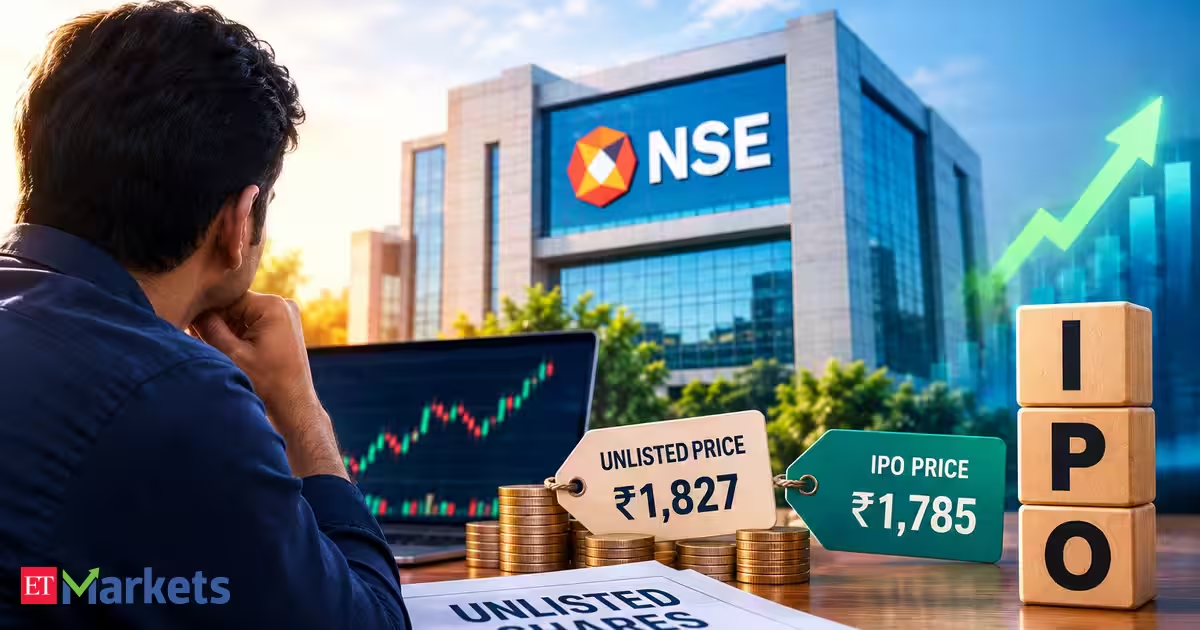
NSE's long-awaited IPO may turn into a reality check for some investors who bought the exchange’s shares in the unlisted market at higher prices before the public issue. One such case is Mahesh Gupta, who is selling up to 500 equity shares in the NSE IPO. According to the offer documents, he had acquired the shares at Rs 1,826.85 each. The upper end of NSE's IPO price band is Rs 1,785, which is Rs 41.85 lower than his acquisition price.If all 500 shares are sold at the upper price band, the price difference would work out to about Rs 20,925. In percentage terms, the IPO price is about 2.3% lower than his acquisition cost. The amount may look small in Gupta’s case because the quantity is limited. But the example shows a larger issue for investors in the unlisted market: the price at which a stock trades before an IPO may not always be the price at which it comes to the public market.NSE has been one of the most actively traded names in India's unlisted market for years. Its shares attracted demand from institutions, family offices, brokers, wealth managers and individual investors because of the exchange’s dominant position in Indian equities and derivatives.Also Read: Why can’t NSE trade on its own platform after the IPO, and is it a big deal?NSE has set a price band of Rs 1,700-1,785 per share. This is lower than the Rs 2,000-2,100 range that many investors had expected earlier. At the upper end of the band, NSE is seeking a valuation of about Rs 4.4 lakh crore.Ishan Tanna, Senior Associate at Ashika Capital, said the lower pricing is not surprising when seen against valuation and growth concerns."NSE IPO valuation has been cut by around 15%. At around 43 times FY26 earnings, NSE is still valued at a premium to most global exchanges, but looks reasonable versus Indian peers such as BSE and MCX," Tanna said.He said the bigger question is growth. Around 60% of NSE's operating revenue comes from derivatives, while the options boom is facing regulatory and volume-related headwinds."At the revised valuation, investors are essentially betting that NSE can move beyond the options boom and compound through India’s broader financialisation, while leveraging its dominance in equities, indices, data and other market segments," Tanna said.So, the lower pricing appears to be a practical move. "Leave some upside for public-market investors rather than push for a higher valuation and risk weak demand or poor post-listing performance," he said.This is not the first time unlisted market expectations have run ahead of IPO pricing.HDB Financial Services, which had come with its IPO a few years ago, also faced similar risks at the time. Its IPO price band of Rs 740 was about 40% lower than the Rs 1,225 level at which the stock was fetching just days before the IPO. Investors who had bought the stock a year earlier at around Rs 1,550 were staring at an erosion of about 52% even before listing.Manish Khanna, co-founder of Unlisted Assets, said the NSE IPO is indeed a reality check for unlisted investors, but the issue needs context. "NSE is arguably the biggest name, and the busiest stock, in India’s unlisted market," Khanna said.According to Khanna, the price band is well below earlier expectations, but the comparison should not be limited to the unlisted price versus the IPO price."Even an investor who bought in at Rs 2,100 is paying roughly an 18% premium to the IPO’s upper band, not necessarily unreasonable for a business with NSE’s extraordinary market position," he said.NSE's market position remains strong this year. As of June 2026, the exchange commanded more than 93% of India’s cash-market turnover, nearly 100% of equity-futures turnover and about 75% of equity-options turnover.The larger point, according to Khanna, is that investor returns cannot be judged only by comparing the unlisted price with the IPO price. "IPO allocation size, listing premium and the company’s fair value also matter."The NSE case also underlines the risks of buying unlisted shares. Unlike listed stocks, unlisted shares do not have a transparent market price on a screen. Liquidity is limited, disclosures are not as frequent, and the exit route depends heavily on whether the company eventually lists or whether another buyer is available.For investors, the key risk is that the price paid in the unlisted market may reflect hype, scarcity and expected IPO gains rather than the valuation at which institutions are willing to buy in the IPO.In the NSE case, the company’s fundamentals remain strong, but IPO pricing has still come below the level at which some unlisted trades happened. That is the warning for investors.The public issue may still see strong demand because of NSE’s market position. But for investors who entered the unlisted market at higher prices, the IPO price band shows that pre-IPO investing is not a one-way trade.Disclosure: This article has been written by Podishetti Akash, who is not a SEBI-registered Research Analyst or an Investment Adviser. Podishetti Akash and her ‘relative(s)’ (as defined under Section 2(77) of the Companies Act, 2013) do not hold any financial interest in the companies mentioned in this article as of the date of publication. The views/recommendations mentioned in this article, wherever applicable, are those of the respective SEBI-registered Research Analyst/brokerage and have been reproduced/reported with due attribution. They should not be construed as the views or recommendations of The Economic Times Digital or the journalist. Readers are advised to consider the original research report and make their investment decisions based on their own assessment. Brokerage disclaimers here.
Is unlisted investing a lottery? The story of a NSE investor who bought shares at Rs 1,827
NSEs IPO price band of Rs 1,700-1,785 is below earlier unlisted-market expectations, offering a reality check for investors who bought the exchanges shares at higher prices. While NSEs dominant market position and strong fundamentals could support demand, experts caution that unlisted shares carry liquidity and valuation risks, with pre-IPO prices often reflecting scarcity and expectations rather than fair value.
TL;DRAI
NSE's IPO at Rs 1,700-1,785 undercuts unlisted pricing by 15%, with early investors like Mahesh Gupta facing losses on Rs 1,826.85 shares. Unlisted markets lack transparency and institutional pricing—hype-driven valuations reverse sharply at IPO launch.
925 words~4 min read