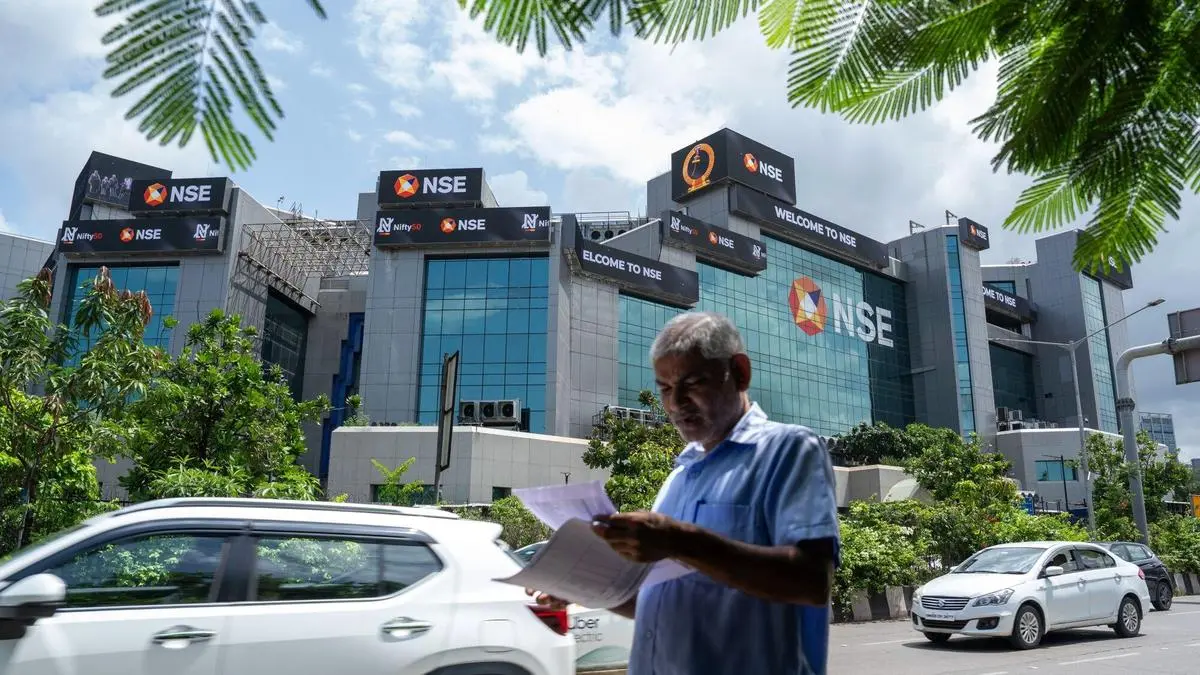
Registered investors on the NSE rose from 30.87 million in March 2020 to 129.1 million in March 2026
| Photo Credit:
For three decades, the National Stock Exchange (NSE) has priced everything India owns except itself. That is about to change. The exchange filed its draft red herring prospectus on June 17, 2026, for 148.9 million shares, close to six per cent of paid-up capital. The Securities and Exchange Board of India (SEBI) has since issued its observation letter. Before a traded price begins to summarise the exchange, its record and unfinished agenda deserve an audit.The record begins with an index. NSE created the Nifty and made it the benchmark for Indian equity risk. Its pull took a slice of India’s price discovery offshore, to a Singapore Exchange contract. The answer was construction, not a ban. Since NSE International Exchange began full operations at Gujarat International Finance Tec-City (GIFT City) on July 3, 2023, the GIFT Nifty contract has recorded more than 69.56 million contracts and $3.21 trillion in turnover.Next came operational credibility. In the mid-1990s, screen-based trading across a national network, straight-through settlement and a clearing corporation standing between every buyer and seller were rare. That is why foreign portfolio investors treated India as a destination, not an experiment. Registered investors rose from 30.87 million in March 2020 to 129.1 million in March 2026. The growth is no longer confined to metropolitan areas: Uttar Pradesh led new registrations in 2024-25, adding 29.5 lakh investors. The same instinct built institutions. In 1996, the exchange set up the National Securities Depository Ltd along with the Industrial Development Bank of India and the Specified Undertaking of the Unit Trust of India. The depository was listed last year, with NSE among its selling shareholders. The pattern extended to NSE Indices, NSE Data and Analytics, NSE Clearing, and the exchange and clearing corporation at GIFT City. Some capabilities were built and then handed over: acting on the Mahalingam Committee’s recommendations, the exchange exited its technology and skilling businesses in early 2025. Letting go of what specialists can run better says as much as the balance sheet.Unusual balance sheetThat balance sheet is unusual. Revenue from operations was ₹16,601 crore in FY26, with profit of ₹10,302 crore, both easing after SEBI’s derivative measures. Operating margins are near 76 per cent, net debt is zero, and the treasury book stands at about ₹64,771 crore. Roughly 51.2 per cent of global equity derivative contracts pass through the exchange, a position held for seven consecutive years, along with about 93 per cent of cash equity turnover.What does listing add to an institution that is already considered a deemed listed entity, with disclosures, board, and conflict norms equal to or better than those of a listed company? The regulations remain largely the same; however, their enforcement varies significantly. Since the exchange lacks a promoter and the Life Insurance Corporation of India holds the largest stake at 10.72 per cent, ownership is widely spread; the listing will make the market the key oversight mechanism.The open agenda deserves equal attention. Listed companies have a combined market value of ₹411 trillion across nearly 3,000 firms, while the corporate bond market is a fraction of that and municipal debt is barely present. Commodity derivatives remain thin in an economy that lives off agriculture and now leans on manufacturing. The Emerge platform for smaller firms was worth ₹1.8 trillion in March 2025. Retail’s share of market value reached a 22-year high of 18.75 per cent in the second quarter of 2025-26, but retail money still prefers short-dated derivatives to ownership. Each gap is a multi-year commitment that a listed company must defend every quarter.The offer structure is often misread. It is only an offer for sale, so the money goes to the selling shareholders and not to the exchange. The Life Insurance Corporation, the State Bank of India, other banks and development finance institutions have held the stake for decades at close to original cost. Listing turns a locked strategic holding into liquid capital when the primary market needs it. The timing is a test in itself. With a heavy pipeline lined up for the coming quarters, an issue of this size will measure domestic institutional and household demand better than any survey.For regulators, the listing carries forward what corporatisation and demutualisation began. For investors, it offers an asset whose returns follow the market’s activity rather than its direction. For policymakers, the sharper question is not what the exchange has built, but which of the remaining gaps it will now be pressed to close, when 129 million investors can also be its shareholders and its performance is priced every day.The writer is Partner, MCQubePublished on September 14, 2026