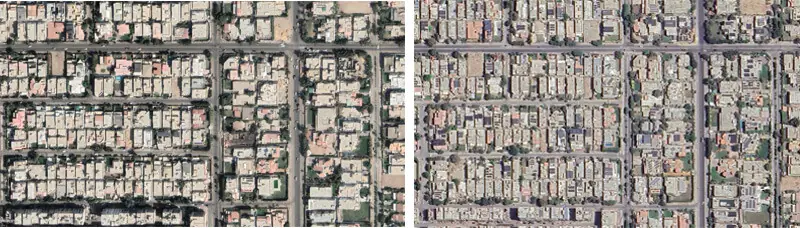
Satellite images show the transition to solar power in Karachi’s DHA from 2020 (left) to 2026 (right), based on solar panels visible on roofs| Renewables First
Muhammad Ali, 26, lives with his parents and two sisters in a three-bedroom flat in a three-storey apartment block near Shaheed-i-Millat Road in Karachi. At night, they share a single air-conditioned (AC) room.
“I need my privacy and to study for my exams in peace, not with my father scrolling through reels — with the volume on high — on his phone while awake and snoring loudly when he dozes off,” says Ali, a disgruntled dental resident.
“Even the AC is a source of negotiation — the cool air from the vent barely reaches the corner where I sleep,” he continues. “If I turn up the fan speed or change its direction, my mother and sisters complain.”
With a rapidly growing population — and a much-disputed census estimate of 20 million — Karachi is bursting at its seams. As the city struggles to accommodate its growing population, its skyline — dotted with highrises and multi-storey buildings — reflects a relentless push vertically.