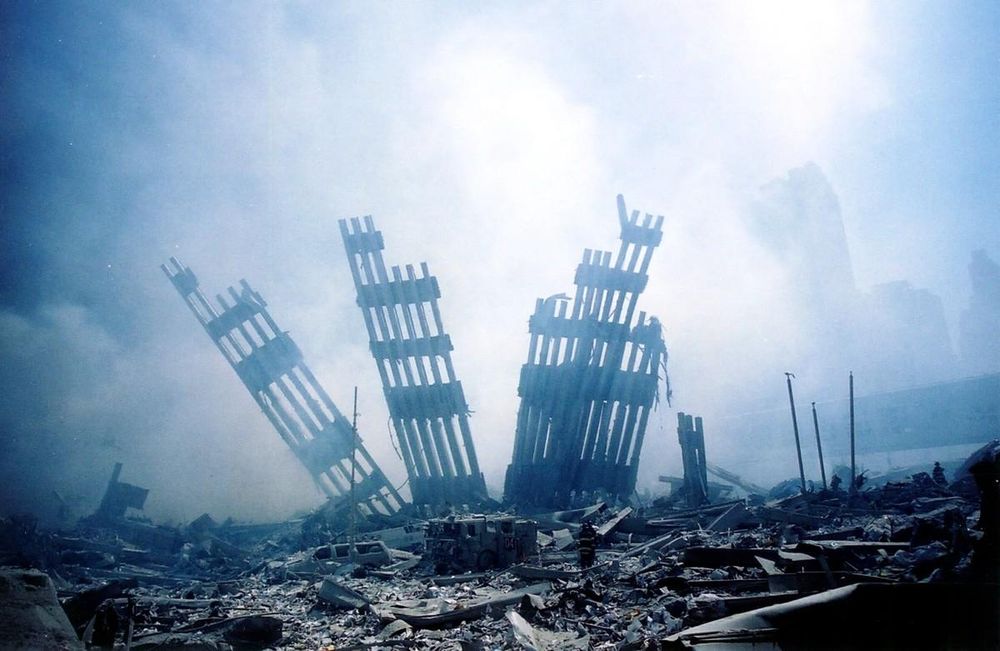
From Gen Z to the Silent Generation, Americans told USA TODAY about how they learned of 9/11. These moments of fear, confusion and mourning are seared into the memory of Americans young and old.Where were you on Sept. 11, 2001?For many Americans, that question recalls searing memories that remain vivid 25 years later.They remember the classroom, office, airport or city street where they first learned the United States was under attack. They remember who told them, whether it was Katie Couric on the "Today" show or a loved one on the phone. They remember the fear and confusion as they watched the country's deadliest act of terrorism unfold.For some, it's one of their earliest memories. For more than a third of Americans, it's a day they're too young to remember but one that shaped the world they grew up in.USA TODAY spoke with Americans whose lives intersected with Sept. 11 in different ways, from those who witnessed the attacks to those whose paths were altered by their aftermath. Together, their stories reveal how a single day continues to echo across generations.'Holding my new son'Gen X were born in 1965-1980 (age 21-36 at the time of the attacks)Felicia RiosRios gave birth to her first child, a son, on Sept. 10, 2001, and was sitting in her hospital room in New Mexico when she saw the news come across the television. Holding her baby, she watched live as the second plane hit the World Trade Center.“I literally was there holding my new son and just thinking, ‘What kind of world did I bring this kid into?’” she told USA TODAY. “It was very sad, and just terrifying.”Rios, then 22, was discharged from the hospital hours after the attacks. She remembers the drive home and her worries that the worst had yet to come.She was "scared of what was going to happen to our country," she said. "We panicked and went and bought fuel for our vehicles and sent someone to buy some groceries for us."Hal HintonHinton, then a 36-year-old pilot for American Airlines, heard the news from a fellow aviator during a layover in Honolulu.“Turn on your TV. It’s the end of the world,” Hinton recalls his coworker telling him.Hinton realized he didn’t know what route his wife, Beth, a United Airlines flight attendant, was scheduled to be flying that day. “First and foremost, it was trying to find her,” he said. “I was scared. I didn’t know where she was. We obviously didn’t know what else was going to happen.” It took hours for them to connect over the phone, the couple said. Over the next several days, they hunkered down until commercial flights resumed. They both remember the flood of phone calls and voicemails from worried loved ones.“It was such a feeling of helplessness, of disconnection and just being unable to wrap my head around the tremendous loss of life,” Hal Hinton said. On that day, he added, one thing was clear: “This was certainly going to change our life.”Renee GertlerGertler was taking the route she took every day from Oakland to Berkeley in California when she sensed something was terribly wrong.“All of these people were walking out of [the train], looking terrified,” said Gertler, who was 27 at the time. “This businessman came up to me and was like: ‘Don't get on the train. We don't know what's going to happen next.’” After learning of the attacks, Gertler thought about her sister, who had just flown out of New York City the day before. She also feared that California might be targeted. “It shook us all to our core, and nothing was the same after that,” Gertler said. “It was like the end of innocence.”Eric BeauneBeaune, then 21, was just beginning his adult life in the Shenandoah Valley of Virginia when he saw the attacks on television."I spent the rest of the day with my family," he said. "I think that's what everybody did, kind of hunkered down at that point. "It was a moment that was set in stone for me. ... I think everybody's life changed that day."With a new landscaping business and a baby on the way, Beaune was concerned about the economic fallout from the attacks. "Nobody was spending money. Everybody was scared," he said. "I do remember that."Amid the uncertainty, Beaune focused on his family and his new business. "I kept moving forward and plugging away. That's what I did."'How quickly things can change'Millennials were born in 1981-1996 (age 5-20 at the time of the attacks)Reet TaylorTaylor said his elementary school in Virginia Beach "went into a pause" when word about the attacks spread among the teachers and administrators.“We went outside on the bleachers and all did the Pledge of Allegiance,” he recalled. “I guess that was a way to keep us from thinking about how heavy of a thing had just happened.”Reet, who was 7 at the time, said there was a "look on the teachers’ faces that I hadn’t seen before.”“The level of concern on their face, the disbelief, the dismay, the processing. ... [They were] definitely trying to hold it together."Amanda BarbieriJust two weeks into her freshman year at Adelphi University in Long Island, New York, Barbieri watched the chaos unfolding in Lower Manhattan from her dormitory's common area.The school had many commuter students, and she said many of them were “terrified” because they had family members who worked in or around the Twin Towers.“The Long Island Railroad stopped running, so that basically stranded anybody that was in Long Island there, and anybody who wanted to get into Long Island, you were stuck in Manhattan or the Bronx," Barbieri said.Looking back, the behavioral therapist said attacks had a profound influence on her outlook on life.“As a kid, I don't know if I really understood it yet,” she said, trying to keep her emotions under control. “But I know as I've gotten older, nothing is ever promised.”Michael Anne BoleneUnlike their older counterparts, many younger millennials have few memories of Sept. 11 – or none at all.Bolene was 4 years old when the towers collapsed. Though she doesn't remember that day, she has developed an understanding about it through teachers and others who have described what it was like.When Bolene moved from Oklahoma to New York City for her undergraduate degree, she felt the impact of the attacks more personally. One of her family friends had stopped flying because of what happened that day, she said.Now, on the 25th anniversary of the attacks, Bolene said she has reflected on how they changed American society, giving way to a rise in anti-Muslim rhetoric.“Everyone was in pain, no matter where you came from,” Bolene said. “So I would hope that we can find ways to talk about [9/11] and talk about how awful it was while also being inclusive of how it was awful for everyone involved.”'I try not to think about that day'Boomers were born in 1946-1964 (age 37-55 at the time of the attacks)Phraner CadetCadet was working inside the kitchen of a Manhattan office building when he heard a loud boom.“Everyone in the building ran out,” he said. Uncertain of what was happening, “we started walking right away.” He kept walking for more than three hours as he made his way past the United Nations Headquarters, then into Brooklyn, where he lived.Cadet, then 43, returned to his office building a week later, “but everybody was different” in New York, he said. “People were scared of each other. The trust we had before − after 9/11, it was completely dead.”Cadet later developed asthma and once had a seizure. He has always wondered if it was because of the overpowering smells he remembers in the city after the buildings collapsed.“I try not to think about that day," Cadet said. "It was horrible."John BridgelandBridgeland, 66, had a "dark feeling" as he watched news coverage of a plane striking the World Trade Center. Less than a decade earlier, his wife and then-3-year-old daughter were on the building's first floor when a truck bomb detonated in the underground garage. They escaped unharmed. As White House Domestic Policy Council director, Bridgeland was with other federal officials at the White House as it became clear the nation was under attack. He called his family to tell them he was safe and to say he would be "focused like a laser" on his job.His work shifted to emphasize national service in the months and years that followed, building on the "millions of acts of kindness and goodness and decency" demonstrated in the wake of 9/11. Twenty-five years later, Bridgeland said, the country would benefit from returning to that spirit, which he described as an antidote to political polarization."I think that's our challenge: to use 9/11 not just as another ceremony, but to look at the civic character that emerged from the American people."Pritt SeetramSeetram, a former taxi driver, recalls heading toward John F. Kennedy International Airport to drop off a man he had picked up at the World Trade Center.As they left Manhattan, they heard news reports that a plane had struck one of the buildings. Stopped in traffic, Seetram and his passenger turned and looked out at the Twin Towers.“Just about then I saw the second plane turning,” said Seetram, who was 47 at the time. The two watched as a plane hit the South Tower. “The plane went right through and it hit that World Trade Center, and it exploded in a ball of fire.” An immigrant of Indian descent who had moved to New York from Guyana, he was gripped by fear as an anti-Middle Eastern sentiment took hold in the wake of the attacks. People from India were being mistakenly identified as Middle Eastern, and a friend of his was attacked, he said. Seetram quit driving the taxi out of fear for his safety.That day “changed everything,” he said. “The whole America.”Heidi HartmanHartman worked at the Pentagon but was at a training session a short drive away when a plane struck the iconic building.Hartman, a human resource specialist, watched in disbelief as newscasters ran footage of the destruction in New York and nearby Arlington, Virginia. She tried calling her family but the phone lines were jammed. She tried to take a cab home but traffic ground to a halt. In a frenzy, she ran to a nearby Metro station. From the train window, she said, she could see smoke billowing from the building.“I was just numb,” she said.The next morning, Hartman went to work and found a layer of black soot covering everything in her office. The smell of smoke filled the air, and the building was eerily quiet. No one in her office had been hurt, but 124 people inside the Pentagon died in the attack.To this day, Hartman said, she cringes when she hears the engine of a passenger plane. She never again went to work on Sept. 11 because she didn’t want to be near a federal building or on public transportation. She refuses to watch any documentaries or movies about that day. “It just really affects me,” she said. “It’s just so heartbreaking.”Scott WirthWirth was teaching a high school law class in rural Phillips, Wisconsin, when a fellow teacher knocked on his door with startling news: A plane had hit the World Trade Center. Wirth initially pictured a small-aircraft accident. Then he turned on the classroom television. As images of the burning tower filled the screen, the mood in the room shifted. When a second plane struck, Wirth and his teenage students realized they were watching “not just some random occurrence.” The students turned to their social studies teacher for answers. "Mr. Wirth, what's happening?" they asked. He didn't have one. More than two decades later, Wirth, now retired from teaching, still remembers that moment. His students were looking to him for an explanation, but he had none to give. “It's a very empty feeling. I’m supposed to be able to answer their questions in the classroom, right? And I couldn’t.”'I still hesitate going into big crowds'Silent Generation were born in 1928-1945 (age 56-73 at the time of the attacks)Anthony FasoloFasolo had just finished calling his wife to tell her about the terror attacks at the World Trade Center in New York City when he heard a boom. At the time, he worked for the Department of the Army, in a first-floor office on the north side of the Pentagon.Fasolo didn’t know what happened until he fled the building and saw black smoke billowing into the blue morning sky. He watched stunned as a nurse helped a 6-foot tall soldier limp out of the building. Authorities on the scene told everyone another aircraft was inbound and they had to get as far away as they could. He walked in a daze, unsure of how to get home to Leesburg, Virginia. The city was quiet. Bumper-to-bumper traffic filled the streets of Pentagon City, but nobody honked their horn, Fasolo remembered. The only sound he heard was from a television in a shop window. By the time his wife, Anna, picked him up at a Metro stop near their home, it was close to 5 p.m. He got a call from his boss that evening telling him two colleagues, Sandra Taylor and Cheryl Sincock, were missing. Later, he learned the two women had died in the attack.Fasolo’s wife tells him that day changed him, made him more empathetic. Fasolo, now 89, doesn’t disagree. “My first thought coming out of the building was, ‘We have to learn to live with each other.’”Ruth Kimball GutteryWithin 20 minutes of takeoff on a direct flight to New York City from Orlando, Guttery and other frequent flyers seated around her noticed the pilot was deviating from the normal flight path. “Things just weren’t right,” said Guttery, then a 57-year-old retail executive who made the trip weekly. The pilot continued flying in circles before landing in Atlanta. Officials ordered a nationwide ground stop. Walking into the terminal, Guttery immediately saw television footage of planes crashing into the World Trade Center. “The shock of it still makes me gasp,” she said. “It was something I’ve never experienced since and I hope I never do.” Her immediate concern was her daughter, who lived in Washington, DC, and worked across from the Pentagon, but her daughter had called in sick. Guttery also worried about the employees in stores in the World Trade Center and Pentagon City mall. She would later learn the New York store employees had escaped. When she could fly again, her first store visit was to check on the “traumatized” employees at the mall store. "Traveling had changed," she said. “And I traveled for a living, so every week of my life was different.”Carolyn GollhoferWith 30 minutes to go before Tuesday's classes began at the Missouri vocational school where she taught health occupation, Gollhofer relaxed over a cup of coffee in the teachers’ lounge. Then word spread that a plane had hit one of the Twin Towers in New York. The teachers all headed to classrooms equipped with TV sets to see what happened.“We were all just kind of stunned,” said Gollhofer, then 59. “Of course, no one studied that day. They all hovered around the TVs in disgust. A few wept.”She recalls anger setting in after the shock, that anyone could do such a thing within American borders. That gave way to sadness and the responsibility of consoling distraught students. It was hard to know what to say. It wasn’t just airport security measures that changed after that day. She changed.“I did not want to travel as much, even by car,” Gollhofer said. “You just always felt that uneasiness, and so we stayed home a lot more than we ever did before. I still hesitate going into big crowds.”Pat WernerEnjoying her retirement, Werner helped her daughter’s family move into their new home in Manhattan, Kansas, oblivious to what was happening in another Manhattan 1,300 miles to the east.“We didn’t have the TV on that day because of the move,” recalled the longtime educator, then 65. Werner didn't learn what happened until her daughter returned from work and told her to flip on the television. What appeared on the screen shocked them.“All of the ugliness was there," Werner said, "the towers having disintegrated, the horrors of the people falling off of the towers, the horrors of all the debris that was spread. It was just as ugly as it could be."As a former teacher, Werner worries the lessons of what happened that day are lost on young people who didn’t live through the attack. “They aren’t looking for the history behind it. They say, ‘Oh, this happened, it’s terrible, let’s move on.’ It doesn’t work that way, because history does repeat itself. And if you’re a student of history at all, you can see the patterns.”'My mom was sobbing'Gen Z were born in 1997-2012 (the oldest members of Gen Z were age 4 at the time of the attacks)Hannah BornBorn remembers playing with dance ribbons inside the Pentagon Daycare Center not long before a plane smashed into the building. Just 3 years old at the time, Born describes what came next as “sensory overload.” Staff and service members evacuated toddlers and infants, including her 4-month-old sister, amid the blare of sirens and emergency vehicles. The acrid smell of jet fuel and fire lingered in the air.“The biggest memory I have is just an overwhelming sense of confusion, more than anything,” Born said. “Confusion more than fear.”Days later her father, a career member of the Marine Corps, took Born and her sister to an overlook where they watched the recovery operations.For weeks after the attacks, she furiously painted pictures of the scene. The sound of sirens and school fire drills left her inconsolable. But years later, she said, the experience led her to follow in her mother's footsteps and join the U.S. Air Force. She also set out on a personal mission to run 2,977 miles – one mile for each person killed in the attacks.“Obviously, it was a traumatic day,” Born said. “It was the worst day for a lot of people’s lives, but it also helped me recognize you can use that as a source of inspiration and do good.”Dominique VelezVelez can vividly recall seeing her mother react to images of her former workplace consumed by fire and smoke.“I remember sitting on the floor and my mom was sobbing in front of the television,” said Velez, who was 4 at the time. “I remember being confused. I had no clue what was going on or why she was sad. She just said: ‘It’s a really bad day. Something really bad happened.'” Velez's mother had worked at AT&T in the World Trade Center before relocating to Florida. Velez's grandmother had also worked in the Twin Towers and lost friends in the attacks.Her mother’s and grandmother’s personal connections to victims of Sept. 11 made Velez want to learn more about what happened that day and why. She said she has become “obsessed” with documentaries and closely follows news coverage about the attacks."In some ways it gave me a lot of faith in humanity, which sounds weird to say, in watching how New Yorkers came together and helped one another. … I think in times like this when there’s so much division, it just reminds me to have faith in humanity. When it comes down to it, humans really want to help other humans.”Sada Jewels HusseinNot everyone remembers the day itself, but they witnessed how the attacks shaped their lives.Hussein was born in Tanzania in 2002, and immigrated with her family to Kentucky when she was 5. She said being an immigrant with the last name Hussein shaped part of her childhood because of the fear and Islamophobia that erupted after the attacks.“Growing up in grade school when your last name is Hussein, the other kids would just be like, ‘Oh my gosh, that’s a name a terrorist would have,’” she said.Starting around the second grade, she said that her school would make every Sept. 11 about the attacks and that she was first shown footage of people jumping from the towers around age 10. Though she knows it's important to learn what happened that day and how it affected the country, she said, those days at school were hard for kids like her.“Every single year all the Southeast Asian kids, the Persian kids, the Arab kids – anybody who was foreign – they’d watch people who looked like them be the villains to American society,” she said.'I watched with them'Greatest Generation were born in 1901 to 1927 (the youngest members were 74 at the time of the attacks)Don GravesGraves was 17 when he joined the U.S. Marines amid the throes of World War II. Two years later, the kid from Detroit found himself wielding a 72-pound flamethrower and praying for his life on the beach of Iwo Jima, the pivotal World War II clash in the South Pacific in which more than 300 of his fellow battalion members perished. He was among just 18 who survived. At 101, the decorated veteran is still puzzled about why God showed him favor while so many others lost their lives. The question led him to become a pastor, which is how he came to be at a rescue mission in Tucson, Arizona, dishing out breakfast to homeless and troubled young men on the morning of Sept. 11, 2001. “All of a sudden a kid said to me, “Don, that can’t be real – look!” he remembered. Graves glanced at the TV and saw smoke pouring from the North Tower of the World Trade Center over Manhattan. His first thought was that some fool pilot clowning around had messed up bad. Then he saw the second plane hit the South Tower and knew this was a deliberate act.“That really shook these boys up,” he said. “They stood there and they watched it happen. And I watched with them.” This story was reported and written by: Christopher Cann, BrieAnna J. Frank, Trevor Hughes, Amanda Lee Myers, Thao Nguyen, Dinah Voyles Pulver, Marc Ramirez, Doyle Rice, Jeanine Santucci, Swasti Singhai, Phaedra Trethan, Karissa Waddick and N'dea Yancey-BraggGraphics and illustrations by: Veronica Bravo, Ramon Padilla and Ariana TorreyGenerations of Americans remember exactly where they were on 9/11Where were you on Sept. 11, 2001? From Gen Z to the Silent Generation, Americans told USA TODAY about their memory of 9/11.
Americans remember exactly where they were on 9/11
From Gen Z to the Silent Generation, Americans told USA TODAY about their memory of 9/11.
3,743 words~17 min read