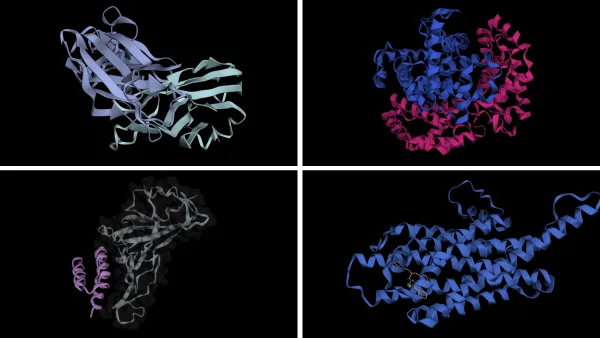
Biomolecular structure prediction is now often run at proteome scale, where the goal is to move an entire worklist through the pipeline efficiently.
NVIDIA BioNeMo Inference Runtime (BioIR) helps accelerate supported biomolecular structure-prediction models on NVIDIA GPUs while keeping the familiar PyTorch workflow. It uses optimized kernels and, where applicable, CUDA Graphs to speed model execution. For large batches of independent inputs, Ray can run a complete model replica on each GPU in a single node to increase overall throughput.
BioIR has also been used in real proteome-scale work, including the recent expansion of the AlphaFold Database (AFDB), accelerating the generation of protein-complex structures across 4,777 proteomes, about 31 million candidate complexes in total, with 1.81 million released as high-confidence predictions.
You can use it in two ways (see Figure 1, below):
The end-to-end processor moves an InputRequest through parsing, tokenization, feature generation, GPU inference, and PDB or mmCIF writing.