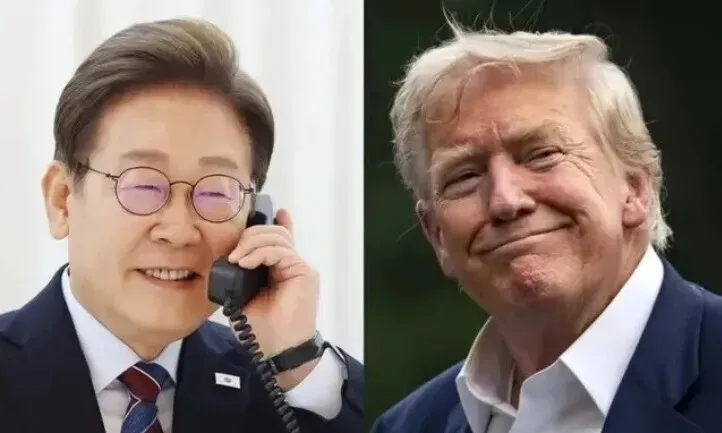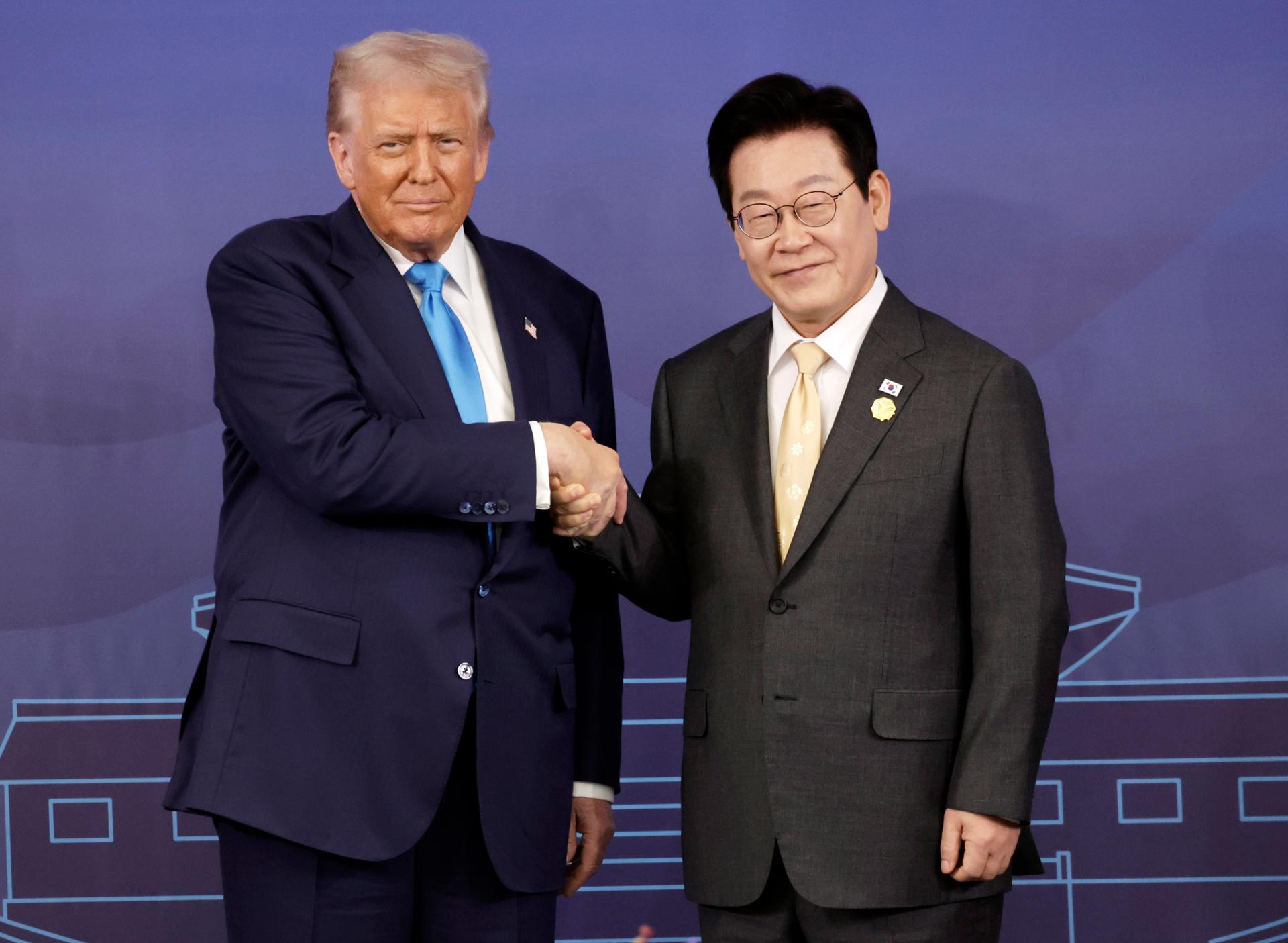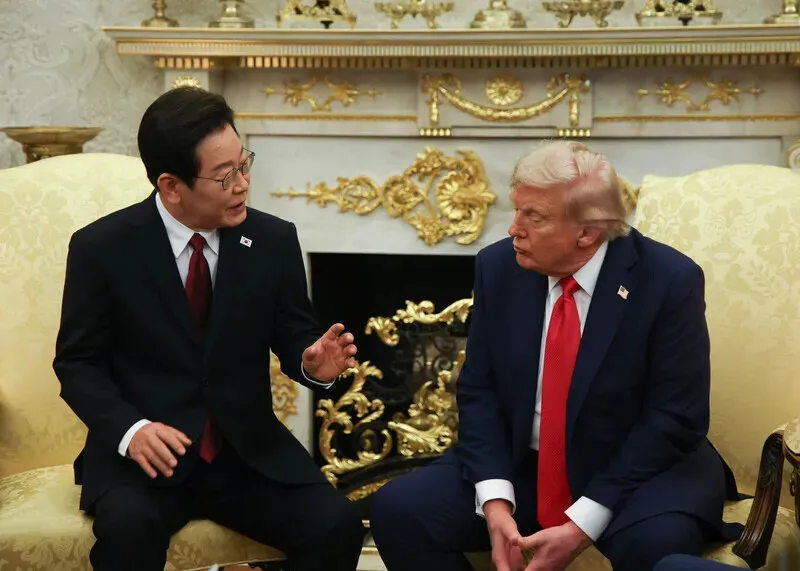
President Lee Jae Myung of South Korea speaks to US President Donald Trump in the Oval Office on Aug. 25, 2025. (Yonhap)
One of the safeguards for recovering Korea’s pledged US$200 billion investment in the US was an overarching investment special purpose vehicle (SPV) that would manage all projects. This entity would consolidate and manage the combined revenue generated by the companies supervising each project. This structure ensured that even if one project suffers losses, profits from others could be used to repay the principal and interest on Korea’s investment.The Hankyoreh on Wednesday confirmed that Washington recently scrapped this provision which had been included at Seoul’s request during negotiations on the memorandum of understanding (MOU) on Korea’s strategic investment signed last year. Seoul’s de facto acceptance of this also means a heightened risk of Korea bearing the full burden of losses arising from projects with murky commercial viability, such as the construction of large-scale nuclear power plants or an Alaskan gas pipeline.Because this undermines the principle of “commercial reasonableness” that governs Korea’s investment in the US, this issue is expected to ignite controversy when reported to the National Assembly.“While the bilateral MOU initially stipulated the diversification of investment risks through an ‘umbrella-type’ SPV structure, the Korea-US Strategic Investment Steering Committee decided in a meeting Monday to settle profits under a project-specific SPV approach,” a ruling party source told the Hankyoreh. The committee deliberates and resolves matters on the launch, management and operation of the Korea-US strategic investment fund, which finances Korea’s US$200 billion investment in the US.The strategic investment fund is structured to invest in specific projects such as a gas-fired, combined-cycle power plant in Encinal, Texas, a candidate for the fund’s inaugural project, and the construction of eight large-scale nuclear power plants (a potential second project, under review) and an Alaska gas pipeline (a third project, also under review).Both sides initially agreed that after project-specific SPVs were named to supervise each of the projects, the parent investment SPV would raise investment capital for each venture and collect all resulting profits.The structure was designed so that even if a project incurred losses, profits from other ventures could be used to repay the principal and interest on Korea’s investment. Because the US rejected this arrangement, another plan was approved to separately settle profits and losses for each project.Another official familiar with the investment negotiations said that the US was “reluctant to accept” this approach despite having agreed to it and “tried to scrap it.” “But thanks to our efforts to fully reflect the spirit and wording of the MOU, we eventually preserved the umbrella structure but agreed to handle profit and loss allocation on a project-by-project basis,” they said. Funding is raised through the parent investment SPV while profit distribution and loss liability arising from the investments will be borne by project-specific SPVs.“This mechanism was designed to offer higher protection for taxpayer funds, and yes, it puts us at a disadvantage [in investment recovery]. We’ve decided to set additional safeguards in place, even if they’re not perfect,” the official added. In their MOU, the two sides designated safeguards such as a provision to disburse investment funds in phases based on a project’s progress up to an annual cap of US$20 billion.The umbrella SPV model is a key concession that Korea secured only after difficult negotiations with the US over investment in America; it incorporates the concept of “commercial reasonableness.” Japan agreed to a project-specific SPV approach that renders offsetting losses against gains across investments difficult, but this method offers more flexibility to compensate losses.On Nov. 14 last year, the Blue House and the White House released their MOU and a joint fact sheet agreed on by both sides.The MOU requires the US to set up an investment SPV and Korea to provide funding for the SPV (Article 13), with Washington to ensure that all available free cash flow generated from the investments is distributed under the MOU. In turn, project-specific SPVs must distribute such funds to the investment SPV (Article 14).At the time, the Ministry of Trade, Industry and Resources in Seoul said that the investment SPV would pool the profits from all project-specific SPVs to repay the principal and interest on Korea’s investment. “In other words, this risk-pooling structure is designed to consolidate risk management, ensuring the offset of losses from one project with profits from successful ones,” the ministry said. The emphasis was that this was not a case of being fleeced but rather a recoverable “investment” backed by a final safety net.Following the release of the MOU, then-presidential policy chief Kim Yong-beom described the negotiation process as “worse than the Eulsa Treaty,” through which Korea lost its sovereignty to Japan in 1905.Minister of Trade, Industry and Resources Kim Jung-kwan was also critical, saying, “The US isn’t putting up a single penny but will take half of the profits. Does this make any sense?”“The US apparently sought to secure an agreement via an MOU while retaining the freedom to make actual investment decisions at its own discretion,” a source familiar with the negotiations said.“The negotiation process was irregular and one-sided but should be viewed as a comprehensive package including national security as well as economic benefits,” they added. “Instead of an attitude of avoiding even the smallest loss, we must look at the bigger picture of our give-and-take relationship with the US.”The official noted the significance of upholding the intent and wording of the investment SPV outlined in the MOU, saying, “Investment in the US isn’t a one-off transaction but will proceed in stages worth trillions of won each time. Whenever controversies arise during this process, we can negotiate by emphasizing the MOU’s basic principles.”In response, a government official said, “The resolution [by the Steering Committee] was intended to report the status of negotiations to the National Assembly. Since risk pooling has both pros and cons, we are in discussions with the US.”In addition, Seoul’s plan to remit an initial investment of over US$2.2 billion to the US this month conflicts with the terms of the MOU. The agreement stipulates that payment of the funds should come within 45 business days after notification is received of the selected investment sites in the US.The remittance schedule was in effect announced before Korea’s process of reviewing the investment. The Trump administration may have wanted to give the impression of Korean money flowing into the US before the Nov. 3 midterm elections.By Kim Nam-il, staff reporter; Park Su-ji, staff reporterPlease direct questions or comments to [english@hani.co.kr]