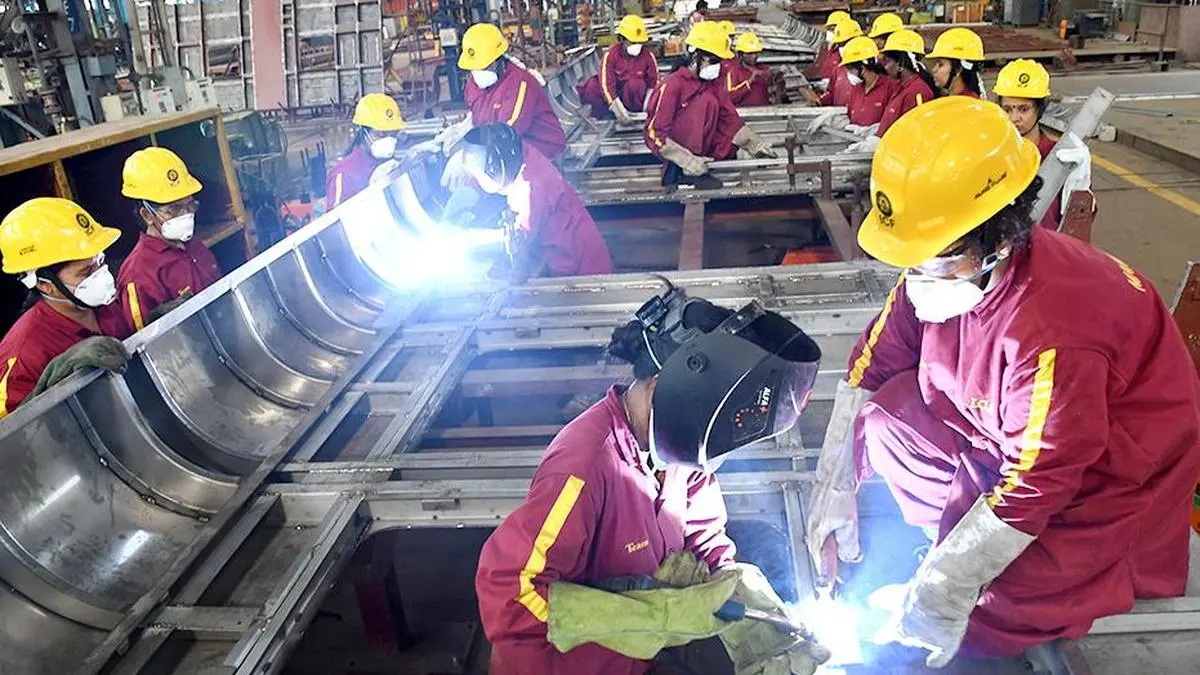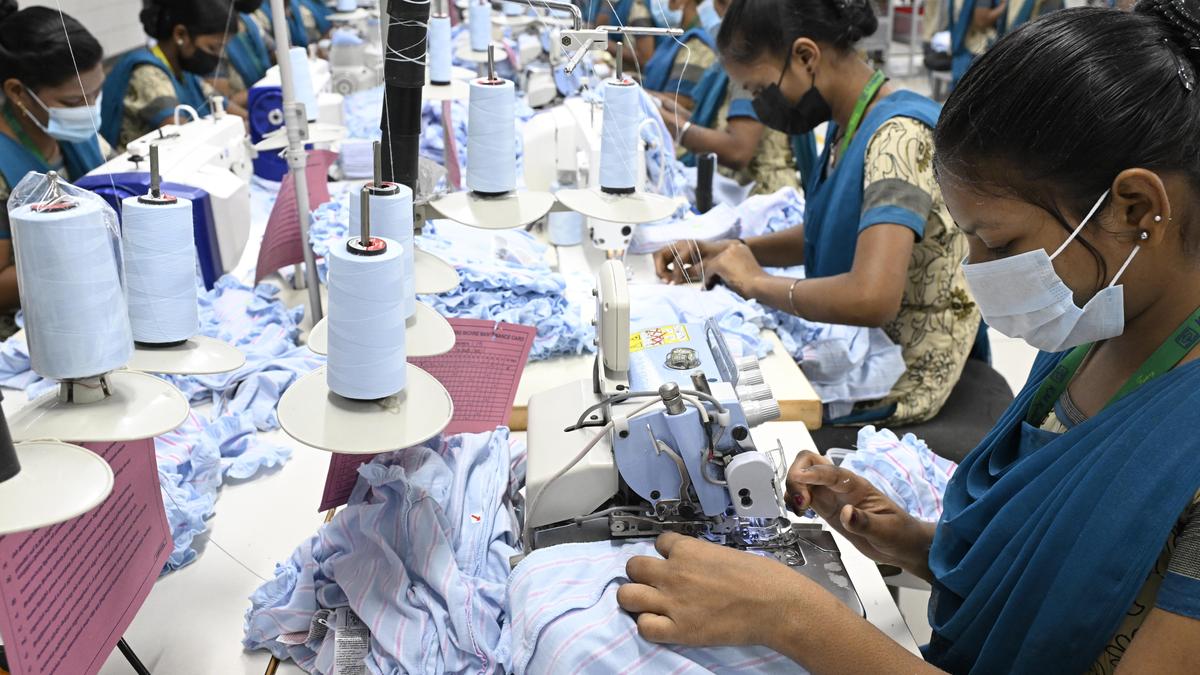
Manufacturing has traditionally been seen as the bridge between low-productivity work and more productive employment
| Photo Credit:
India’s economy has started the new financial year on a strong note. Real GDP grew 7.8 per cent in the April-June quarter, making India once again one of the fastest-growing major economies. Consumption remained reasonably strong, investment picked up and exports also performed better. These are encouraging signs at a time when the global economy remains uncertain. The number deserves to be celebrated. But it also raises a more interesting question: what is driving this growth, and what is it doing to the structure of the Indian economy?Interesting exampleManufacturing GVA grew 9.2 per cent in the first quarter. Investment in capital goods has also been strong. Yet manufacturing’s share in GDP remains around 16 per cent, roughly where it was a decade ago. In other words, manufacturing is growing, but its weight in the economy has not changed very much. This is not necessarily a contradiction. A sector can grow rapidly without increasing its share if other parts of the economy are also growing. But for India, the distinction matters because manufacturing has traditionally been seen as the bridge between low-productivity work and more productive employment.There is another interesting part of the story. Corporate profitability has risen sharply in recent years. Strong profits have helped companies repair their balance sheets and should provide resources for fresh investment. The latest GDP numbers suggest that investment is indeed beginning to respond. The real opportunity now lies in connecting these two developments. If higher corporate profits lead to more investment, and investment creates larger manufacturing ecosystems, supply chains and new businesses, the benefits can spread much beyond the large companies at the top. That is when growth starts changing the structure of the economy.This matters particularly for India’s young population. Urban youth unemployment remains high, at around 18 per cent. The problem is not simply the absence of jobs. It is also the difficulty of creating enough productive jobs for young people entering the labour market every year. India therefore faces an unusual situation. It has relatively strong economic growth, rising investment and increasingly profitable companies, but the transition towards a more employment-intensive economy remains incomplete.There is, however, good reason to be optimistic. The foundations are considerably stronger today than they were a decade ago. India’s physical infrastructure has improved, digital connectivity has expanded, domestic companies have become more competitive and global firms are looking at India as an alternative production base. The recent increase in investment suggests that some of these changes are beginning to translate into actual economic activity.A large factory can create thousands of jobs. But the bigger impact comes when it also creates demand for hundreds of smaller suppliers, transport operators, technicians, designers and service providers. A successful manufacturing ecosystem can generate opportunities well beyond the factory gate.India does not have a growth problem in the conventional sense. It has a conversion problem: converting growth into productive employment, investment into wider industrial capacity, and India’s large domestic market into globally competitive businesses. In this context, the 7.8 per cent growth rate gives us reason for confidence. The relatively modest change in manufacturing’s share and the continuing challenge of youth employment tell us that there is still considerable ground to cover. That is not a pessimistic conclusion. In fact, it is an opportunity. The next achievement would be to ensure that this growth changes the lives of a much larger number of people — not only through higher incomes, but through better jobs, more productive firms and greater economic mobility.The writer is with NCAER, New Delhi. Views are personalPublished on September 10, 2026