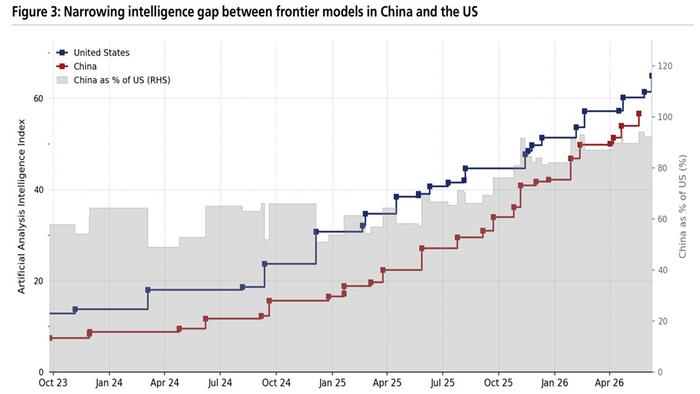
Despite stringent US export controls on chips and semiconductor exports to China since 2022, the latest Chinese artificial intelligence (AI) models — Kimi K3, DeepSeek V4 Pro and GLM-5.3 — are approaching or matching leading US models on many public benchmarks, often at lower costs and with ‘open weights’ that allow more user modification. Some take this as evidence that US export controls must have failed.
But that conclusion doesn’t follow. These impressive models show that US export controls have not stopped China’s AI development. But they do not show whether the controls have reduced China’s access to compute or how much better Chinese models would be without them.
Leading Chinese models have made substantial progress on public benchmarks. As of September 2026, the Epoch Capabilities Index, a composite of curated benchmarks, places Kimi K3 at 158, Claude Fable 5 at 163 and GPT-6 Astra at 169 — gaps equivalent to roughly four to ten months of progress at the recent historical rate. These scores show real capability and should not be explained away.
But benchmark performance does not fully capture how models perform in practice, especially during extended work on difficult and open-ended problems. Because there are few systematic measures of this kind of performance, any assessment will inevitably rely partly on expert use and judgment.