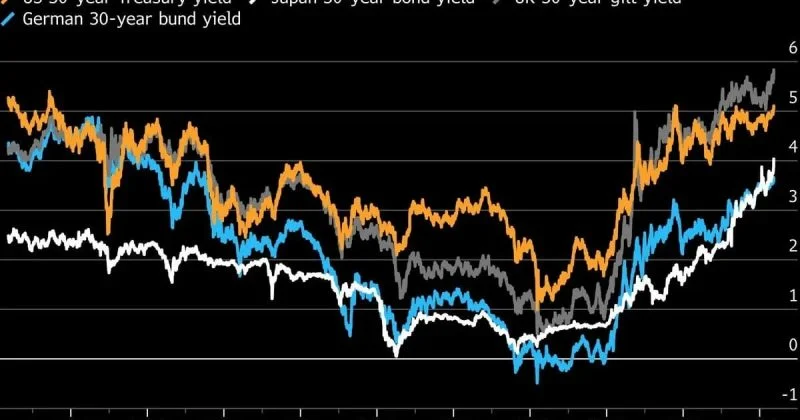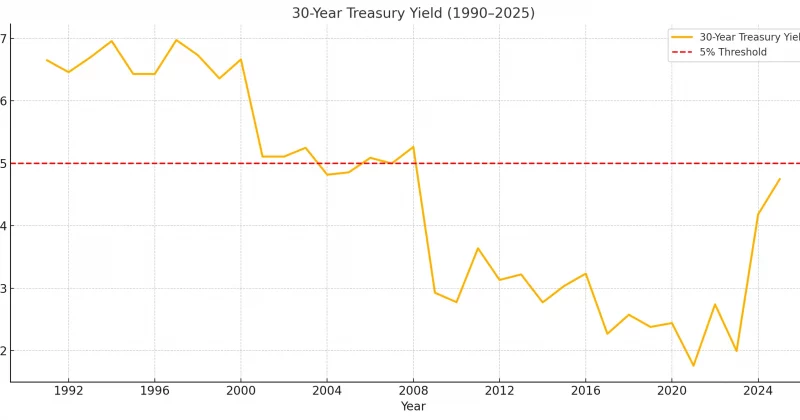
The bond market is not usually where crypto investors look for excitement. It should be. In August, long-term government yields across the US, Japan and Europe moved to levels that forced every risk asset to pay attention.The US 30-year treasury yield climbed above 5%, a level not seen since before the global financial crisis. Japan, Germany, France and Britain saw their own long-end yields press higher.This is not just a story about bonds. It is a story about the rising price of money. The easy explanation is inflation. The better explanation is competition. Governments need capital. AI companies need capital. Energy markets are keeping inflation pressure alive. Investors are demanding more compensation to lend money for decades at a time.If this were a classic panic over sovereign debt, markets would be shouting in other places too. Inflation break-evens would be racing higher. Credit default swap markets would be flashing red. They are not. The evidence points less to an immediate default scare and more to a crowded market for long-term savings.AI is central to that crowding. The infrastructure buildout behind AI is no longer just a technology story. It is a capital markets story. Data centres, chips, power systems and cloud capacity are expensive. Even highly profitable hyperscalers are leaning more heavily on debt markets to finance the buildout. At the same time, governments are running large deficits and issuing more debt of their own. The result is simple. More borrowers are arriving at the same window, and lenders are raising the price.For crypto, this creates an uncomfortable test. Bitcoin is often described as digital gold, a hedge against fiat debasement and political money. Yet in 2026 gold has done a better job of playing that role. It has benefited from reserve diversification, central bank demand and investor unease about fiscal trajectories.By contrast, bitcoin has behaved more like a volatile technology asset. Rising real yields have hurt it. Exchange traded fund outflows have hurt it. Regulatory uncertainty has hurt it. The broader crypto market still appears more sensitive to liquidity conditions than to the long-term debasement thesis its supporters often cite.That does not mean the thesis is dead. It means the market is demanding proof. A true hard-asset hedge should not need perfect liquidity, falling yields and speculative enthusiasm to work. Bitcoin may get there, but it has not fully arrived. The next phase will depend on whether institutional allocators begin treating it less like a trade and more like a reserve-style asset.Regulation is the missing bridge. US digital asset legislation has advanced, stalled and become tangled in political disputes. Until the rules are clearer, many large institutions will remain cautious. A hedge fund can take a view today. A pension fund, insurer or sovereign allocator needs more than a narrative. It needs legal certainty, custody standards and career-safe compliance.The US Federal Reserve also matters. A rate cut would not automatically save crypto if the guidance around future policy remains restrictive. Markets care less about one meeting than about the path. If real yields stay high, long-duration assets will remain under pressure.This is why the bond market’s message is so important. It is telling investors that capital is no longer free, fiscal policy has consequences, and even the AI boom must compete for funding. Crypto investors do not need to become bond traders, but they do need to understand what long-term yields are saying.The 2026 market is asking a hard question: is bitcoin really digital gold, or is it still leveraged growth tech in a different costume? The answer may define the next cycle.• Muchena is the founder of Proudly Associated and author of ‘Artificial Intelligence Applied’ and ‘Tokenized Trillions’.
HEATH MUCHENA | The bond market is warning crypto investors to grow up
Rising long-term yields challenge crypto’s narrative as a hedge against fiat risk
610 words~3 min read