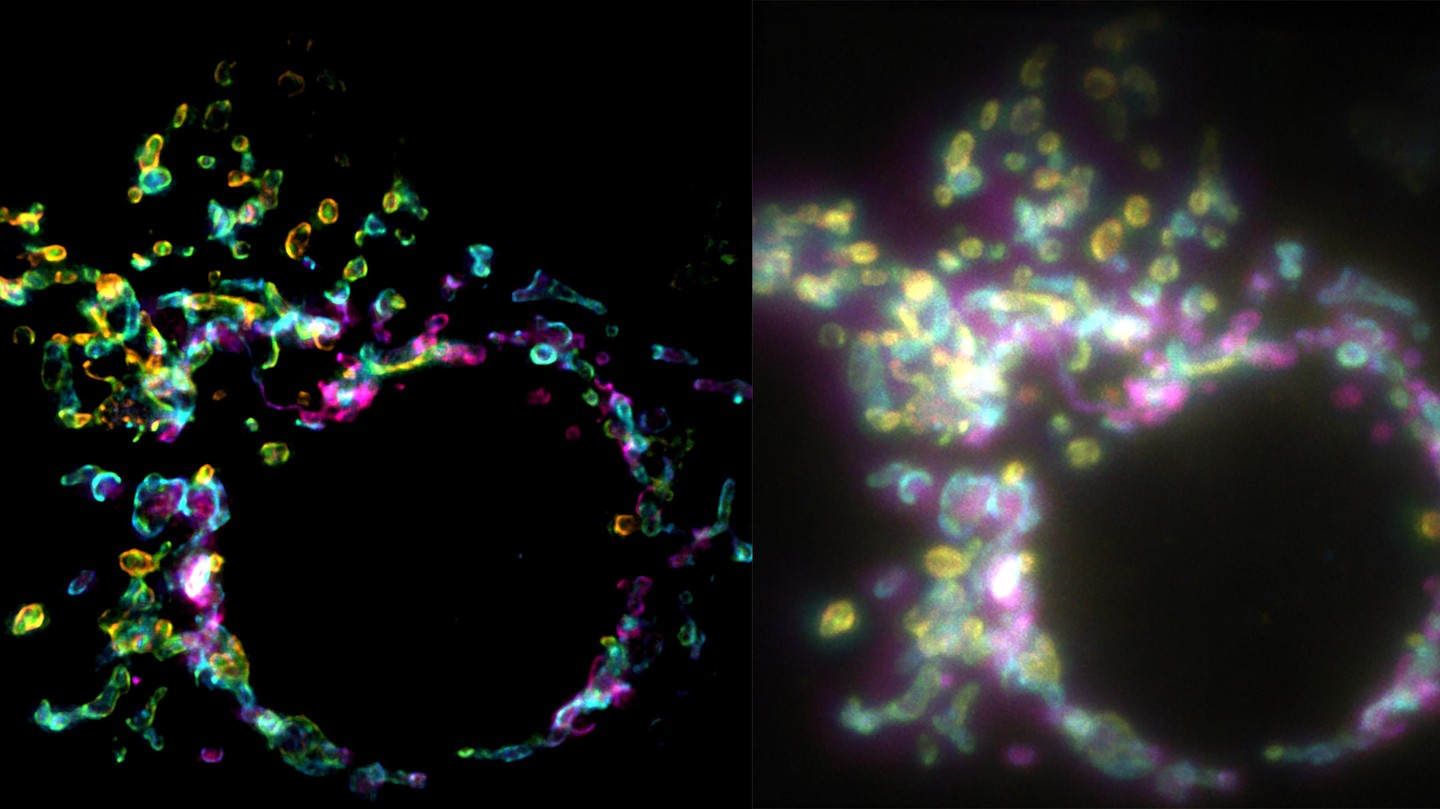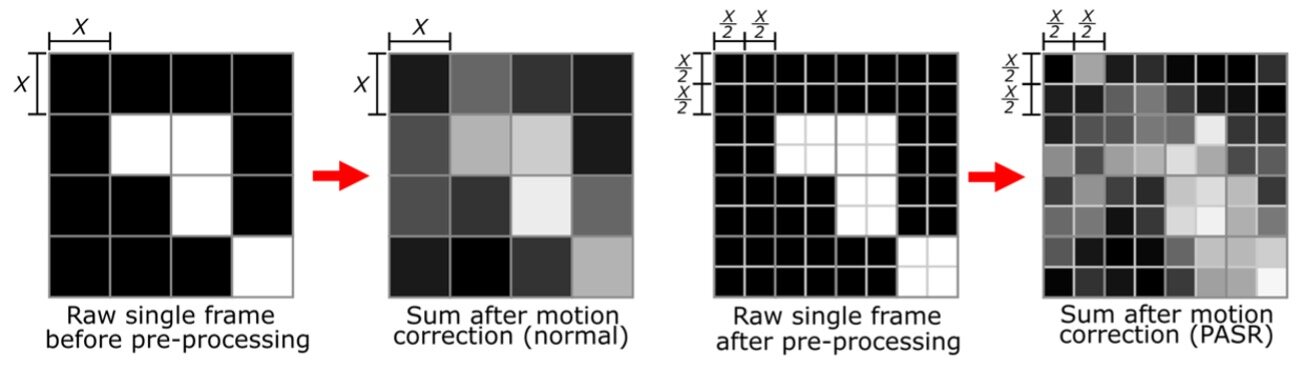
Comparing to standard motion correction (left panel), sub-dividing pixels prior to motion correction allows for correction of more subtle motion within the captured frames, enabling higher resolution processing. This overcomes physical limitations imposed during acquisition in restrictive situations (right panel). Credit: Raymond N. Burton-Smith
Cryo-electron microscopy (cryo-EM) has become a powerful tool for determining the structures of proteins, viruses and molecular complexes at near-atomic resolution. However, achievable resolution is fundamentally limited by the Nyquist sampling frequency, which is determined by detector pixel size and microscope magnification. Once this physical limit is reached, researchers typically must recollect data at higher magnification, requiring additional microscope time, increased storage capacity and often fewer particles per image.
Researchers from the Exploratory Research Center on Life and Living Systems and the National Institute for Physiological Sciences have developed a computational method called Post-Acquisition Super Resolution (PASR), which enables cryo-EM data sets to surpass conventional physical Nyquist limits after data collection. PASR works by computationally subdividing detector pixels before motion correction, allowing subtle particle motion between movie frames to recover higher-frequency structural information. The findings are published in the journal IUCrJ.