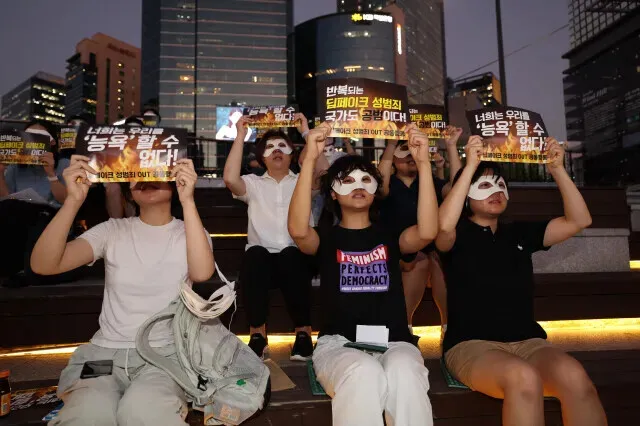
Participants in a rally outside Exit 10 of Gangnam Station hold signs and chant slogans condemning sex crimes on the messaging platform Telegram on Aug. 30, 2024. (Jung Yong-il/Hankyoreh)
Thirteen days — that’s how long it took the Korean government to confirm and remove sensitive information about victims of digital sex crimes that had been submitted to Google and exposed on an external website. Only after Korea’s Ministry of Gender Equality and Family and the Korea Communications Standards Commission (KCSC) repeatedly protested and emailed Google were they finally able to get the posts removed.The episode highlights the government’s inability to swiftly remove Koreans’ identifying information exposed by a global tech giant.The Ministry of Gender Equality and Family first became aware of the problem on Aug. 25.The Hankyoreh notified the relevant government agencies after discovering that the website of a project that archives and manages removal requests submitted to Google was publicly displaying the personal information of Korean digital sex crime victims and the text of their removal requests. The project, identified here as “Project L,” is run by a research institution affiliated with Harvard Law School.The ministry first asked Google and the website to remove 47 posts containing sensitive information such as the victims’ names, schools, student identification numbers and workplaces.On Aug. 28, the KCSC also reviewed whether to block access to the posts on the grounds that they contained victim information protected under the Act on Special Cases Concerning the Punishment of Sexual Crimes. It also lodged strong protests with Google and Project L and sent an email request for the removal of all posts containing the related search terms.Timing was critical given the risk that word about “Project L” could spread if the back and forth dragged on.But when reporters checked early on Aug. 31, six days later, the victims’ personal information remained openly accessible online. Officials at the ministry and the KCSC fretted that Google was taking too long to follow through on its promise to remove the posts. But the Korean government agencies could do little but wait.The information was not removed until the following day, Sept. 1. Even after that, additional posts exposing the victims’ identities continued to surface. Reporters had to find each of them manually and then request the government to have them removed.The KCSC is the only Korean government body legally empowered to block websites containing illegal information, but that authority proved useless.The problem was on the technical side. The KCSC’s current blocking technology cannot penetrate sites using secure HTTPS connections or encryption. As a result, KCSC could not block access to posts on Project L even after its emergency review. Ultimately, the ministry and the KCSC had to make another appeal to Google and Project L to delete the posts.One bizarre episode involved the authorities deciding which victims qualified for protection. Among the posts exposing victims’ personal information identified by the Hankyoreh was one involving a livestreamer.But the KCSC excluded the post from its review, concluding that the footage could not be classified as material from a digital sex crime because the victim had shot it herself.The KCSC, which defines digital sex crime material as footage filmed or distributed without the person’s consent, noted that the livestreamer had in fact consented to being filmed during a livestream.The victim had clearly not consented to others recording or sharing her streams and wanted these unauthorized recordings removed, but she was excluded from protection under the KCSC’s arbitrary criteria.The ministry also opted for a low-key approach, noting that the KCSC had determined that the livestreaming case did not apply. Only after reporters repeatedly protested did the two agencies ask Google to remove the post.By Shin Da-eun, staff reporterPlease direct questions or comments to [english@hani.co.kr]