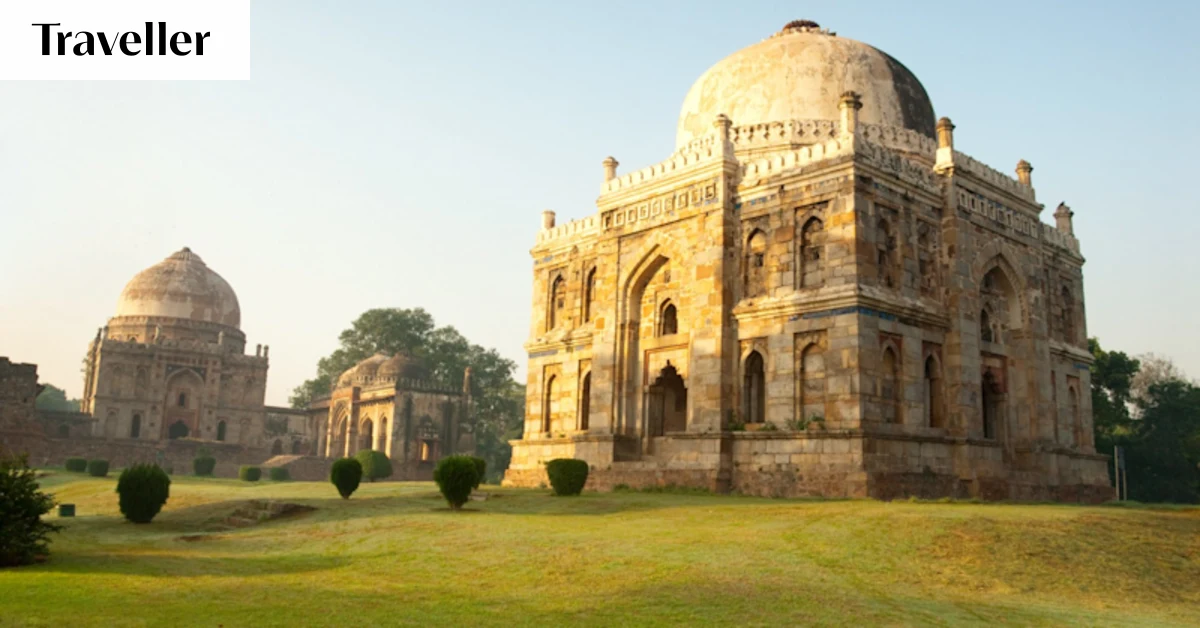
September 8, 2026 — 5:00amIndia’s capital Delhi has emerged as a colossal urban giant with more than 30 million inhabitants. But it also boasts one of the great city parks – the historic Lodhi Garden. No trip to Delhi is complete without a visit to this green haven near the city’s bustling heart.Lodhi Garden in Delhi is scattered with impressive 15th-century buildings.iStockThe area was used as a burial ground for the Lodhi dynasty, which ruled much of North India in the 15th century, and the parkland is still scattered with impressive medieval buildings.But Lodhi Garden has much more than a collection of historic monuments. Over 100 different tree varieties grow within its boundaries, and it attracts about 50 bird species, including kingfishers and peacocks. It even has a lush butterfly garden.And like any public space in India, Lodhi Garden is alive with people, from local picnickers to chai sellers. It’s the perfect place to take a break from the city’s hectic streets and relax under a tree.When I lived and worked in Delhi as the India correspondent for this masthead the garden was a favourite destination for my children. My wife and I celebrated many a wedding anniversary on its lawns during the years we lived in Delhi.Sign up for the Traveller Deals newsletterGet exclusive travel deals delivered straight to your inbox. Sign up now.The area was first landscaped in 1936 and called Lady Willingdon Park after the wife of the then British viceroy. It was renamed about a decade later following India’s independence.Visitors are welcome to join a 7am yoga class (bring your own mat) held on the grass beside a stone gate and mosque complex known as the Bara Gumbad. The huge domed structure was built in 1494.M.S. Rawat, a 64-year-old retired civil servant who has been leading yoga at Lodhi Garden since 2009, claims the soothing surroundings add to the experience.“This is a beautiful place with all this greenery and the vibes are very positive,” he says after class. “Doing this gives health to our society.”One of Rawat’s devotees is 75-year-old Mahesh Arora.Retired civil servant M.S. Rawat (left) leads yoga at Lodhi Garden.Photo: Matt Wade“There is no garden like this in the whole world,” he tells me while packing away his yoga mat. “I’ve been to many countries, but I’ve never found a park like this.”At the centre of Lodhi Garden stands the late 15th-century tomb known as Sheesh Gumbad, which combines features of both Islamic and Hindu architecture. Its elegant dome was once completely covered with enamelled tiles of turquoise and cobalt-blue; you can still see remnants of the original tile work on the facade.Nearby a group of men does acrobatic exercises; one walks on his hands and another stands on his head for several minutes. A member of the party, who introduces himself as ‘AJ’, fills his lungs and blows a white conch shell.“I blow the conch here every day,” he says. “It is good for the heart and lungs.”AJ also has a board of nails and explains that standing on it offers various physical and mental benefits. I turn down his offer to give it a try, but he convinces some passers-by to have a go.A local blows a conch shell at Lodhi Garden in DelhiPhoto: Matt WadeOn the same lawn a young couple, recently engaged, poses for a camera – Lodhi Garden is a popular location to take photographs and video for pre-wedding Instagram posts.It’s also common to find TikTok dance routines being performed in front of the park’s historic stone monuments.A favourite location for these videos is the arched verandah of the tomb of Muhammad Shah Sayyid, the oldest structure in the garden. Built in 1450, it stands on a platform in a square garden with an avenue of palm trees leading to the main entrance.But perhaps the park’s most peaceful spot is within the walled garden surrounding the tomb of Sikandar Lodhi, who was Sultan of Delhi from 1489-1517.The Bara Gumbad gate and mosque complex at Delhi’s Lodhi Garden.iStockSoon after his tomb and its turreted walls were completed, Lodhi rule in Delhi ended. The dynasty’s downfall marked the rise of the Mughals, who would forge an empire that dominated much of the subcontinent for three centuries.At the northern entrance of Lodhi Garden you’ll find yourself strolling over the stone Athpula bridge, believed to be one of the few remaining structures in Delhi built during the reign of the great Mughal emperor Akbar, who governed during the 16th century.If you take a seat on one of Lodhi Garden’s many benches it probably won’t be long before a chai seller arrives offering sweet milky tea from a huge flask (a small paper cup costs 20 rupees – about 30 cents).The tomb of Sikandar LodhiPhoto: Matt WadeThere’s a constant stream of walkers and joggers on a pathway that rings the gardens. Along the way there is a Crateva adansonii, or Garlic Pear tree, revered by many Hindus and Buddhists for its purported purifying properties. Joggers sometimes pause at the holy plant to offer a brief salutation.On the weekends Lodhi Garden is crowded with families having fun; badminton is a favourite game, especially in winter.The park is also popular with young couples seeking privacy – it can be difficult to find a bench not occupied by lovebirds in its more secluded corners.Lodhi Garden is close to other historic landmarks in Delhi, including Safdarjung’s tomb with its impressive marble dome, which dates from the 18th century.The garden is also near Khan Market, one of the city’s best shopping destinations. Visitors can easily pick up some supplies at one of its delicatessens and stroll to Lodhi Garden for a picnic surrounded by Indian history, nature and culture.The detailsVisitLodhi Garden is about nine kilometres south of New Delhi railway station. It is open from 6am to 8pm every day and entry is free. See incredibleindia.gov.inThe writer was previously the India correspondent for The Sydney Morning Herald and The Age based in Delhi. He travelled at his own expense.Matt Wade is a senior economics writer at The Sydney Morning Herald.Connect via X or email.From our partners
One of the world’s most hectic cities is home to one of the greatest parks
No trip to this city of 30 million people is complete without a visit to its central green haven.
1,017 words~5 min read