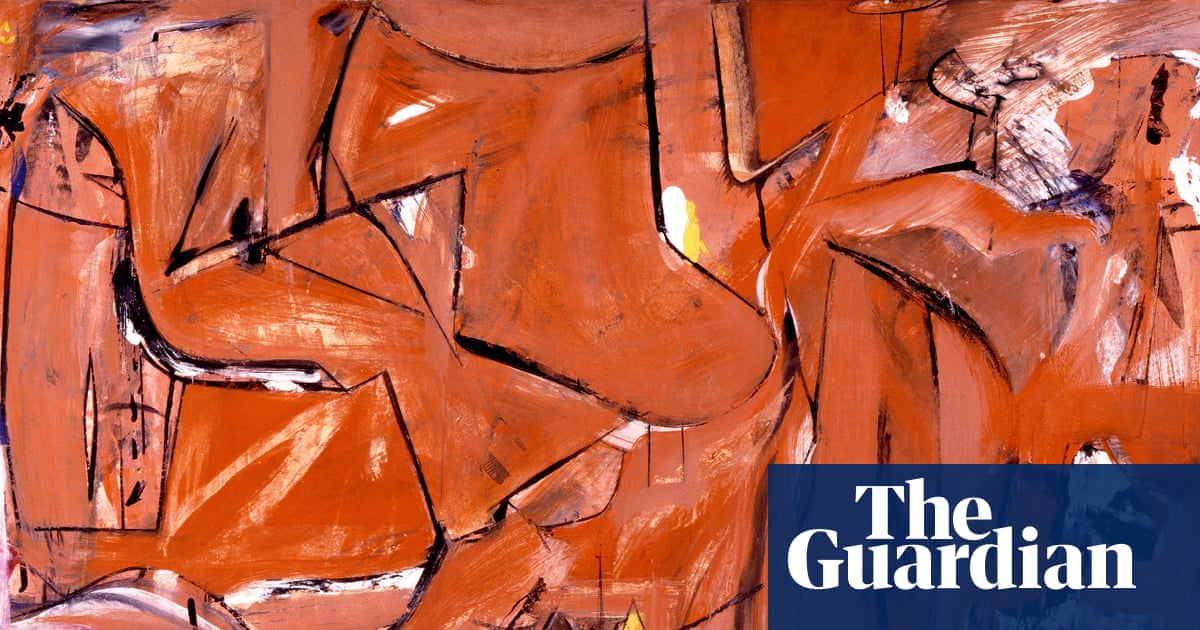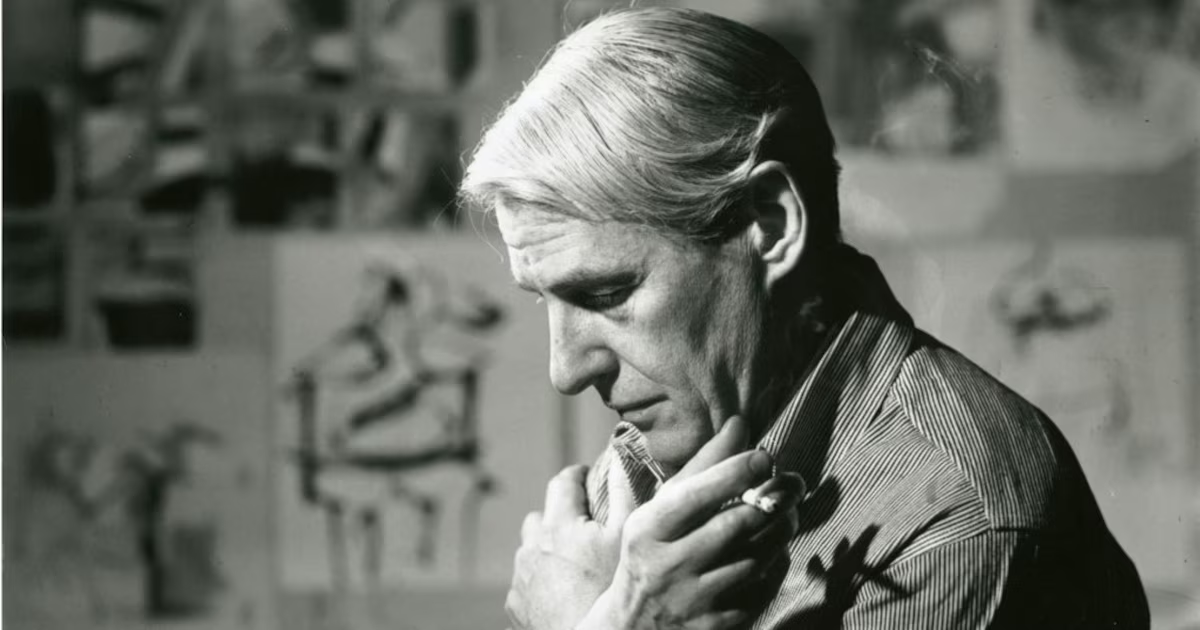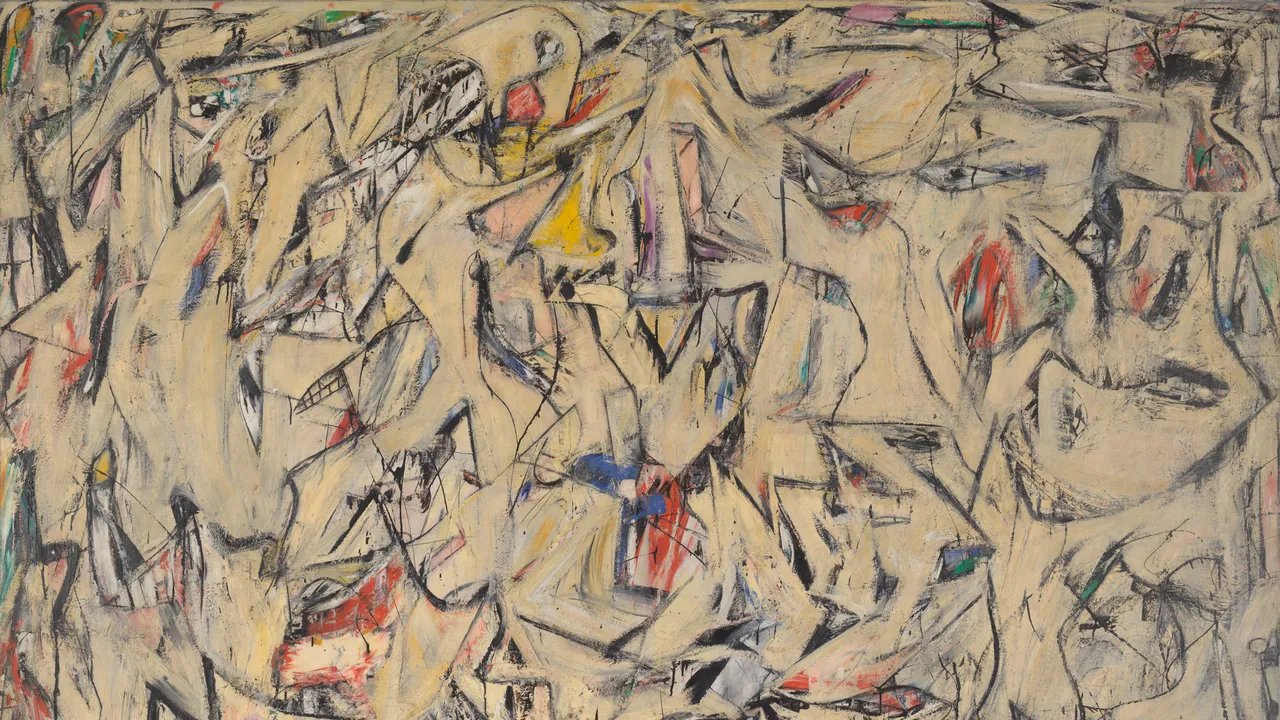
Drawings, like dreams, can often feel open-ended, prompting a multiplicity of thoughts. As painting’s poor cousins, they usually command a lesser fee in the art market, and their position somewhat to the left of capital may account—at least in part—for the fantastic, unfixed energy you often find in them: an artist draws not in the service of a career but in search of a self. Drawings, for me, are a kind of calligraphy of the soul, and, as you take in “Willem de Kooning Drawing” (at the Art Institute of Chicago through September 20th), it’s the enormous spirit behind many of the works—a searching spirit—that holds your attention, as do the artist’s questions about line, volume, voice, what the eye sees, and what the hand is capable of.De Kooning drew throughout his long creative life. (He died in 1997, at the age of ninety-two.) When he allowed the younger artist Robert Rauschenberg to erase one of his drawings for the piece “Erased de Kooning Drawing” (1953), he knew that part of the poetry of the work would be the idea of him watching himself disappear. It would have been a nice touch to include “Erased de Kooning Drawing”—a bridge between modernist and postmodernist thinking—in this first major show of de Kooning’s works on paper, but, even without seeing it, you can keep it in mind as you study de Kooning’s own ghostly markings.De Kooning, who grew up with almost nothing and then had everything, struggled with both deprivation and abundance. His story? It’s such an American one, especially if you think of having grown up elsewhere as definitively American. Born in Rotterdam in 1904, he was the child of Cornelia and Leendert de Kooning. His father, closed off and remote, tried to make a living bottling beer. His mother, hemmed in by poverty and the limitations of gender, had a dramatic personality and thought nothing of expressing her rage. Her anger was the great event of her life—and of her son’s. De Kooning’s affable but aloof personality was formed in part in reaction to Cornelia’s volubility; as a young man, he became known for his ability to defuse fights in bars and for his interest in theatrical women. His parents separated when he was two, and he shuttled back and forth between them through his childhood and adolescence. Still, his destitution and his spiritual orphanhood did nothing to eclipse the pleasure that he found, from an early age, in drawing.“Self-Portrait with Imaginary Brother,” ca. 1938.Art work by Willem de Kooning / Courtesy © 2026 The Willem de Kooning Foundation / ARSThere was no explaining de Kooning’s aptitude for art. Though he didn’t get far in his formal education—he left school at the age of twelve, and that was that—his teachers noticed his talent, and so did Cornelia’s second husband, Jacobus Lassooy, a barkeep. Because drawing was a marketable skill, Lassooy took the boy to various places to see if he could get work. He was accepted as an apprentice at a design firm that specialized in interior decoration. De Kooning’s renderings there were strong enough that, after some time, his boss encouraged him to apply to the Academie van Beeldende Kunsten en Technische Wetenschappen, a technical art school in Rotterdam.In the school’s drawing program, de Kooning copied classical works, mostly from Greece. He was also trained in commercial art. The experience forever bonded him to artisans. As Mark Stevens and Annalyn Swan point out in their definitive 2004 biography, “De Kooning: An American Master,” the young de Kooning’s development was unlike that “of many later artists, who grew up when becoming an artist was considered more a matter of temperament than of know-how. De Kooning began by learning the hows, rather than the whys. His hand led his mind.” Rotterdam was a port town, and its red-light district, full of music and women—and conveniently situated near the Academie—was one of the jazziest in Holland. That scene, the energy of it, nourished de Kooning: the accidents of life, the meetings and partings in an environment dominated by sound, fed his imagination, as did his dreams of freedom, and of becoming an artist.After finishing his fourth year at the Academie, de Kooning went to work as a commercial artist for Cohn Donnay and Company, a large department store. His supervisor, Bernard Romein, encouraged the restless youth to stay in school and helped open his mind to the world of art. The De Stijl movement, Mondrian, Bauhaus: Romein turned de Kooning onto all of this. But Holland was a backwater when it came to modern art. In 1924, de Kooning spent time in Belgium—to prepare himself, he said, for going to America—and while there he drew a series of cartoons. We see a bunch of them at the beginning of “Willem de Kooning Drawing”: light, all-on-the-surface illustrations. The best one, untitled and executed in Conté crayon and pencil (ca. 1924), shows a girl, perhaps in her early teens, holding a dark balloon, while a boy beside her grips a lighter-colored one, on a shorter stick—a not insignificant psychological detail. There are two younger boys to the girl’s left, but the girl is the emotional center of this piece. Stevens and Swan, among others, identify this drawing as an early example of de Kooning’s fascination with the female figure and power, but, at the show, I was less interested in the cartoons than in the part they played in his move to America.The work that excited de Kooning in those years was the illustration he saw in American magazines. He wanted to be an illustrator, and in 1926, when he was twenty-two, without saying goodbye to his family he stowed away on a freighter and travelled to Hoboken, New Jersey. By 1927, he was in Manhattan, living in the kind of here-but-where limbo that characterizes the immigrant experience. At first, de Kooning found work painting signs and designing window displays. In 1935, he was hired by the Federal Art Project of the Works Progress Administration to create murals, and although the gig lasted barely two years, it was pivotal in helping him give up his commercial mind-set and concentrate on the difficult task of finding his own voice as a visual artist. At the W.P.A., de Kooning could work on a larger scale, but what story would he tell to fill this new expansiveness?Untitled cartoon, ca. 1924.Art work by Willem de Kooning / Courtesy © 2026 The Willem de Kooning Foundation / ARS; Photograph by Useful Art ServicesNew York opened the world of modern art to de Kooning. Admired for his seriousness and for his eagerness to learn, as well as for his movie-star face and sturdy body, de Kooning was a looker in a city full of lookers. He went from a paucity of love to a series of sometimes overlapping, complicated relationships. He was also porous, open to being claimed by older artists, as he had been by his mentors in Holland. The New York that he settled in was teeming with new, experimental talent, including Stuart Davis and Arshile Gorky, who had fled Armenia during the genocide and with whom de Kooning shared a close and uneasy friendship—but what other kind is there between mentor and protégé? De Kooning relied on the experience of more seasoned artists to tell him who to become. Gorky was using European traditions—Roberto Matta’s Surrealism, Picasso’s neoclassicism, Cézanne’s explorations—to make work that captured New York’s sexiness, skittishness, and force. The mind-and-eye-expanding “Water of the Flowery Mill” (1944), like a number of his other paintings, builds on a series of lines that coalesce in an expanse of colors that shadow and seemingly swim away from one another. Gorky’s art not only presaged the Abstract Expressionism of which de Kooning would become a towering figure; it also pointed the way to color-field painting.It’s moving to spend time at “Willem de Kooning Drawing” looking for Gorky; it’s like searching for any unknowable father. Gorky and Davis are evoked, rather than imitated, in “Three Studies of Men” (1938). The drawing shows one man sitting, one standing, and one almost fading into the background. The standing man waves an admonishing finger at the passive, seated one; he is perhaps an older man looking at a younger friend or a student. The drawing has the feeling of a dream—that dream in which you unwittingly let your mentor down. I believe that Gorky also shows up in the great “Self-Portrait with Imaginary Brother” (ca. 1938), which isn’t at the Art Institute, though you can find it in the show’s catalogue. In the drawing, two male figures are rendered in pencil. They stand together, their hands almost touching; one holds a ball, the other a pencil. The symbolism would be comical if they didn’t look out at the viewer with such tenderness, a tenderness that inhabits the drawing itself, which is faint, as though you were seeing it through mist or memory. At the Academie, de Kooning had learned to “smudge”—to rub the fine lines of a pencil drawing with his fingers—a way of visually marrying technique with what I see as the accident of feeling, a controlled mistake. By smudging himself and another male figure, perhaps inspired by Gorky, de Kooning brought his emotional life, his desire, to the page, just as Rauschenberg would do, fifteen years later, when he smudged de Kooning.Again and again, I returned to works in which men were de Kooning’s focus, because I wanted to see the division in de Kooning’s art between the romantic and the sexual. I don’t think he was able to bring the two together, at least not with ease, given the romance of his drawings of men and the ferocity and the staggering sexuality he conveyed in his “Women” series, which he began in 1950. In an unpublished 1971 interview with the critic Harold Rosenberg, de Kooning said, “I was painting those male figures . . . but I found out that that didn’t get me anywhere.”Men had loved and helped de Kooning from the time he was a boy, but because of this he could go only so far with them as subjects. What was missing in most of his early work was not just the drama of resistance that his mother had supplied but the drama of psychological exile, coupled with actual exile. You may try not to be like your parents, but still you create situations in which you are their child, over and over again. De Kooning was forever Cornelia’s scorned and abused boy. Mother and son meet up again in the painting “Excavation” (1950), though the work isn’t a portrait of Cornelia; it’s a portrait of where de Kooning’s anguish about his mother led him, a canvas that articulates his pain, the intimacy of anger, and the frightful, destructive epoch he was living in. (The show’s curators, Kevin Salatino, Mel Becker Solomon, and Charlotte Healy, have included a number of major canvases and sculptures, which help to anchor the more than a hundred and fifty drawings.)De Kooning parked his “nice” side in his pencil portraits of men. The artist who made “Excavation” was someone else: inconsolable, wounded, wry, unforgiving. “Excavation” is one of the ugliest and most gorgeous modern paintings I have seen, a monster that swallows you whole. The main colors here are black and white, with flashes of red and blue. The artist said that “Excavation” was inspired by the neorealist Italian film “Bitter Rice” (1949), a depiction of workers in northern Italy which is dominated by the bodies of women. The painting shows a world of bodies, too, but they are fractured, and seemingly feed on other bodies and on birds and on paint itself. The drama here is rendered in sharp and round lines that stop and start, leading to other lines and to fragments of figuration: gaping mouths, elongated necks. All of these—the abstracted figures, the colliding lines—look as though they’re trying to escape the painting. It’s an emotionally claustrophobic and, in a way, hopeless work, but at the same time one that is thrilled by its own newness, the newness of its language.“No, the boss is a real snake—he dropped from a tree through the sunroof.”Cartoon by Frank Cotham“Excavation” screams as excruciatingly as Picasso’s “Weeping Woman” (1937) does, but in a different register. It was completed five years after the Second World War ended, in the intense early period of the Cold War. De Kooning needed that time to become more himself, so that the work could be more itself, too. There are no fully executed figures in it, no Cubist unity to pull the broken bodies together again. The painting exists as a whole because of the way de Kooning works and reworks the surface. It brings to mind newsreel images of Holocaust victims—prying camera eyes gazing at mountains of bodies, limbs tossed here and there, the dead shovelled on top of the dead. Abstraction was the mode of the fractured postwar world. But de Kooning, unlike his near-contemporary Jackson Pollock, believed that “even abstract shapes must have a likeness.”De Kooning was still poor in 1950, but his reputation among critics and painters was growing. Part of his poetic and dramatic genius was in bringing together pieces of the world that American art hadn’t seen—or been willing to look at—before. He could do this because he was learning to face the complications of his adopted country, just as he faced the complications of his relationship to women. Psychoanalysis was a hip thing to talk about and sometimes experience in de Kooning’s bohemian circles, but the artist, without necessarily being aware of it, showed us, in his “Women” series, what it actually looked like, and thus felt like, to uncover one’s primal feelings. No doubt buoyed by the success of “Excavation”—which was included in the Venice Biennale and, the following year, in an exhibition of abstract painting and sculpture at MoMA—de Kooning wanted to delve deeper into this new psychic freedom, to find more of what he knew or could face imagining. His ethereal drawing of his wife, the wily and captivating Elaine de Kooning—whom he married in 1943 and never divorced, although they were separated for decades—is as romantic as de Kooning gets, which is to say that Elaine, in that drawing, might as well have been one of his men. But in the works that followed de Kooning’s elegant, sure-handed lines were disturbed once again.“Monumental Woman,” 1953.Art work by Willem de Kooning / Courtesy © 2026 The Willem de Kooning Foundation / ARS; Photograph by Tim Nighswander / Imaging4Art.comIn the “Women” series, the real and the mythic, memory and reality, wrestle for pride of place in de Kooning’s consciousness. He may be strong, but when he pushes these women they push back, and in that heated exchange the viewer is likely to get burned. In the fascinating charcoal drawing “Monumental Woman” (1953), a woman exists in a series of swirls; we see her belly, her breasts, but she seems to be asking if we’re seeing enough of her. On the left side of the drawing are a series of markings that may be hair—or perhaps they’re de Kooning trying to get the woman, and by extension himself, to shut up. Neither he nor the woman wins, and neither will be silent—about the soul’s relationship to desire, at least, which can only be misunderstood or misinterpreted. “Two Women” (1951-52) is less robust than “Monumental Woman,” and it affords us the opportunity to see the fineness of de Kooning’s hand in what at first appears to be a quieter sphere. The two women—but there seem to be three—are at the center of the field, with air around them. The main figure has a tiny head, while the others are a series of smudged pencil markings. The drawing is an abstraction of flesh, floating in a kind of amusement-park world: de Kooning’s New York. To spend any time with this magnificent piece is to see the body at work, a wall of stretched and stretching limbs, a modern version of the Three Graces, who stand there not to be admired but to be claimed by the only thing they understand: distance.“Two Women” and other pencil drawings from the same period show us de Kooning in relation less to visual art than to theatre and dance: especially George Balanchine’s “plotless” ballets, such as “The Four Temperaments” (1946) and the ever-astonishing “Agon” (1957). The Russian-born Balanchine—another émigré artist who survived a brutal, forlorn childhood with his poetry intact—dressed his dancers in black and white leotards, the colors of New York cool. Like Balanchine, de Kooning made images for the mind about the body as it was expressed in the streets of the city. Sometimes, when I watch Balanchine’s choreography, I can’t help imagining “Monumental Woman” and other drawings from the “Women” series flashing behind the dancers as they embody de Kooning’s symphony of flesh. ♦
Willem de Kooning’s Excavations of Intimacy
The first major show of Willem de Kooning’s drawings articulates his pain and anger and the frightful era he lived in.
2,820 words~13 min read