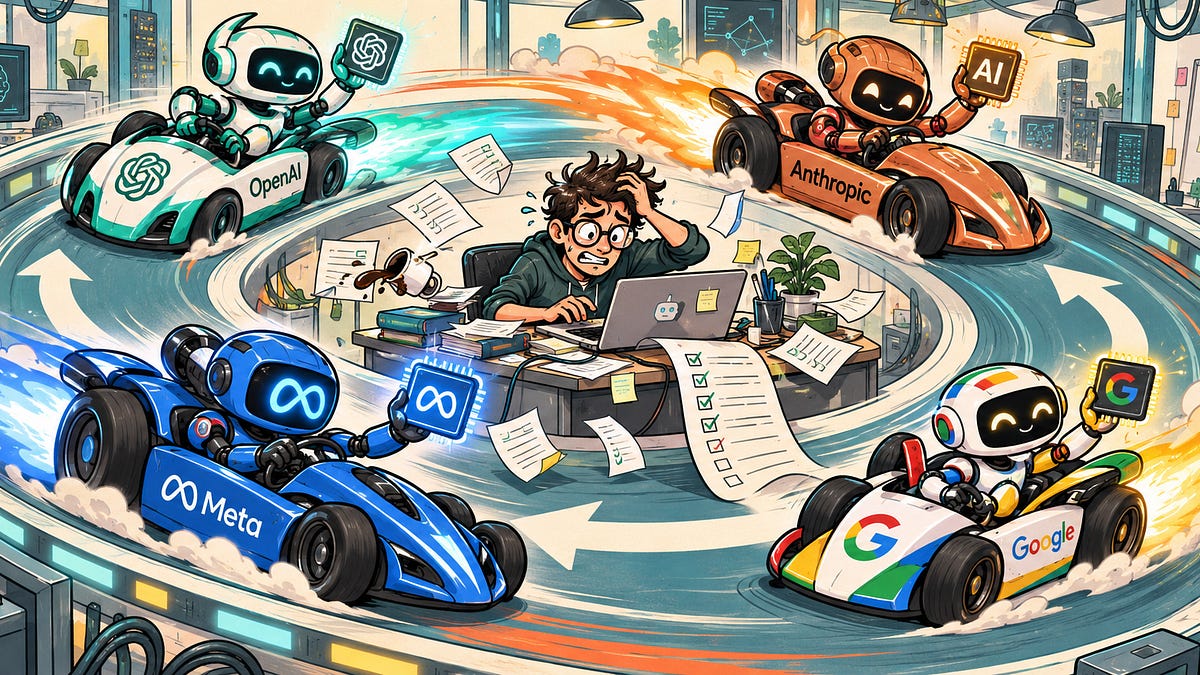
The AI industry has a shipping addiction. Frontier model releases, once spaced out enough for engineers to catch their breath and users to learn what they’d just been given, now land with the frequency of software patches. The median interval between major model drops has compressed from 37.5 days in 2023 to just 11 days so far in 2026.
The result is a phenomenon insiders are calling “model fatigue,” a creeping exhaustion that’s spreading through engineering teams, enterprise customers, and even the investors bankrolling the whole operation.
The compression nobody asked for
OpenAI’s own release cadence tells the story in miniature. The company’s median interval between model launches went from 170.5 days in 2023 to 49 days in 2026 year-to-date. What used to be a roughly six-month development and polishing cycle now barely covers a quarter.
The pressure isn’t purely domestic. Chinese labs like Moonshot AI and Z.ai have emerged as serious contenders, releasing open-weight models that perform at or near the level of closed, proprietary systems. Moonshot AI’s Kimi K3, a 2.8 trillion parameter model, has achieved benchmark parity with established competitors while cutting deployment costs to roughly one-sixth of what comparable closed models charge.