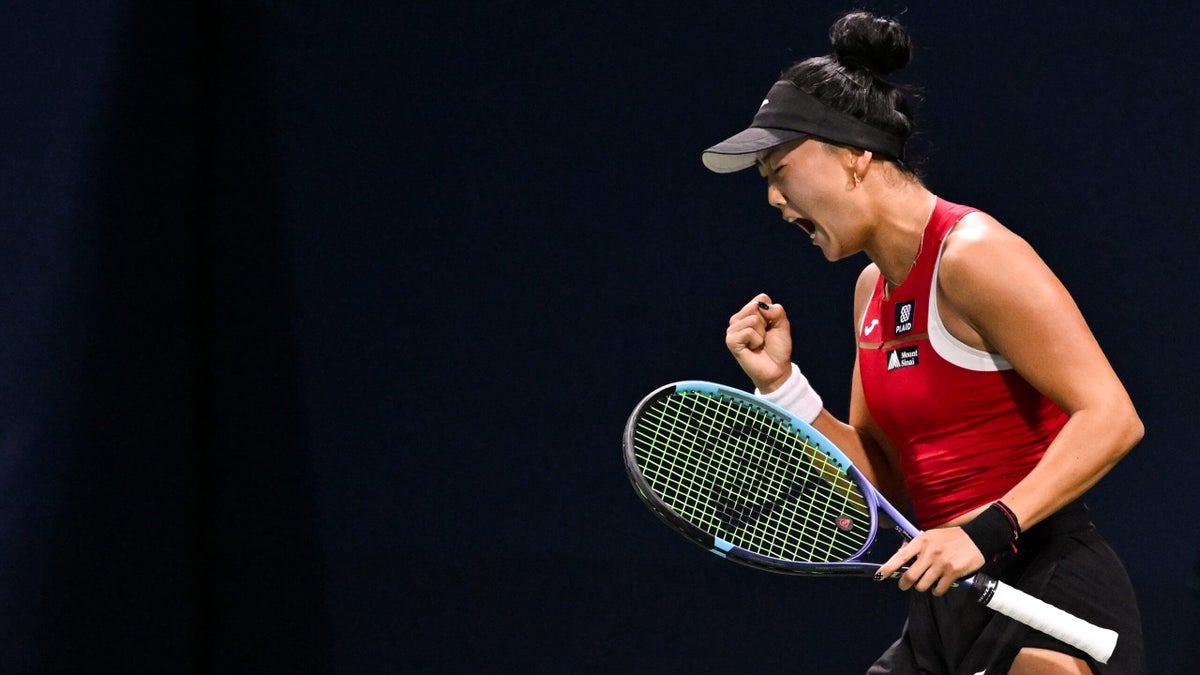
The Athletic has live coverage of the 2026 U.S. Open. NEW YORK — They don’t have big trophies or a slew of fancy endorsement deals.If they leave their racket bags and credentials in the locker room, they might be able to wander the grounds of the Billie Jean King National Tennis Center without anyone but their dedicated fans bothering them.If they hailed from most other nations, they might be big-time celebrities, at the top of their national tennis tree.The depth of American tennis is such that while they move in rarefied air across the world, at the U.S. Open, their home Slam, they are among many players vying to move up a rung or two, while remaining focused on the elements of a tennis rise that they can control.For the past three years, Ann Li, a 26-year-old from Pennsylvania, has enjoyed a mostly steady rise up from the 160s into the top 30. She’s the No. 29 seed at the U.S. Open and played Donna Vekić, the top-ranked player in Croatia and 2024 Olympic silver medalist, in the second round Thursday. She won, coming back from a set down on a largely empty Court 13, with its low stand of metal bleachers on one side and fans walking by through every point.On a night when she wasn’t at her best, Li basically refused to go away, forcing Vekić to hit one more ball, including a devastating miss in the second-set tiebreak, when Vekić was closing in on the finish line. Vekić moved to a ball bouncing short and high above the net, but ripped it a foot past the baseline.Li was off to the races.How much food can $100 get you at the U.S. Open?Hannah VanbiberCaty McNally, 24, is from Cincinnati. After first suffering a hamstring injury, and then undergoing a version of Tommy John surgery on an elbow condition, her ranking fell from No. 54 in spring 2023 to No. 1020 in fall 2024. She has been trying to climb back from tennis oblivion ever since, and reached a career-high ranking of No. 50 in June.In August, she played one of the great matches of the summer in the third round of the Canadian Open, losing to Alex Eala in three sets on a raucous night in Toronto.In New York, McNally largely cruised through her first-round match against Anouk Koevermans to set up an all-American tie with Emma Navarro. A semifinalist two years ago and a top-10 player in 2025, Navarro has been managing a chronic medical issue for the past year. Now she’s also in that American chasing pack, better than all but about two dozen people in the world, but just the sixth-best American. She has a handful of blue-chip endorsements, including Red Bull, some of which she earned after she reached the semifinals of the U.S. Open two years ago.After Navarro beat McNally Wednesday afternoon in three hard sets, she said she’s not really sure where she registers on the radar. But she had this to say about McNally, after it took her three sets to solve an opponent she’s been playing since the juniors: “Caty is really good.”Amanda Anisimova, a finalist at Wimbledon and the U.S. Open last year, and the world No. 10, said in an interview recently she’s well aware of that next tier of American women trying to push their level up to the elite.“Everyone kind of pushes each other,” Anisimova said. “I think it’s great.”She should know. There are three Americans in the top 10; she is the third. There are 14 in the top 100, and five in the top 25.For those just below the top level, the dynamic can have plusses and minuses.“Disadvantages, of course, are sponsors and all that good stuff,” Peyton Stearns, a former NCAA singles champion who cracked the top 30 last year but has since dropped to No. 55, said during an interview in Cincinnati.“We have so many players in the top 100 right now, so many players knocking on the door of the top 100. American tennis is just killing it.”In New York, Stearns lost to Harriet Dart of Great Britain in the first round, but she made the third round of the Australian Open in January. Hailey Baptiste, who signed a full Nike deal after a Madrid Open run in which she defeated world No. 1 Aryna Sabalenka, is out with a knee ligament injury that struck just as she was building up a head of steam.Li made the fourth round at the U.S. Open last year, before losing to Jessica Pegula, now the world No. 3 and the top American by ranking. Li cracked the top 50 for the first time five years ago. Injuries and a breakup with a longtime coach set her back.She never doubted that she would rise back up, though. She loved tennis. She always has, except during that lost year of injury when she didn’t have a full-time coach. She says she doesn’t play for money or fame or anything else.Ann Li has enjoyed a steady rise toward the upper echelons of women’s tennis. (Ben Solomon / USTA via Getty Images)Three years ago, she tried something radical for an American player. Most Americans base themselves in Florida, an international tennis hotbed, with coaches and top players and academies seemingly everywhere. Li hired Carlos Boluda, a young Spanish coach, and moved to Alicante, on Spain’s southeast coast, to train with him. She’s still based there, an ocean away from her friends and family.It’s not easy. She still doesn’t speak Spanish. But it’s been darn good for Li’s tennis. She won a tournament the first week that Boluda coached her, and she has been mostly rising ever since.During an interview last month in Cincinnati, Li said Boluda kept hammering home the message that tennis is supposed to be fun. From the beginning, he told her to mostly ignore her results. Before matches and tournaments they would talk about two or three goals, built around improvement. If she accomplished those, they didn’t care whether she won or lost.“When I’m happy I play the best,” she said. “And then it’s just been figuring out how we improve little things here and there, and for me the biggest thing now is kind of the consistency. Not so many ups and downs in the matches, in tournaments.”She and Boluda will turn practices into a series of games. He will set up boxes on the court and keep track of how many balls she can hit into them. Just like that, an accuracy drill becomes a game — a game that helps Li to understand something bigger than hitting a ball in the same spot.It helps her understand that she can win when she’s not playing her best. She can aim for bigger targets, or bigger boxes. She can change how she hits the ball into them, rather than where she hits it.“You can also win by running a lot,” she said.During an interview after her first-round win Monday over Antonia Ružić of Croatia, Li sipped on a protein drink and talked about what she still needed to work on.“I could pat myself on the back a little more,” she said.Most tennis players could. Finishing nearly every week with loss can get in the way. The sport requires taking a long view.McNally has had no choice but to do that for the past two years. With her all-court game, athleticism and tennis genes, she was one of the country’s most promising juniors. She made the third round of the U.S. Open in 2020. As teenagers, she and Coco Gauff were doubles partners. They lost the U.S. Open final in 2021.Caty McNally met compatriot Emma Navarro in the second round of the U.S. Open. (Matthew Stockman / Getty Images)Then came an elbow injury that McNally at first tried to play through, before she submitted to an operation that no tennis player ever wants to endure. If wrist injuries are the most feared in the sport, then elbow injuries might be equal second, with shoulders.Shortly after the surgery, long before McNally was hitting a tennis ball, Kathy Rinaldi, the former pro who was the head of women’s player development at USTA until last year, traveled to McNally’s home in Ohio to visit for a long weekend.Rinaldi has known McNally since she was young child. She played professionally with McNally’s mother, Lynn Nabors-McNally. She and Rinaldi have known each other for more than 40 years.“It’s important to support players not just when they’re doing well, but when they’re not,” Rinaldi said during a recent interview. “I knew that with her love of the game it was probably hard for her to be off the Tour.”Rinaldi accompanied McNally to rehab in the mornings and fitness sessions in the afternoons. They went for lunch and coffee. She joined her family for a dinner.“It was really great just to see her attitude and to see her in action like that,” Rinaldi said.McNally’s mother was coaching her earlier this year, but she decided to go through the clay-court season alone. After that, she wanted some more hands-on guidance. She called Rinaldi, who is setting up an academy on the east coast of Florida, to come aboard.“Full-circle moment,” McNally said in Cincinnati last month. “Really cool.”Rinaldi said McNally is one of those rare players with too many options. She can hit with shape and depth from the baseline. She can feather the ball at the net. She can jump forward to take it on the rise. It’s a good problem to have, but like most players, she does better when she can simplify her approach.Other than that, she just needs more big moments in big matches against big players, to develop a level of consistency when she needs it. She has two top-10 wins this season, including one in Canada against Linda Nosková, the Wimbledon champion. The Czech Republic is probably the women’s tennis country closest to mirroring the U.S., blessed with a bevy of talent from Grand Slam champions and finalists, to precocious teenagers and veterans, to top-30 and top-40 stalwarts.For players from both nations, accepting what they can control brings everything else.“It’s not always my best tennis, or my prettiest tennis. Maybe things aren’t looking, or playing, or feeling how I’d want them to be,” McNally said.“But if I can be known for just going out there, and giving everything I have, and trying to fight and figure things out and compete… That’s really all you can ask for yourself.”
How the U.S. Open showcases the depth of women’s tennis in America, win or lose
At the U.S. Open, fans can see players up and down the rankings up close.
1,750 words~8 min read