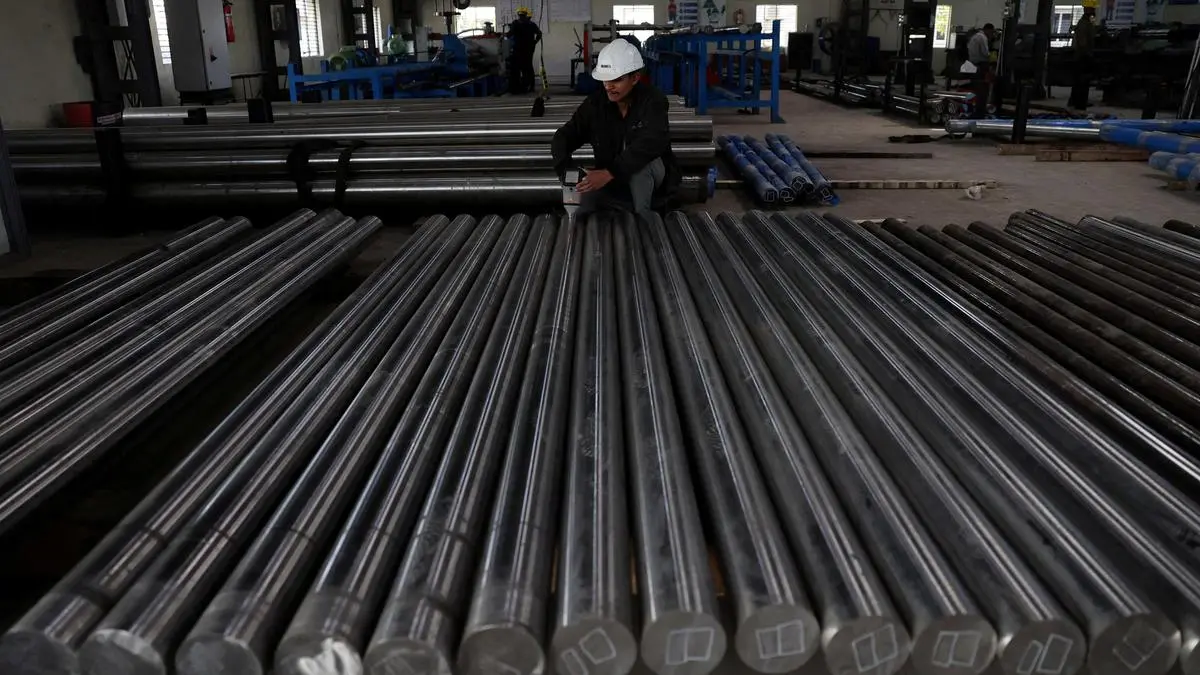
In Q1, manufacturing’s nominal GVA grew 7.7 per cent, compared with 9.2 per cent growth in real GVA, resulting in the -1.5 per cent implicit deflator. MoSPI said this was particularly evident in activities such as textiles and cotton ginning, basic metals, and rubber and plastic products.
| Photo Credit:
istock.com
The Ministry of Statistics and Programme Implementation (MoSPI) has sought to address concerns over the newly released GDP estimates, saying a negative implicit deflator for manufacturing does not mean that manufacturing prices declined and that revisions to last year’s GDP were not aimed at mechanically boosting the latest growth rate.In a set of questions and answers released on Wednesday, the ministry explained the impact of the new double-deflation methodology, the revisions to the GDP series and the differences between the GDP deflator, consumer price inflation and wholesale price inflation.The clarification comes days after MoSPI released the updated annual and quarterly GDP estimates with 2022-23 as the base year. The revised series incorporates the new Producer Price Index (PPI), Banking Services Price Index and updated administrative data.One of the key issues addressed by the ministry was the -1.5 per cent implicit GVA deflator for manufacturing in the April-June quarter of 2026-27, despite increases in both output and input prices.Under double deflation, output and intermediate consumption are deflated separately before real GVA is derived. If input prices rise faster than output prices, nominal GVA can grow more slowly than real GVA, resulting in a negative implicit deflator even when actual manufacturing prices are rising.In Q1, manufacturing’s nominal GVA grew 7.7 per cent, compared with 9.2 per cent growth in real GVA, resulting in the -1.5 per cent implicit deflator. MoSPI said this was particularly evident in activities such as textiles and cotton ginning, basic metals, and rubber and plastic products.The ministry also rejected the contention that the sharp revision in last year’s current-price GDP, from the earlier ₹86.05 lakh crore estimate to ₹80 lakh crore, was intended to make the current year’s growth rate appear stronger.The ₹86.05 lakh crore figure was calculated under the old 2011-12 base-year series. Following the introduction of the 2022-23 base year, the corresponding Q1 2025-26 estimate was revised to ₹80.32 lakh crore. It was subsequently updated to ₹80.44 lakh crore in June 2026 and then to ₹80 lakh crore after the new IIP and PPI data were incorporated.MoSPI said these changes reflected successive revisions arising from the base-year change, improved data sources, methodological changes and updated indicators, rather than an attempt to artificially raise growth. The relevant comparison for Q1 2026-27 GDP of ₹88.27 lakh crore, it said, is therefore with the ₹80.32 lakh crore estimate under the comparable new series and not with the ₹86.05 lakh crore figure from the superseded series.The ministry also explained why the 2.5 per cent implied GDP inflation rate in Q1 differed sharply from consumer inflation of 3.9 per cent and wholesale inflation of more than 9 per cent.Unlike CPI and WPI, which cover specific baskets of goods and services at different stages of the supply chain, the GDP deflator covers the entire economy, including government expenditure, investment, exports and services. MoSPI said high raw-material prices combined with relatively low inflation in some services could therefore produce a GDP deflator substantially different from CPI or WPI.The ministry further clarified that double deflation is not directly used to calculate private final consumption expenditure (PFCE). It is a production-side methodology used for calculating constant-price GVA, while PFCE is estimated using detailed volume and price indicators appropriate to individual goods and services.The ministry also addressed the large divergence between nominal and real GVA growth in mining. Real mining GVA contracted 2.4 per cent in Q1, broadly consistent with weak mining IIP readings during April and May, while nominal GVA grew 22.3 per cent because mineral prices rose sharply. Prices of crude petroleum and natural gas, for instance, rose 69.5 per cent in April, 72.2 per cent in May and 33.7 per cent in June on the PPI measure.On the sizeable statistical discrepancy between production-side and expenditure-side GDP estimates, MoSPI said it was a statistical balancing item and should not by itself be interpreted as evidence that GDP had been understated or overstated.The ministry cautioned that the Q1 estimates remain subject to revision as more comprehensive data become available. It said the direction and magnitude of future revisions cannot be predicted from the current discrepancy alone.Published on September 3, 2026