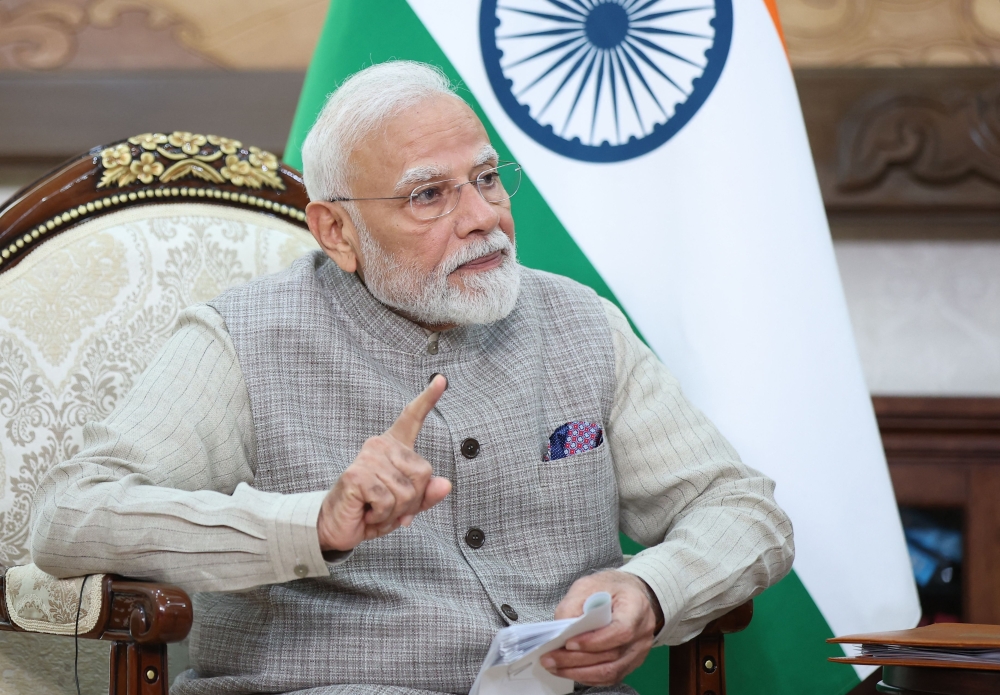
Saurabh Garg, Secretary, Ministry of Statistics and Programme Implementation
| Photo Credit:
It is “unfortunate” that the revision in the estimate of last year’s first-quarter GDP under the new national accounts series is being misinterpreted as an attempt to mechanically boost the current year’s growth rate, said Statistics and Programme Implementation Secretary Saurabh Garg, asserting that the comparison being made by critics mixes different GDP series and current-price and constant-price numbers.World Bank Executive Director Neelkanth Mishra, meanwhile, described claims that Q1 growth was actually closer to 2.6 per cent as “ill-educated” and “egregiously wrong”, arguing that independent high-frequency indicators corroborate the strength reflected in the official 7.8 per cent estimate.The comments come amid a controversy over the revised national accounts series introduced in February 2026. Former finance secretary Subhash Chandra Garg has questioned the sharp revision to the size of the economy in the June 2025 quarter and argued that the lower base could materially boost the subsequent year-on-year growth rate.
Neelkanth Mishra, World Bank Executive Director
Saurabh Garg, defending the 7.8 per cent real GDP growth recorded in the April-June quarter of 2026-27, said the comparison of GDP across two years had to be made at constant prices and, crucially, using the same series.“Whenever we compare two different years, we always compare at constant prices. Firstly, what has been done in that statement is comparing figures at current prices,” Garg said. Comparing current-price figures across years, he said, would inevitably involve differences arising from price changes. The “even more glaring” problem, he said, was that the comparison used the Q1 2025-26 figure from the old 2011-12 base-year series against Q1 2026-27 data from the new 2022-23 series.“As you are aware, in February, we released numbers with the new base year, 2022-23, and we had given numbers for all the years in the back series up to 2022-23,” he said. “So, a number from the new base year for the first quarter of this year has been compared with a number from the obsolete series based on the old base year of 2011-12, even though the new series had already been published in February 2026,” he said.Garg said the argument that the figures had been “compressed” therefore referred to a number that had already been revised in February 2026 but was not being used in the comparison. “The claim that the numbers have been compressed now relates to a figure that was released in February 2026 but was not quoted,” he said.The ministry’s FAQ also explains that quarterly GDP is compiled using the benchmark-indicator approach, with the movement in estimates guided by hundreds of high-frequency volume and value indicators. These include crop production, cement production, finished steel consumption and commercial vehicle sales.Physical indicatorsGarg pointed to such physical indicators to reinforce his argument. “When you look at the actual output or actual volumes, whenever a growth rate is compared from quarter to quarter, we do it based on actual production, let us say, of steel, cement and automobiles,” he said. “In each of these areas, volume growth has been of the order of 10 per cent, 15 per cent and 20 per cent.”“It’s unfortunate that a comparison is being made of apples and oranges,” he said.Mishra’s argumentMishra made a similar argument, but from the perspective of the wider economic indicators. In a post on X, he said he was “shocked” by “the ill-educated and egregiously wrong claims” that using the “original” June 2025 base would result in substantially lower growth in June 2026.“The new series introduced in Feb-2026 cleaned up the data and also significantly improved the methodology,” Mishra said, adding that the downward revision in the base had been known in March.More importantly, he said the latest GDP numbers were consistent with indicators that are difficult to manipulate. “That such claims got traction is itself surprising, given that easy-to-track and not-possible-to-fudge indicators of economic activity have been so robust,” he said.Mishra cited strong vehicle dispatches, tax collections, credit growth and construction activity as evidence of continuing momentum. Personal vehicle dispatches, including cars and SUVs, grew 35 per cent year-on-year in August, while two-wheeler growth exceeded 20 per cent and commercial vehicle dispatches rose more than 40 per cent, he said.“As expected, with the fiscal headwinds fading and monetary headwinds (falling credit growth till 1HFY26) becoming tailwinds (credit growth accelerating), GDP growth is surprising on the upside,” Mishra said. He said this could push consensus estimates of trend growth to above 7 per cent.At the same time, Mishra cautioned that there was still slack in the economy, reflected in weak real-wage growth, and that several quarters of above-trend growth could be needed before that slack was eliminated and inflationary pressures became sticky.Published on September 3, 2026