The IDE for professional development in Go
GoLand
This article was initially published by a community contributor, Christoph Berger, in the JetBrains’ Go Guide and has since been moved to the JetBrains Go blog. We have also updated it in August 2026 to reflect the most recent changes to the Go language.
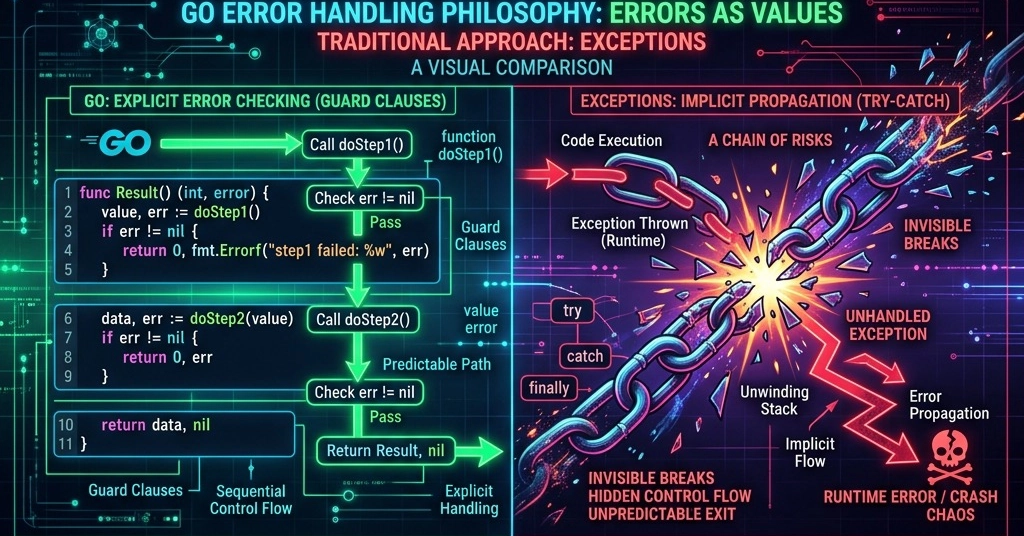
Error handling is one of the aspects in which Go differs from other popular languages like Java, C++, JavaScript, and Python. In Go, errors are values. While other languages move error handling out of the code flow, Go considers errors a natural part of the program flow. If a function encounters an error, it returns that error alongside other return values. The caller has the duty to check this error and handle it accordingly.
A typical Go package or app can encounter various types of errors at runtime, including logical errors, I/O errors, network errors, data validation errors, and more. Each of these types may require specific error handling. Go provides a set of tools and techniques to handle different types of errors.