In the previous article, we explored how functions allow us to package logic into reusable blocks. However, a crucial question remains: what happens when that logic goes wrong?
Building applications is not just about writing code for the "happy path," the scenario where everything works perfectly. In reality, our programs interact with the messy, unpredictable outside world. Files we try to open might be missing. Network connections might timeout. Databases might be overloaded. Disk drives might fill up mid-write.
If we ignore these possibilities, our applications will crash spectacularly, leaving users frustrated and data corrupted.
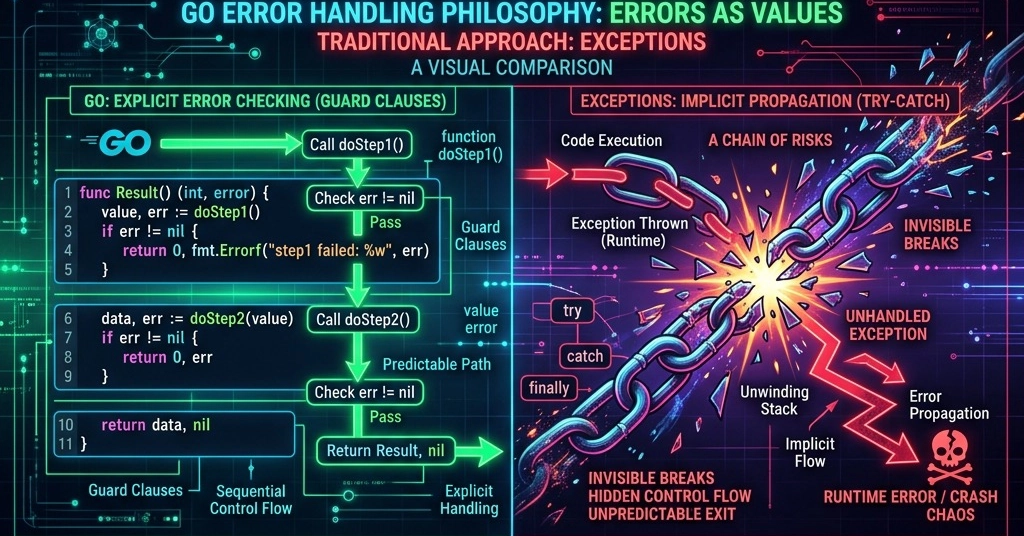
Therefore, a programming language must provide a clear, disciplined way to predict, handle, and recover from failures. This is where Python and Go diverge in one of the most profound ways possible. They represent two completely different schools of thought on how to manage errors. Python embraces the Exception Model, using structured "try/catch" blocks to intercept errors thrown from anywhere. Go rejects exceptions in favor of Errors as Values, forcing developers to handle errors immediately and explicitly by checking return values. Furthermore, when it comes to cleaning up resources (like closing files or releasing network connections), Python offers the elegant with statement (Context Managers), while Go provides the powerful and unique defer keyword.