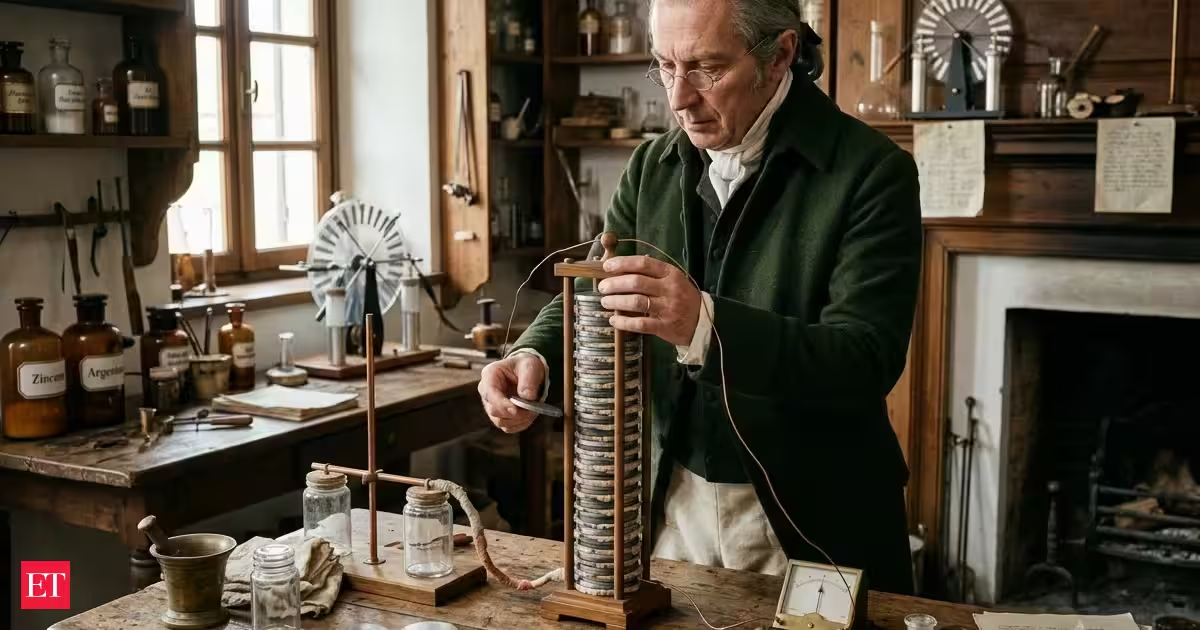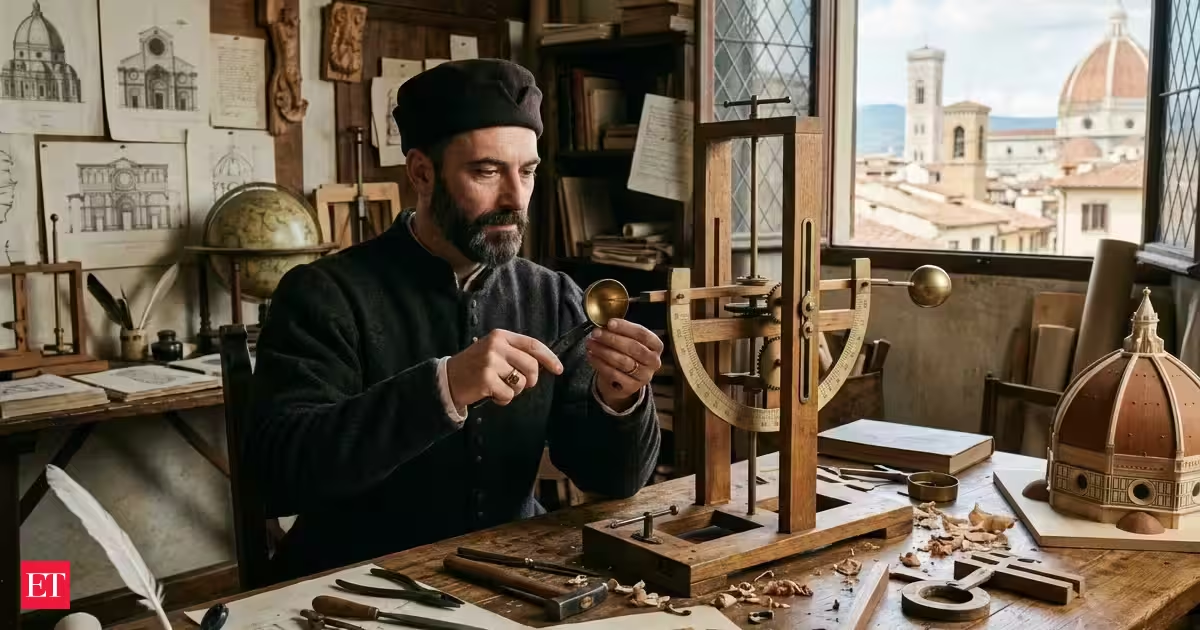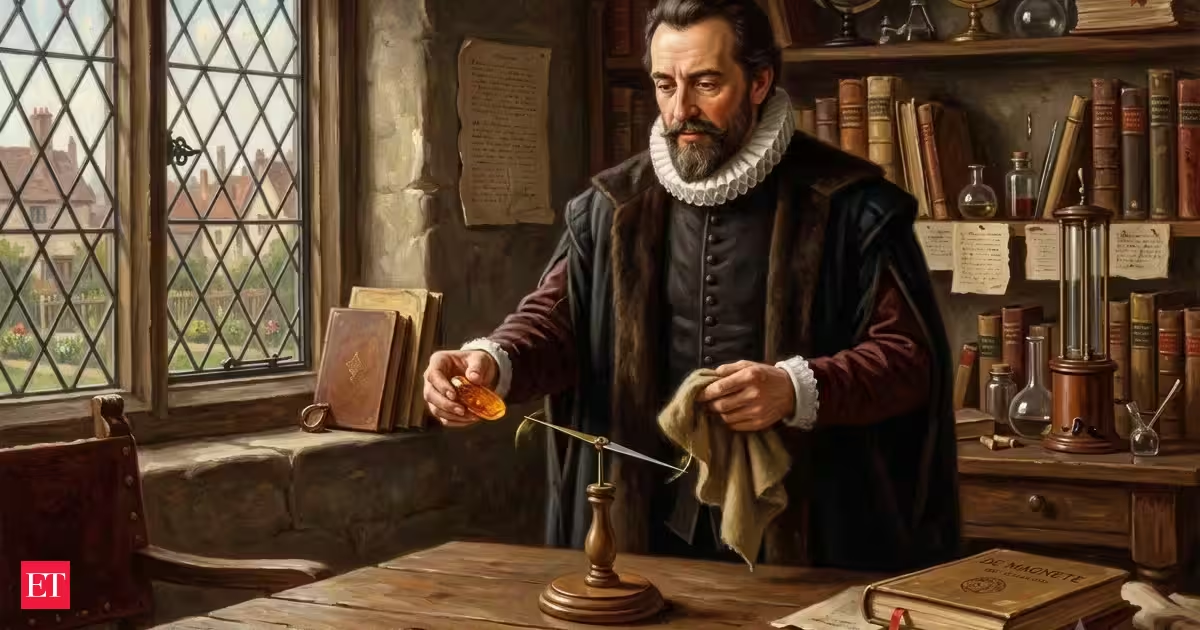
Around 1600, William Gilbert, an English physician and natural philosopher, invented the versorium, which is regarded as the first electroscope. The device was made to detect the presence of static electric charges. Gilbert studied the effects produced when materials such as amber were rubbed. He observed that a charged object could attract a light metal needle. This observation gave him a way to study static electricity through an instrument. Gilbert also studied magnetism and concluded that Earth itself acts like a giant magnet. His 1600 work, De Magnete, brought together experiments on magnetism and electricity and influenced later scientific study.Around 1600, William Gilbert invented the versoriumWilliam Gilbert was born in 1544 and died in 1603. He was an English physician and natural philosopher. He is often described as the father of electricity and magnetism because of his work on magnetic and electrical forces.Gilbert is best known for his scientific treatise De Magnete, published in 1600. The work presented experiments and observations about magnetism and electricity. It became an important part of the study of these subjects. One of Gilbert's inventions was the versorium. It was a simple device that could show the presence of static electric charges.What is the invention?The versorium was a lightweight metal needle placed on a vertical pivot. The needle was not magnetized. Because it could move freely around the pivot, it could respond when an electrically charged object was brought close to it. The device worked through attraction caused by static electricity.For example, amber can become electrically charged when it is rubbed. When a charged piece of amber was brought near the versorium, the metal needle moved toward it. This movement showed Gilbert that an electric force was present. The name versorium comes from the Latin word vertere, meaning "to turn around". The name describes the movement of the needle as it turned toward an object.The versorium did not measure an electrical charge in the way modern electronic instruments do. Instead, it provided a visible indication that an electric charge was present. This is why it is regarded as the world's earliest electroscope.Why and how was it invented?Gilbert wanted to understand natural forces through observation and experiments. Before his work, magnetism and the attraction produced by rubbed amber were often discussed together with other ideas about matter and nature. Gilbert investigated these forces separately.His experiments with amber were important to his study of static electricity. When amber was rubbed, it could attract small objects. Gilbert examined this effect and used the versorium to make the attraction easier to observe. The instrument gave him a way to distinguish electrical attraction from magnetic attraction.A key part of his approach was the use of experiments instead of relying only on established philosophical ideas. Gilbert was critical of rigid Aristotelian philosophy and argued for knowledge based on observations of nature. His work is associated with the development of empirical scientific investigation.Who invented it?William Gilbert invented the versorium around 1600. Gilbert had trained as a physician. He studied at St. John's College, Cambridge, and received his medical doctorate in 1569. His medical career developed in London. His work and position eventually brought him recognition among physicians and at the royal court.In 1600, Gilbert was elected President of the Royal College of Physicians. He was also appointed personal physician to Queen Elizabeth I. After Queen Elizabeth I died in 1603, Gilbert briefly served King James I. He died later in 1603, probably during the bubonic plague that was affecting London. His medical career therefore existed alongside his scientific work.Gilbert's work on electricityGilbert made a distinction between magnetism and static electricity. He studied the ability of amber to attract objects after being rubbed. From these observations, he used the Latin word elektris, associated with amber, as the basis for the term electricity.Gilbert also described ideas and terms connected with electric and magnetic forces. His work included concepts such as magnetic poles, electric force and electric attraction. These ideas helped establish a vocabulary for discussing electrical and magnetic behavior.The versorium was important because it turned an observation into something that could be demonstrated with an instrument. A person could bring a charged object near the needle and observe the needle move. The movement provided evidence that an electric effect was present.Earth as a magnetGilbert's research was not limited to static electricity. One of his major conclusions was that Earth itself is a giant magnet. This idea helped explain why a compass needle consistently aligns in a north-south direction.At the time, the behavior of compasses was known, but the physical explanation required further study. Gilbert proposed that the magnetic properties of Earth were responsible for the behavior. He conducted experiments to support this conclusion.The terrella experimentGilbert constructed a spherical lodestone magnet called a terrella. The word means "little Earth". The terrella was used as a model of Earth. Gilbert placed a small compass on its surface and observed how the compass behaved. The compass showed magnetic behavior on the terrella that was similar to its behavior on Earth.The experiment supported Gilbert's argument that Earth itself has magnetic properties. The terrella became an important part of his explanation of terrestrial magnetism. It also showed how a physical model could be used to investigate a larger natural system.How did it help the world?The versorium helped scientists study static electric charges through direct observation. It provided an early method for identifying electrical effects before modern electrical instruments existed. Gilbert's wider work also helped establish a distinction between electricity and magnetism. This distinction became important for later scientific research.His approach placed importance on experiments, observations and evidence. This influenced the development of scientific investigation. His book De Magnete became a reference point for later researchers. Gilbert's work helped create a foundation on which later studies of electricity, magnetism and electromagnetism could develop.His ideas did not provide the complete understanding of electricity that exists today. However, they introduced methods and concepts that contributed to later discoveries. Gilbert also argued that knowledge should come from studying nature and conducting experiments rather than depending only on books. This approach was part of his criticism of established Aristotelian ideas.Gilbert's scientific legacyGilbert's influence continued after his death in 1603. His studies of magnetism and electricity became part of the history of experimental science. The versorium is remembered as the first electroscope because it could detect the presence of static electric charges through the movement of a metal needle.His work on Earth as a magnet also influenced the understanding of geomagnetism. Gilbert's name was later used for the "gilbert" (Gi), a unit in the centimetre-gram-second system associated with magnetomotive force. His scientific legacy therefore covers electricity, magnetism, experimental methods and medical practice.The invention of the versorium around 1600 was one part of this wider body of work. The simple device showed that static electric charges could produce an observable force. That principle became part of the development of electrical science.William Gilbert life and inventionsWilliam Gilbert invented the versorium around 1600.The versorium is regarded as the first electroscope.It was used to detect static electric charges.The device had a lightweight, unmagnetized metal needle.The needle was balanced on a vertical pivot.A charged object could cause the needle to turn.Gilbert studied the electrical effects produced by rubbed amber.The name versorium comes from the Latin word vertere, meaning to turn around.Gilbert published De Magnete in 1600.He argued that Earth is a giant magnet.He constructed a spherical lodestone called a terrella.He used the terrella to model Earth's magnetic behavior.He separated the study of magnetism from static electricity.He helped establish terms linked to electric and magnetic forces.He was a physician and received his medical doctorate in 1569.He became President of the Royal College of Physicians in 1600.He served as physician to Queen Elizabeth I.He briefly served King James I after Elizabeth's death.He died in 1603, likely during the bubonic plague in London.His experimental approach influenced later scientific work.
Around 1600, a pioneering English physician and natural philosopher invented versorium, the first electroscope, and detected the presence of static electric charges
Around 1600, William Gilbert invented the versorium, the first electroscope, to detect static electric charges. The English physician and natural philosopher studied electricity and magnetism through experiments. His work helped separate magnetism from static electricity. He also argued that Earth is a giant magnet and used a terrella to demonstrate how magnetic behavior works.
1,306 words~6 min read