Spectacle was an essential component of Victorian scientific promotion—perhaps most famously enacted by (eventual) Royal Society president Sir Humphry Davy, who would demonstrate chemical and physical experiments (sometimes of a dangerous nature) to packed lecture halls for most of his career. Although Davy died at the very beginning of the Victorian era (and his scientific accomplishments are more closely associated with post-Enlightenment discoveries than Victorian ones), he and his equally performative contemporary, the astronomer William Hershel, are credited with stoking the nineteenth-century interest in the visuality of scientific discovery.Article continues after advertisement
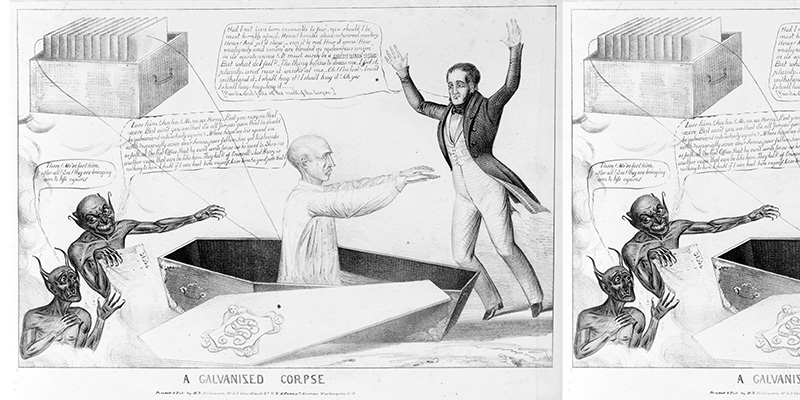
Early nineteenth-century scientists, especially Davy’s protégé Michael Faraday, would conduct demonstrations of electromagnetism and electrochemistry in similar academic (and yet dazzling) manners. But there was one man who took the trend of flamboyant scientific performance to an entirely new, and very dark place: Giovanni Aldini.
Aldini was Italian, born in Bologna in 1762, and devoted his life to the study of science. Both a medical doctor and a trained physicist, became a professor of experimental physics at the University of Bologna in 1878. What was the research interest for which he would become famous? Electricity.