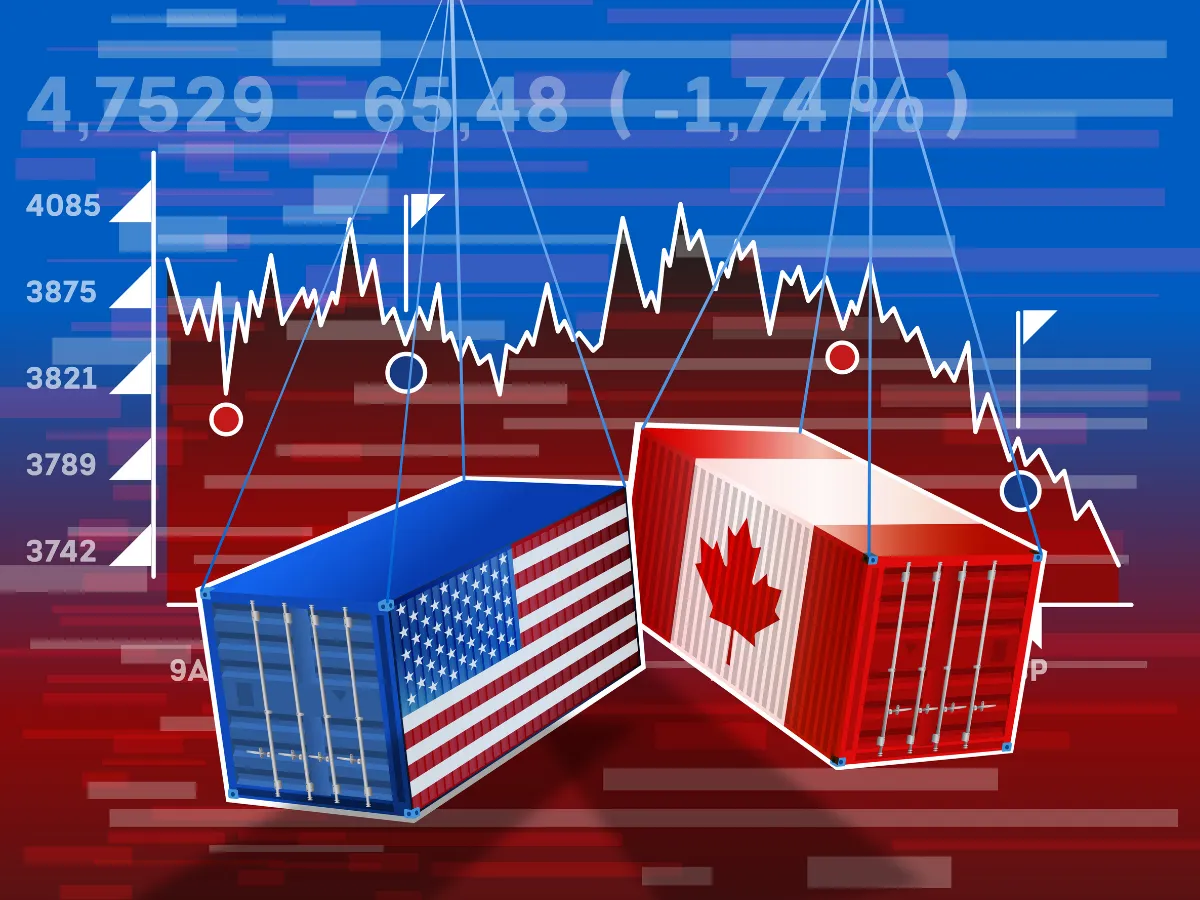
Skip to Content News Archives Economy Energy Oil & Gas Renewables Electric Vehicles Mining Commodities Agriculture Real Estate Mortgages Mortgage Rates Finance Banking Insurance Fintech Cryptocurrency Work Wealth Smart Money Wealth Management Investor Personal Finance Family Finance Retirement Taxes High Net Worth FP Comment Executive Women Puzzmo Newsletters Financial Times Business Essentials More Innovation Information Technology FP500 Podcasts Small Business Lives Told Tails Told Shopping Financial Post Store Obituaries Place a Notice Advertising Advertising With Us Advertising Solutions Postmedia Ad Manager Sponsorship Requests Classifieds Place a Classifieds ad Working Profile Settings My Subscriptions My Offers Newsletters Customer Service FAQ News Economy Energy Mining Real Estate Finance Work Wealth Investor FP Comment Executive Women Puzzmo Newsletters Financial Times Business Essentials HomeInvestorCanada-U.S. trade war, rising rates and debt: What stock market investors need to knowMartin Pelletier: As higher rates and political risks reshape markets, opportunities may lie beyond the short-term noiseLast updated 1 hour ago The future rarely looks obvious in real time, which is why successful investing is often less about forecasting and more about adapting before everyone else does. Photo by Grafissimo/Getty ImagesI just returned from my summer holidays after deliberately stepping away from the markets and the daily news cycle. Every year, I find value in creating some distance from the constant stream of headlines, earnings releases, economic data and political commentary. The goal is simple: reset my big-picture thinking, challenge my internal assumptions and reduce the influence of what may ultimately prove to be short-term noise.Subscribe now to read the latest news in your city and across Canada.Exclusive articles from Barbara Shecter, Joe O'Connor, Gabriel Friedman, and others.Daily content from Financial Times, the world's leading global business publication.Unlimited online access to read articles from Financial Post, National Post and 15 news sites across Canada with one account.National Post ePaper, an electronic replica of the print edition to view on any device, share and comment on.Daily puzzles, including the New York Times Crossword.Subscribe now to read the latest news in your city and across Canada.Exclusive articles from Barbara Shecter, Joe O'Connor, Gabriel Friedman and others.Daily content from Financial Times, the world's leading global business publication.Unlimited online access to read articles from Financial Post, National Post and 15 news sites across Canada with one account.National Post ePaper, an electronic replica of the print edition to view on any device, share and comment on.Daily puzzles, including the New York Times Crossword.Create an account or sign in to continue with your reading experience.Access articles from across Canada with one account.Share your thoughts and join the conversation in the comments.Enjoy additional articles per month.Get email updates from your favourite authors.Create an account or sign in to continue with your reading experience.Access articles from across Canada with one accountShare your thoughts and join the conversation in the commentsEnjoy additional articles per monthGet email updates from your favourite authorsSign In or Create an AccountorWhile the break was refreshing, I have to admit it was difficult to completely disconnect given the escalating trade tensions between the United States and Canada. The steady stream of tariff threats, negotiations and retaliatory measures continued to dominate headlines, adding another layer of uncertainty for businesses, consumers and investors alike.Canada's best source for investing news, analysis and insight.By signing up you consent to receive the above newsletter from Postmedia Network Inc.A welcome email is on its way. If you don't see it, please check your junk folder.The next issue of Investor will soon be in your inbox.We encountered an issue signing you up. Please try againThe longer this dispute remains unresolved, the greater the risk that companies delay capital spending, manufacturers rethink supply chains and hiring decisions are postponed until there is greater clarity. Businesses can adapt to many challenges, but uncertainty is often the most difficult variable to manage.The risks are particularly acute for Canada. Roughly three-quarters of Canadian merchandise exports are destined for the United States, making continued access to our largest trading partner essential for economic growth. Yet for years we have made it increasingly difficult to develop and export our own natural resources. Policymakers continue to talk about diversification, but diversification requires pipelines, ports, infrastructure and investment. Without them, Canada enters trade negotiations with fewer options and less bargaining power than it should have.As a result, escalating trade barriers have the potential to weaken business investment and reduce export competitiveness, placing additional pressure on an economy already struggling with weak productivity growth and elevated household debt. Export-oriented regions such as British Columbia, Ontario and Quebec would likely feel the impact first, but the effects would ultimately spread throughout the economy through slower growth, softer labour markets and weaker business confidence.The United States is not immune either. While its economy is larger and less dependent on exports, tariffs effectively act as a tax on businesses and consumers. Higher import costs can squeeze corporate margins, increase prices and add inflationary pressure at a time when policymakers are already trying to balance economic growth with price stability. Many American manufacturers also rely on Canadian energy, raw materials and intermediate goods, meaning disruptions can ultimately raise costs and reduce efficiency across supply chains on both sides of the border.What concerns me most is that these developments appear to be part of a broader shift toward economic nationalism. For decades, investors benefited from expanding global trade, with integrated supply chains and increasing economic co-operation. Today, geopolitical priorities are increasingly taking precedence over economic efficiency. As a result, political decisions are becoming more influential in shaping economic outcomes and market returns.As if trade tensions were not enough, U.S. Treasury Secretary Scott Bessent recently announced that the Treasury would use its General Account to purchase up to US$4 billion of longer-dated Treasury securities. While small relative to the size of the Treasury market, the announcement was notable because it highlighted how closely policymakers are monitoring conditions in the bond market.Long-term interest rates, and particularly real interest rates, have climbed to levels not seen since the aftermath of the Global Financial Crisis. This matters because they influence virtually every corner of the economy, from mortgage rates and consumer borrowing costs to corporate financing and government debt servicing. When rates move higher, the consequences ripple through financial markets and the broader economy.The timing is also noteworthy. U.S. federal debt has now surpassed US$40 trillion, while interest costs continue to consume an increasing share of government revenues. Macro strategist Luke Gromen recently pointed out that entitlement spending, interest expense and veterans’ benefits now exceed total government receipts. Meanwhile, federal liabilities continue to grow faster than revenues. Whether one agrees with all of Gromen’s conclusions or not, the trend highlights the growing fiscal constraints facing policymakers and raises important questions about the long-term sustainability of current spending trajectories.Adding to the complexity is the lack of resolution in the conflict with Iran and the ongoing vulnerability of global energy markets. A continued significant disruption to oil flows through the Strait of Hormuz would reverberate throughout the global economy, placing additional pressure on inflation and economic growth, as well as financial markets.Taken together, these developments reinforce a theme that has become increasingly evident over the past several years: Markets are no longer driven solely by corporate earnings and traditional economic fundamentals. Trade policy, fiscal policy, government borrowing needs, geopolitical conflicts and direct market interventions are playing an increasingly important role in shaping investment outcomes.For investors, this means the investment landscape has become more complicated, but not necessarily more unpredictable. Understanding the incentives, constraints and likely responses of policymakers is becoming just as important as analyzing balance sheets, economic forecasts, and valuation metrics.This is where an investment manager can add value by recognizing when major structural shifts are creating opportunities and risks that markets may not yet fully appreciate. For example, following Treasury Secretary Scott Bessent’s announcement, we at TriVest Wealth established a position in longer-dated U.S. Treasuries, buying bonds for the first time in five years, using a derivative overlay that provides approximately two times the upside participation with one times the downside exposure. We also added to our holdings in gold producers following this year’s selloff, as rising real interest rates created what we viewed as an attractive entry point.These are just two examples of how we have adjusted client portfolios in response to a changing investment environment. In a world increasingly influenced by trade disputes, geopolitics, fiscal deficits, government intervention and shifting capital flows, investors need to step away from the markets every once in a while to try and get a clear view of the bigger picture. Periods of change often create both risks and opportunities and the challenge is distinguishing between short-term noise and meaningful shifts that can alter the investment landscape.The ultimate objective is not to predict every headline, but to recognize when the environment is changing in ways that matter. In my experience, the biggest investment opportunities often emerge during periods of uncertainty, when markets are busy reacting to the news while longer-term trends are quietly taking shape beneath the surface. The future rarely looks obvious in real time, which is why successful investing is often less about forecasting and more about adapting before everyone else does.Martin Pelletier, CFA, is the author of Investing Through the Storm and a senior portfolio manager at TriVest Wealth, a team that is part of Wellington-Altus Private Counsel Inc. TriVest provides discretionary risk-managed portfolios, investment audit/oversight and advanced tax, estate and wealth planning. The opinions expressed are not necessarily those of Wellington-Altus._____________________________________________________________If you like this story, sign up for the FP Investor Newsletter. Join the Conversation This website uses cookies to personalize your content (including ads), and allows us to analyze our traffic. Read more about cookies here. By continuing to use our site, you agree to our Terms of Use and Privacy Policy.
Canada-U.S. trade war, rising rates and debt: What stock market investors need to know
Martin Pelletier: As higher rates and political risks reshape markets, opportunities may lie beyond the short-term noise. Find out more
1,626 words~7 min read