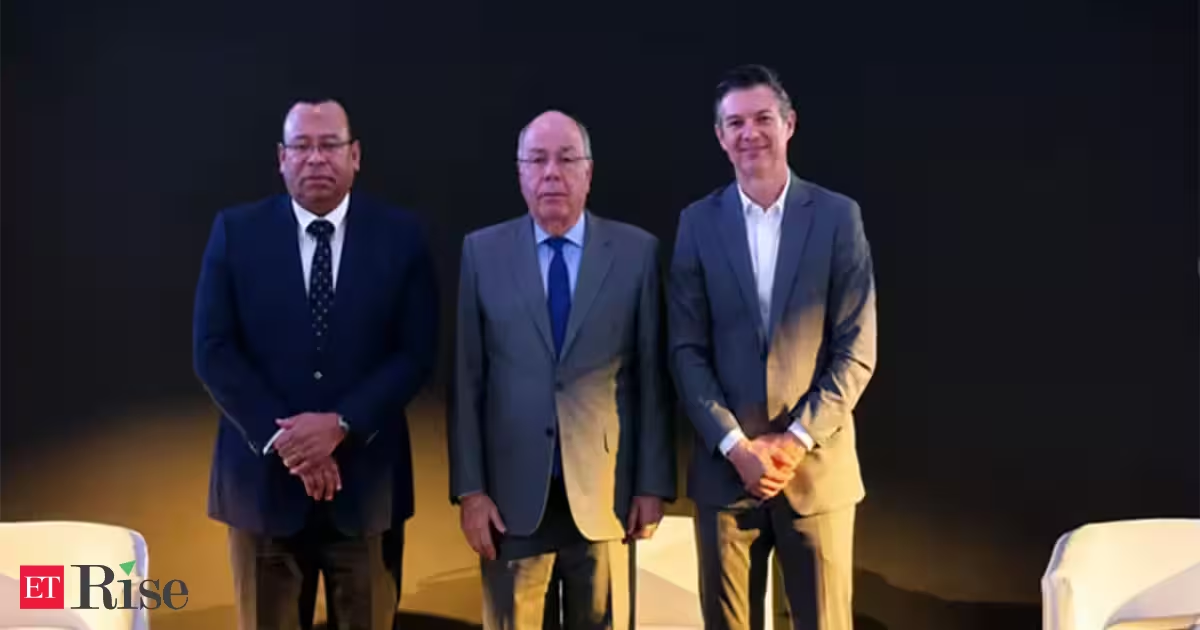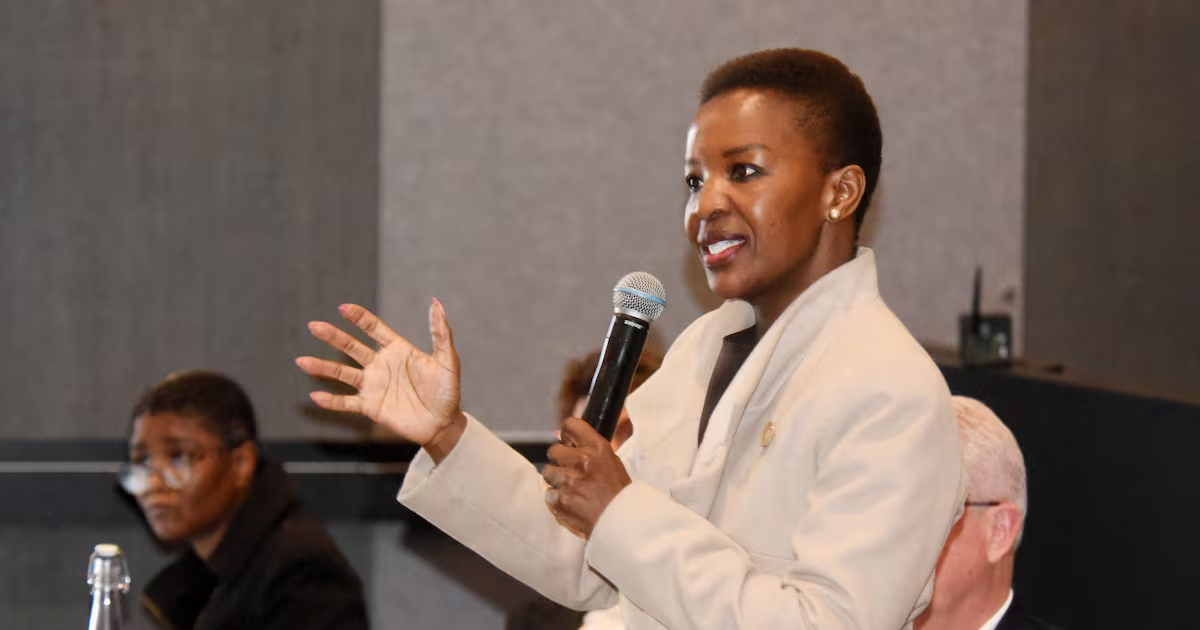
Busi Mavuso, chief executive of Business Leadership South Africa (BLSA), which represents the interests of big business, has criticised the “strategic partnership” aimed at deepening economic ties between South Africa and Brazil, saying Brazil is likely to benefit more from the deal than South Africa.In his opening remarks during the eighth session of the South Africa–Brazil Joint Commission last Wednesday, international relations and cooperation minister Ronald Lamola noted the commission was meeting a few months after President Cyril Ramaphosa’s state visit to Brazil in March, “when we reaffirmed the strength of the friendship between our countries and gave renewed impetus to our strategic partnership. “Our joint commission last met in Brasília in April 2024. This eighth session gives us an opportunity to take stock of what we have achieved since then and to determine where our relationship should go next,” Lamola said.However, in her weekly newsletter on Monday, Mavuso said because the partnership was led by the department of international relations and cooperation (Dirco) and not the department of trade, industry and competition, it suggested “it is politics rather than economics that leads”. She noted that South Africa runs a R22bn trade deficit with Brazil, and free trade would likely worsen it.Brazil is South Africa’s largest trading partner in Latin America and the country’s second-largest partner in the Americas. In 2025 trade between the two countries amounted to about $2bn. South African companies have established a presence in Brazil across pharmaceuticals, technology, mining, financial services and chemicals, while Brazilian companies are investing in South Africa’s automotive and food-manufacturing sectors. In general, we should want free trade with countries that have quite different economies to our own— Busi Mavuso, BLSA chief executiveMavuso said the country needed a serious trade strategy built on analysis of “where we can actually compete, not on the optics of summits. Brazil is a case study in why getting this wrong might be costly. “International trade is important in our economic growth outlook — we need our goods to be able to reach diverse markets where they can be competitive. The work we are doing to improve the performance of our logistics system is one part of the competitiveness equation. “Being able to get our goods onto ships at low cost makes us more competitive, but that must be complemented by a trade strategy that strikes agreements with suitable markets to remove trade barriers. Without that, markets are closed to us even if we get everything right in our domestic supply chain.“A trade strategy must focus on markets that offer the right balance — a good market for our goods, without a reciprocal flooding of our market with their goods. Before we rush into a new trade agreement, we must assess the net effect on our economy. South Africa runs a significant trade deficit with Brazil. In 2025 we exported R5.2bn-worth to Brazil, but we imported R27.3bn-worth. Currently trade is governed by the SACU-Mercosur Preferential Trade Agreement (PTA), which provides tariff relief on specified products, but many goods fall outside the preference rules.” The two countries’ economies had significant overlaps, Mavuso said. “We both have sizeable automotive, mining, agro-processing, renewable energy, chemicals and pharmaceuticals industries. The risk we face is that Brazil is a much larger producer of several sensitive goods, particularly poultry, sugar and certain manufactured goods such as vehicles. “A free trade agreement would remove barriers to those goods flooding our market, threatening domestic production. Poultry is one area that has historically garnered headlines, with cheap chicken imports from Brazil severely affecting local production. Sugar production is also highly sensitive to cheap imports.” The current trade deficit indicated that Brazil would likely benefit more than SA would from free trade between the two countries, “assuming both sides increase trade in proportion to the existing ratios. SA’s trade agreement portfolio is one of the thinnest for an economy of our size. Fixing that is not complicated — it requires effort by both government and business and a clear methodology for assessing where we can compete— Busi Mavuso“In general, we should want free trade with countries that have quite different economies to our own. For example, many of the countries in the Middle East do not have our manufacturing base and need goods like our agricultural exports. We tend to import oil and other petrochemicals, which we don’t produce much of domestically.” South Africa’s existing economic partnership agreement with the UK is an example of a positive trade agreement, “we imported R117.8bn from the UK but exported R179.1bn, a healthy trade surplus of R61.3bn. “That agreement is not symmetric. SA enjoys preferential access to the UK market but is not required to reciprocate in the short run. This allows SA to protect sensitive domestic industries within the framework of the agreement,” Mavuso said. SA’s list of free trade agreements is currently rather short, she said. “We actually have a poor set of free trade agreements. There are none with key markets like China, India, Japan, Korea or blocs like the Association of South East Asian Nations (Asean). Japan in particular is worth examining. “It is one of four regions along with Europe, the US, and Southern Africa with which we consistently enjoy healthy surpluses, suggesting competitiveness and scope for leveraging existing strengths, relationships and investment.” Mavuso said trade deals could be hugely beneficial. The economic partnership agreement “we have with the European Union is a good example of how trade can spur growth. But there are so many more we could be striking if we had a coherent policy and strategy, founded on a clear logic and analysis of what is actually in our economic interests. “SA’s trade agreement portfolio is one of the thinnest for an economy of our size. Fixing that is not complicated — it requires effort by both government and business and a clear methodology for assessing where we can compete. BLSA has offered to support the building out of a trade strategy, and that offer stands. Our exporters deserve more than announcements of intended deals, dressed up as progress, while the underlying work hasn’t been done.” Business Day
SA-Brazil trade pact favours Brazil, BLSA chief Busi Mavuso warns
Busi Mavuso, chief executive of Business Leadership SA, has criticised the “strategic partnership” aimed at deepening economic ties between South Africa and Brazil, saying Brazil is likely to benefit more from the deal than South Africa
1,016 words~5 min read