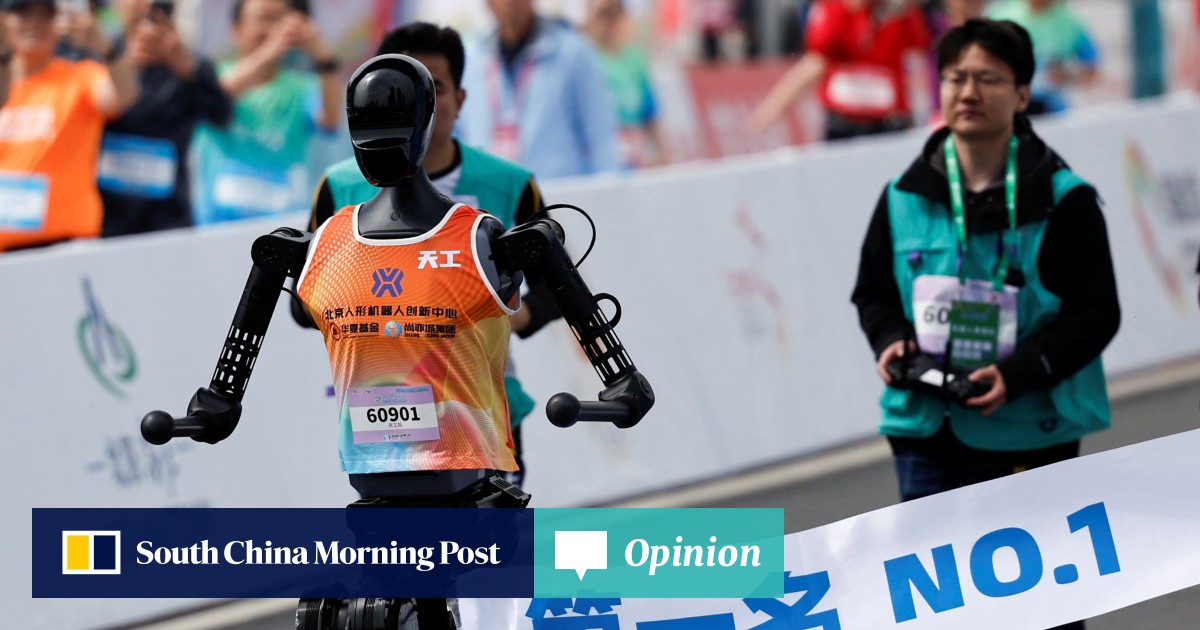
Authored by J.T. Young via Substack,Ceding leadership in AI to China's Chinese Communist Party (CCP), what could go wrong?Just about everything. Yet that is precisely what some here in the U.S.-and all in Beijing-want to occur.America is currently being swept by misguided attempts to curtail AI's development and the development of the data centers on which AI's development will depend. Some of these stem from legitimate concerns (though often inaccurate) about what AI can and will do. Some stem from concerns about what data center development will mean for their communities. [The answer is jobs, investment, and growth-something that West Virginia's governor Pat Morrisey and statehouse leaders presciently see as they pitch their state for just such responsible development.]However, some of this opposition also stems from foreign influence from those who would love nothing more than to see America not be the leader in a technology that has the potential to define this century's development and beyond.The history of mankind's development could be shorthanded into a history of mankind's harnessing of energy. This history began with humanity's use of its own muscle power. It moved from our muscle power to harnessing (literally) the muscle power of animals. This power was supplanted by the power of the elements-wind (with sails, mills, etc.) and water (mills, dams, and more). Then there was steam. Then the internal combustion engine. Electricity. Nuclear. And yes, renewable forms as well.We shifted back and forth between these as refinements were made to their production and application; however, they largely served first to supplement, and soon to supplant, our muscle power. Certainly, there were enhancements to our "mental energy" too, writing and the printing press, for example; however, it was not until relatively recently (in the 1940s) that the "mental energy" revolution exploded with the advent of the computer.AI is different, and in that difference lies its potentially revolutionary aspect. AI offers the power to supplement our mental power far beyond what the computer can. Our mental power is the distinguishing feature of the human species, which underscores just what AI could do for humanity.This brings us back to those who want to curtail America's leadership in this vast potential. Clearly, China's CCP is at the forefront of those who would like to see America not have this leadership. Even more, it is clearly at the forefront of those seeking to prevent American leadership in AI.China's efforts to slow America's AI development are many. Undoubtedly, the CCP will find more ways, and more examples will come to light.All this leads to the question: If America does not lead in AI, who will? China's answer is already clear. Even more important, then, is the question: What would China's leadership in AI entail? We can largely answer that question based on past and present experiences.The virtual monopoly the West gave to China in rare earth mining, production, and manufacturing of products heavily dependent on these minerals has not served us well. It has given the CCP leverage in many instances. It has undoubtedly increased the price volatility of rare earth-dependent products, which has also encumbered the adoption of such products. It has also shifted these rare earth activities to a country with lower environmental standards (one even more pronounced in the past, when the West gave China its rare earth monopoly).China's laxer oversight standards have had global repercussions beyond the environment. COVID's origin from China's Wuhan Institute of Virology is increasingly accepted; concerns about its safety and management standards were known years before COVID. At the very least, China's delayed revelation of important information about COVID allowed the virus to spread. The escape of an earlier SARS virus in 2004 is also widely known.None of these argue for security when it comes to AI oversight in China. How then could China be trusted in the development of a technology that is widely predicted to potentially be the world's most powerful?There should be even less confidence in the CCP's deployment of AI. China regularly targets its adversaries (both at home and abroad) with every tool available-and increasingly with AI-making its citizens among the most surveilled in the world. There are growing reports of China's funding of U.S. protests. China's Belt and Road Initiative uses investment to gain influence and build dependency across the globe-particularly in developing nations.China's direct aggression has been increasingly on display for years. There are its recurrent border conflicts with India. There is the building of island bases in waters near the Philippines (and other areas in the Pacific for years) and confrontations with that government. There has been the abrogation of its deal with Hong Kong for recognized rights, and its jailing of political opponents there. There have been continual threats of aggression against Taiwan; bellicose warnings have also been issued against Japan.The CCP's internal repression is even greater than its external actions. Its recently passed "Ethnic Unity" law builds on past charges of genocidal practices against the Uyghurs and Tibetans. Internal surveillance, already severe, has only been enhanced by the CCP's use of AI.If the CCP uses a myriad of ways to confront foreign governments and intrusive means against its own citizens at home and abroad, there is no reasonable expectation that it would not use AI against foreign nations and their citizens too.The CCP desires AI supremacy, just as they have been allowed to have it in rare earth minerals. They are working to secure this for the obvious reason that AI has the potential to be far more valuable than rare earth minerals.And because the West was shortsighted enough to cede China leadership in rare earth minerals, the CCP has some reasonable expectation of success in its AI efforts. That the West is so willing to allow its own culture and values to undergo assault from within (in contrast to the CCP's enforcement of its cultural hegemony internally with its new ethnic unity law) is just another signal to Beijing that the West is unwilling to defend its interests.How fast China is progressing in the 21st century's technology race is evidenced by its leadership in the development of humanoid robotics and other areas. So, the threat is not only real; it is already here.To recap, China's already using AI for surveillance internally and externally. China's oversight of its science has proven inadequate in medical research, just as its oversight of the environment has been. Yet some, such as Senator Bernie Sanders (I-VT), would not only have us ignore these warning signs, but dramatically exacerbate their potential for danger with AI by curtailing its development and de facto ceding AI leadership to China.The history of energy has written the history of human development. This history of energy was largely one of supplementing muscle energy. The new revolutionary energy is not physical energy but mental energy. It is AI, and it will supplement humanity's mental energy. Beyond the question of what AI can do is who will control it?We all recognize that AI will be overseen; such oversight is a hallmark of the U.S. However, doing so to the extent that it curtails AI development and renounces leadership in a technology of unprecedented power to the world's least accountable government is extremely naive. Doing so to a government that has demonstrated, and continues to demonstrate, that it will use all the means at its disposal to the detriment of those it perceives to be adversaries would be the biggest mistake in history-with potentially the most powerful technology in history.J.T. Young is the author of the recent book, Unprecedented Assault: How Big Government Unleashed America's Socialist Left from RealClear Publishing. Follow him on Substack.
AI's China Syndrome: Who Will Control The World's Newest Energy?
AI may become the world’s newest form of power. The question is who controls it.
1,267 words~6 min read