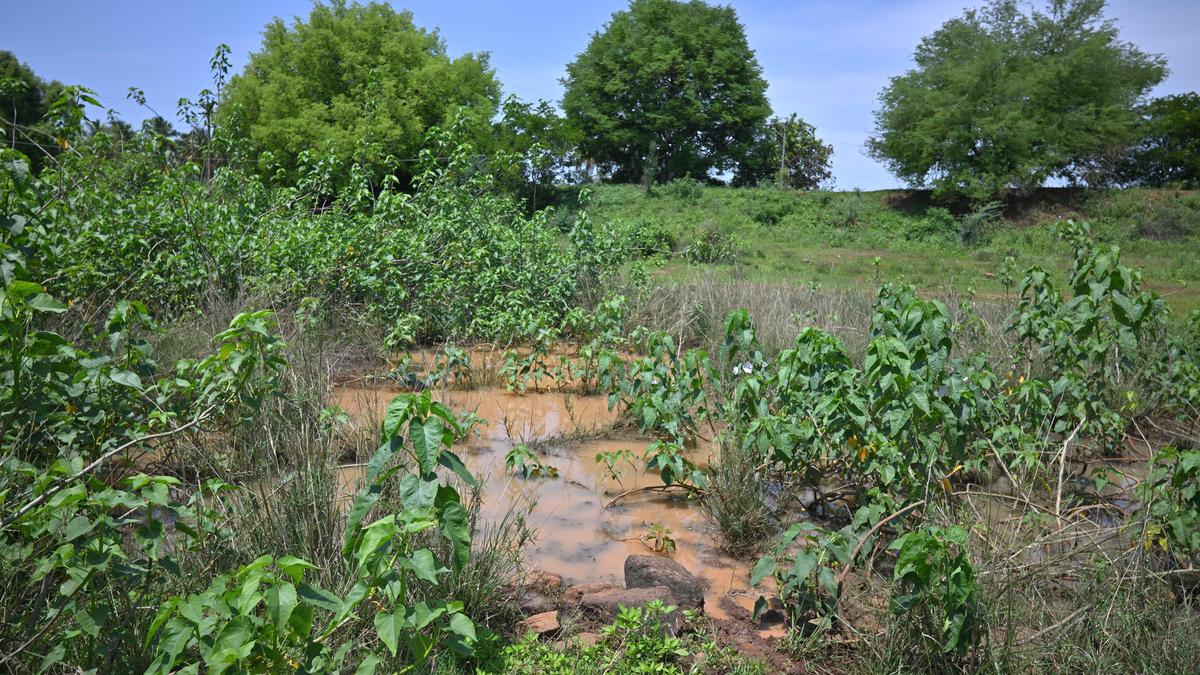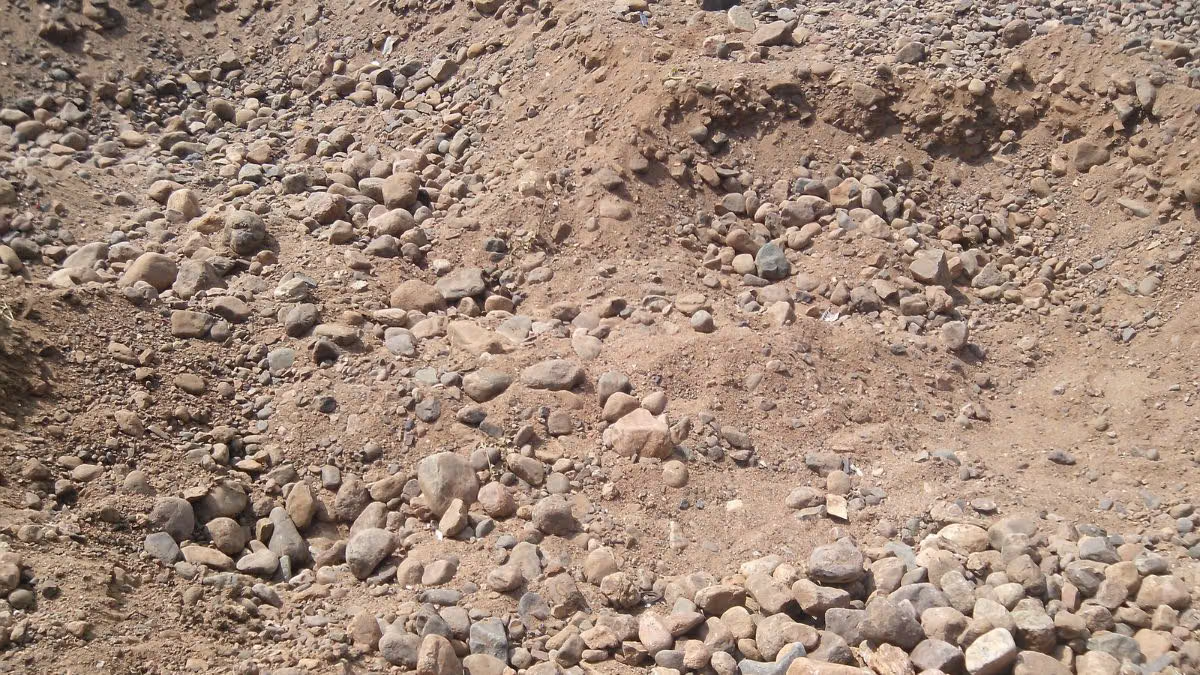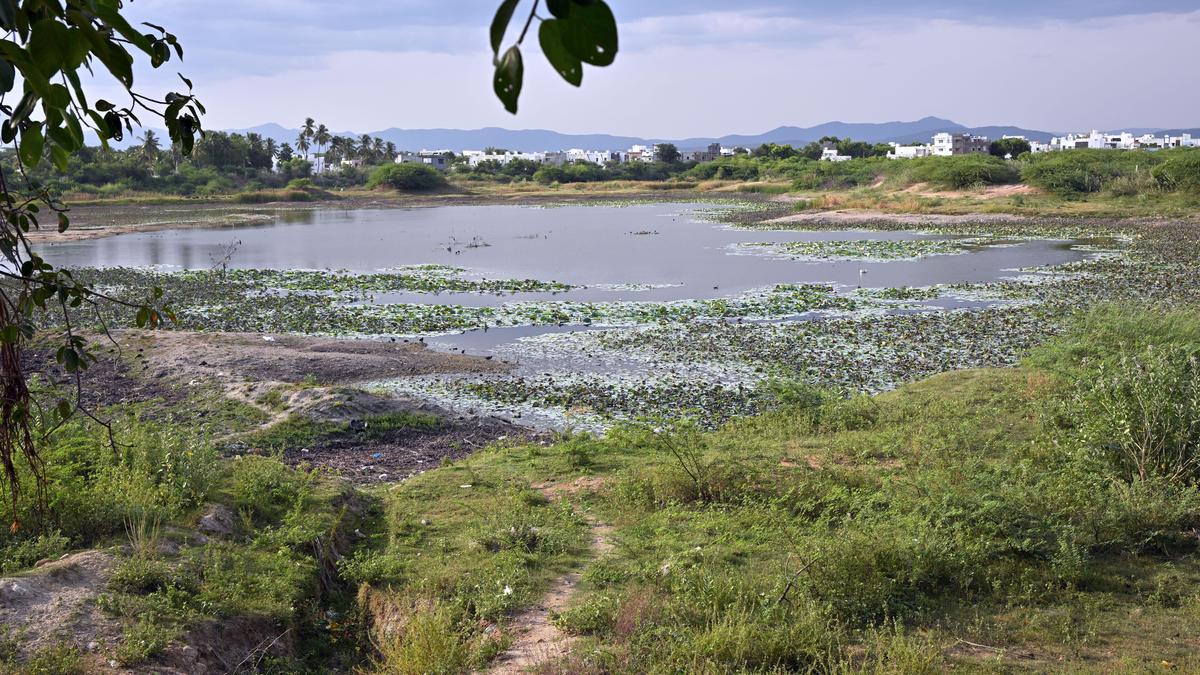
A kanmai in Ramanathapuram district.
| Photo Credit:
L. BALACHANDAR
Tamil Nadu’s waterbodies are facing a silent crisis.While the State government legally permits the controlled extraction of alluvial soil, and silt for agricultural and household use, this well-meaning policy is being misused by commercial syndicates.What is meant to help farmers nourish their fields has turned into a lucrative underground economy, leaving behind ruined lakes, dry wells, and devastated ecosystems.At the heart of the issue is rampant over-excavation. Government guidelines strictly limit extraction to a shallow depth of one to three metres to preserve the natural integrity of waterbodies.Yet, commercial operators routinely deploy heavy machinery like cranes under the cover of night. They dig deep trenches ranging from 10 to 40 feet, transforming once-shallow lakebeds and traditional water storage tanks into deep, useless craters.Instead of holding monsoon rains for farming and groundwater recharge, these scarred basins simply swallow what little water enters them.“This destruction is frequently fuelled by the misuse of welfare schemes designed to protect rural livelihoods. Special permits intended to allow local farmers or potters to take free silt to enrich their fields are being heavily exploited,” said M. Malaichamy, secretary, Southern Tamil Nadu Farmers Association.Anti-social elements and commercial cartels fraudulently obtain these permits or use them as a flimsy legal cover, he added.Under the guise of agricultural welfare, massive quantities of soil are mined and sold off to the highest bidder.Once extracted, this soil is routinely diverted away from farms. Material legally authorised for agricultural enrichment ends up being sold illegally to fuel the construction sector, he noted.Further, he alleged that it was dumped into private real estate projects to fill low-lying land, fed into brick kilns, or used in commercial road-laying operations, generating massive profits for illegal operators at the cost of the public good.“How can we expect district administrations to protect waterbodies from cartels when they are being rewarded for issuing more extraction permits?” Mr. Malaichamy asked.Transporting the stolen soil requires bypassing the law entirely.The movement of unregistered trucks in night convoys is common. Operators routinely bypass mandatory transit passes or resort to a simple trick: running dozens of truckloads using just a single genuine pass over and over again, said Kallanai, a farmer in Melur, Madurai district.This systematic evasion robs the State exchequer of revenue while keeping local enforcement on its toes.“Illegal extractions frequently bleed out of designated silt-deposition zones and spill directly into the deeper, core wet areas of lakes, village tanks, and river channels,” he added.Indiscriminate digging compromises the structural stability of earthen bunds, tears up underground drinking water pipelines laid across lakebeds, and drastically lowers local groundwater tables, he noted.For the surrounding rural communities, the human cost is severe. As the topography of these vital waterbodies is altered beyond recognition, nearby agricultural wells run dry, leaving farmers struggling to irrigate their crops, he stated.What began as a measure to desilt and rejuvenate Tamil Nadu’s water infrastructure is increasingly becoming a threat to its ecological survival, said a revenue official in Madurai district administration.While complaints have grown that Melur taluk is lagging in processing soil extraction permits, an official explained that past officials closely tied to commercial operators had abused their positions to allow over-extraction.Because this widespread abuse triggered court interventions and legal scrutiny, the official noted that current authorities are deliberately taking more time to carefully vet applications and avoid judicial fallout.Safeguarding these waterbodies demands rigorous enforcement, he added, stating that real-time tracking of transit passes and a zero-tolerance policy against commercial operators are essential to completely stop illegal sand mining.Madurai District Collector Nishant Krishna clarified that all permit applications and approvals are handled entirely online.Once a farmer or potter submits an application, it goes directly to the Village Administrative Officer (VAO) to verify the applicant’s land holdings and other details, he explained.The application is then forwarded to the tahsildar, who holds the authority to grant extraction permissions for waterbodies under their jurisdiction, Mr. Krishna stated.Because the entire workflow is systematic and streamlined, the potential for illegal extraction is minimal, he noted.