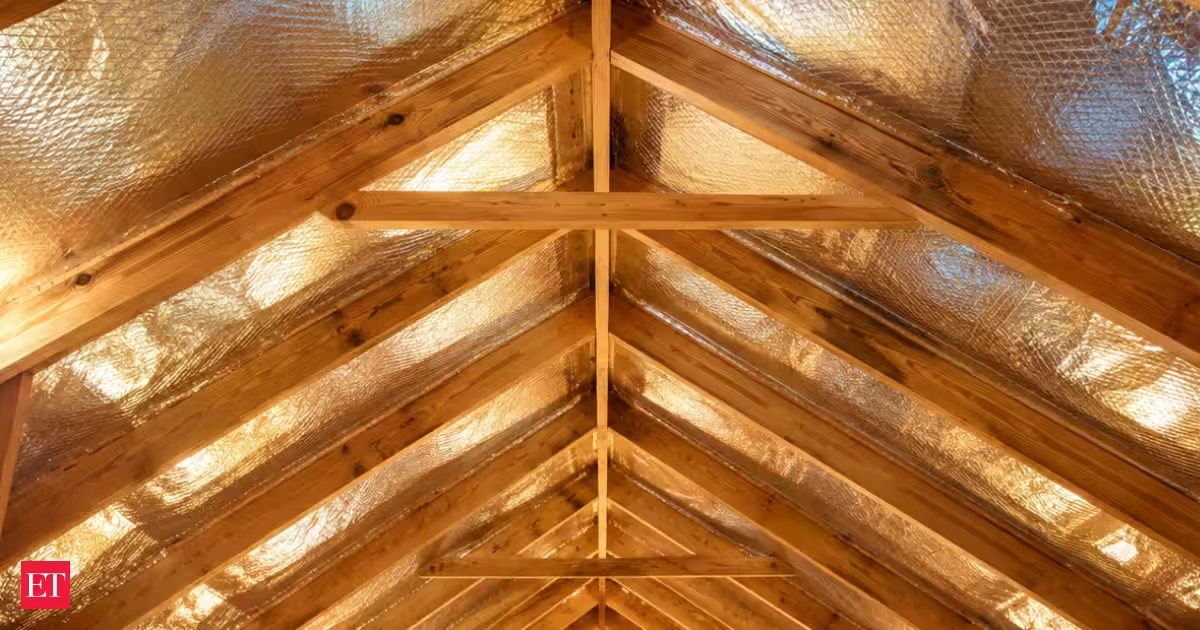
Air conditioning has long been one of the most expensive vices in America. It made up a great portion of residential energy consumption across the country, and researchers at the time warned that share would keep climbing as summers got hotter. In this light, a cheap technology that is capable of cooling a closed room without consuming any power whatsoever seems like a remarkable discovery worthy of investigation. Back in 2019, a University at Buffalo research article titled “Electricity-free tech could help cool buildings in metro areas,” highlights the efforts of a team under the leadership of electrical engineering professor Qiaoqiang Gan, as they managed to create a cheap film using an aluminum foil with a transparent coating of polymer which was able to cool the enclosed box by 11°F during daytime and 20°F at night.How does aluminum foil actually cool anything?The trick lies not in the aluminum itself but in the polymer coat on it. The latter, which is polydimethylsiloxane, also referred to as PDMS, is the material mostly used in making lenses and cooking tools. On the surface of aluminum, it turns into a “thermal emitter." While the metal reflects sunlight to avoid getting heated, PDMS absorbs all the heat from the environment and radiates it upwards through the atmosphere straight into space. It is the so-called passive radiative cooling process, a scientific concept that is not quite new.Close-up view of an aluminium foil. Image credits: Wikimedia CommonsIt is the same principle that makes clear nights colder than cloudy ones. As stated in a 2019 peer-reviewed article, titled “A polydimethylsiloxane-coated metal structure for all-day radiative cooling,” published in Nature Sustainability, what made this specific version of the technology distinctive was the "solar shelter" built by the research team around the film in the form of reflective, angular walls resembling an inverted car headlight, blocking sunlight coming from above and at the same time directing its emitted heat energy towards the sky. This is what helped to achieve daytime cooling, as it is the more difficult task compared to nighttime tests.Why this matters and the part worth pondering onThe reality is that the United States does have a problem with overheating in the majority of the cities, and this problem has been scientifically documented. The Environmental Protection Agency reports that urban environments in the country tend to be 1 to 7 degrees warmer during the day and up to 5 degrees warmer during the evening than nearby rural environments, largely because concrete, asphalt, and other dense building materials absorb and store solar heat during the day and then release it slowly back into the surrounding air after dark, rather than reflecting it away the way a lighter, more open landscape would. This phenomenon is known as the urban heat island effect, and it's one of the key factors that make your apartment downtown feel more like an oven than the place where your cousin might live in the suburbs.A hot summer day. Image credits: Wikimedia CommonsEven at the time, though, this was only a small-scale prototype, the tested item was just a foot-and-a-half high. Turning such an apparatus into one that would cover real buildings, maintain its polymer skin under years of weather, pollutants, and UV light, and be cheap enough for common people to afford it, as compared to an approximately $200 window air conditioner, is completely different engineering challenges, and the 2019 study doesn't seem to have addressed any of them. There is also no sign this particular film has been implemented commercially since then. The physics behind it was real and the lab numbers held up, but the technology itself was always a proof-of-concept, not a finished product; "aluminum foil could replace your air conditioner" was never a claim the researchers made. It's an exaggeration that crept in only afterward.The bigger pictureThe bottom line about this research is that it is only a concept; a reminder that what could be the most practical climate adaptation strategies may well turn out to be not new technology but rather something far more familiar in the world of materials science. For a time that is currently receiving not only high summer temperatures but also high utility bills, it is a gamble worth taking.
In 2019, Buffalo scientists coated aluminum film with a cooling polymer; a small prototype cooled an enclosed box by 11°F by day and 20°F at night
Discover how a novel aluminum film with a polymer coating can potentially revolutionize cooling technologies, offering a significant temperature drop without electrical energy consumption, addressing urban heat problems.
704 words~3 min read