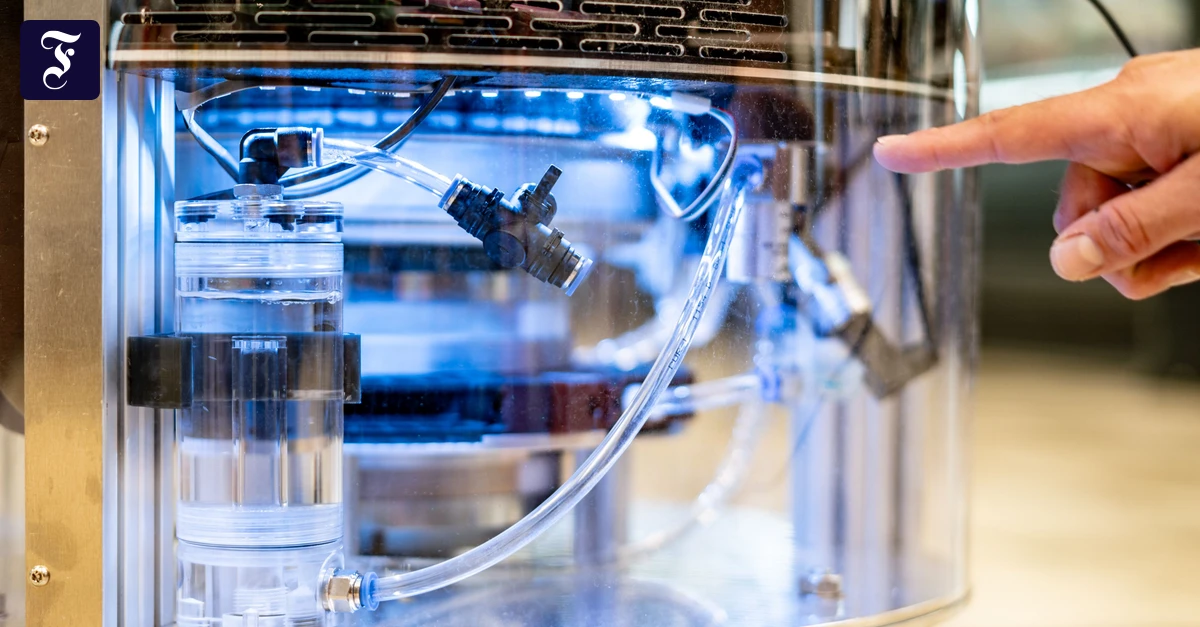
The new cooling system combines two nickel-titanium foils: a heat-responsive foil generates motion, which a second foil uses to produce cooling. Credit Yi-Ting Hsiau and Jingyuan Xu, KIT; visual design by Ella Maru Studio
Refrigerators, air-conditioning systems and data centers consume enormous amounts of electricity, and cooling demand is constantly rising. A research team from the Karlsruhe Institute of Technology (KIT) and the University of Tsukuba in Japan is presenting a new approach demonstrated by a prototype in which heat assumes the role formerly played by an electric motor.
Two ultra-thin shape-memory films interact to convert thermal energy into mechanical work and, ultimately, measurable cooling. Their work opens new possibilities for using waste heat and solar energy for solid-state cooling. The results have been published in Nature Energy.
The basic cooling principle for refrigerators, air-conditioning systems and data centers has been the same for more than 100 years. An electricity-driven compressor transfers heat carried by a refrigerant from one location to another. As cooling demand rises, cooling and heating account for nearly half of global energy consumption. This is aggravated by the fact that many common refrigerants contribute to global warming.