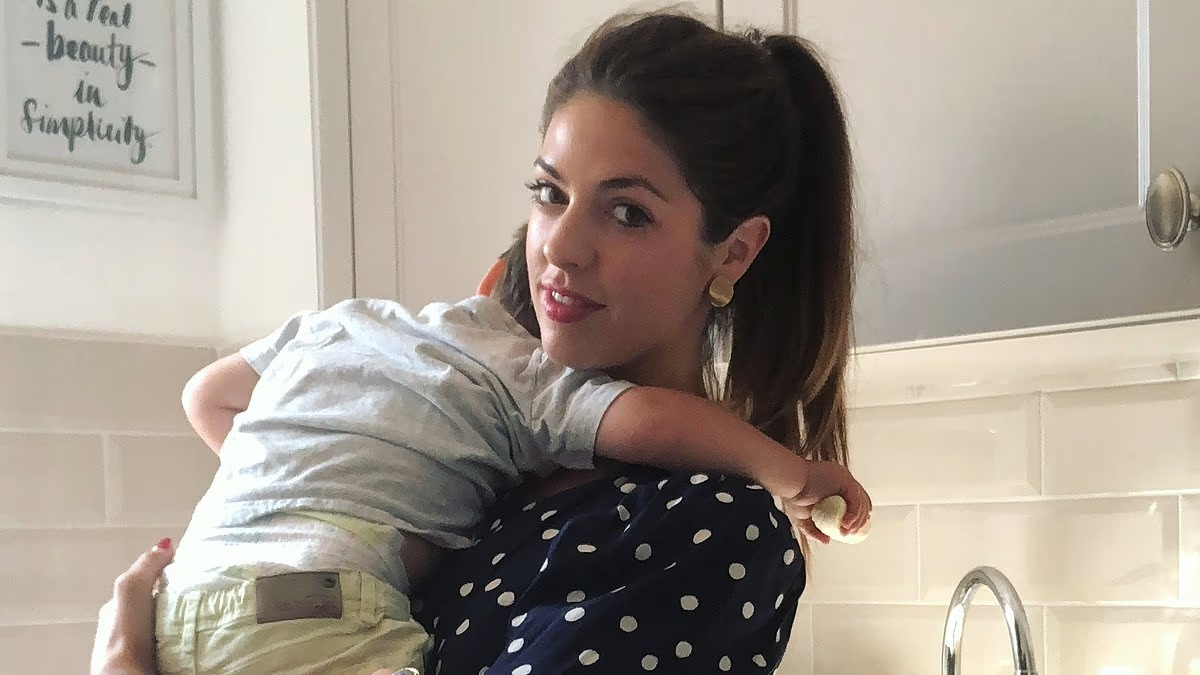
The moment I knew I needed help remains absolutely crystalline in my memory.My son, then two, was in his bedroom, screaming and thrashing around in his cot.I, though, was across the hall, sitting frozen on my bed, while the tears rolled down my cheeks.He had been up since 6am – yet nine hours later was once more refusing to take his nap.I was watching to make sure he was physically safe, but I was in total despair. I had nothing left in the tank to try to calm him.When he eventually cried himself to sleep, I lay back on my bed, weeping. Why was I so bad at motherhood?The routines, the emotional intensity of it all, the endless juggling and organisation – at that moment, it all seemed overwhelming.Other women I knew enjoyed motherhood in a way I just didn’t. Some had three or four children, and were so calm and composed. I felt like my hair was on fire.So desperate was I that, then and there, I got my laptop out, found a private psychiatrist and asked to go on their waiting list.When I eventually reached the top of that waiting list, they said the cause of my problems was ADHD. I was 33 years old.Other women I knew enjoyed motherhood in a way I just didn’t. Some had three or four children and were so calm and composed. I felt like my hair was on fire, writes Liz LewisWhile there has been much talk of how we parent children with ADHD, there is distinctly less about how women with the same condition cope when they become mothers.In short – how does it affect mother and child when the mother is the one with ADHD? And does becoming a mother in itself exacerbate ADHD symptoms?Today, 14 years later, I’m an ADHD consultant and advocate – and have met with thousands of women who are struggling with their ADHD.In women, ADHD is commonly characterised by disorganisation, a chronic inability to focus, time blindness, emotional dysregulation (meaning you can respond excessively to tricky situations) and mental fatigue. There is also, somewhat contrarily, a tendency for people with ADHD to hyperfocus on a pleasing task, losing all sense of other responsibilities. Women are less likely to have the hyperactivity element of ADHD, which is more often displayed by men.All in all, there aren’t many characteristics here which equate to the societal ideal of the capable, multitasking mother.Perhaps it’s unsurprising, then, that I’m certainly not the only woman to find that her ADHD made mothering an almost impossible task. A Danish study, reported in the Journal of Attention Disorders earlier this year, examined 363,904 mothers between 2010 and 2018 and found that ADHD diagnoses increased postpartum to above pre-pregnancy levels – with peak rates observed between two and five years after childbirth.In other words, the mask which so many undiagnosed ADHD women adopt to cope with daily life slipped, under the pressure of motherhood.This fits with my experience – as does one of the other findings from the study. Rates of ADHD diagnoses reduced significantly during pregnancy itself – roughly 72 per cent lower than they were in the pre-pregnancy period.Part of the reason behind this could be to do with how ADHD is linked to levels of oestrogen, the female sex hormone, and dopamine, colloquially known as our happy hormone, and strongly linked to our anticipation of reward.A 2024 review published in Frontiers in Psychiatry suggests that dopamine signalling is disrupted in the ADHD brain. This helps explain why those with the condition can be impulsive or struggle to focus because their brain is constantly seeking ‘rewards’ from daily activities. Grinding organisational activities like making sure the laundry is done, or you have enough nappies, are not activities that provide that dopamine ‘hit’.Oestrogen, meanwhile, indirectly regulates dopamine by increasing our dopamine receptors’ sensitivity and improving how it travels around the body.This means oestrogen plays a vital role in how ADHD shows itself in women.And so at moments when oestrogen is high – like in pregnancy or at certain points of our menstrual cycle – some find their ADHD symptoms are, for want of a better word, tamed. And when oestrogen dips, as it does after giving birth – by around 90 per cent in the first 48 hours after labour – symptoms generally rear back up, just when one is feeling at one’s lowest.Looking back, I can see the difficulties ADHD caused me in my late teens and early twenties. I felt I had to work twice as hard as my peers to appear ‘normal’ and competent. Sure, I developed strategies that helped me to get to work on time and pay bills. I knew how to socialise at parties. But I also lived in fear that if anyone at work or in my social circle got a glimpse of the real me, the messy me, everything would fall apart. That intense anxiety has remained with me.In the end, my son was born by emergency C-section, and I was put on the operating table with my arms strapped down out to my sides – sort of crucifixion style, which did not allay my increasing anxiety, says LizWhile there has been much talk of how we parent children with ADHD, there is distinctly less about how women with the same condition cope when they become mothersI became pregnant in 2009. And looking back, I felt that my higher oestrogen levels in pregnancy – oestrogen levels can rise 1,000-fold when carrying a child, reported the journal Molecular and Cellular Probes in 2024 – helped my then untreated ADHD. My brain was less foggy, and I made all of my many appointments bang on time. There was a clarity that wasn’t there before.That said, one issue which arose during my pregnancy was linked to heightened sensory awareness, which is associated with ADHD.This is not good news for the sensory overload that is pregnancy. Being poked and prodded at, blood tests, listening for the heartbeat during scans… and that’s before you even get to the birth itself.Having your cervix checked is both invasive and painful for someone with sensory issues – and as I never fully dilated, there was a lot of cervix checking. I felt stressed every time I had a medical appointment.In the end, my son was born by emergency C-section, and I was put on the operating table with my arms strapped down out to my sides – sort of crucifixion style, which did not allay my increasing anxiety. When they took my baby away for checks, I felt intensely dizzy and nauseated – something the doctors said was a panic attack. If I ever have to have surgery again, I will ask to be put under completely.Though it wasn’t common when I gave birth, I now tell ADHD women to consider hiring a doula to ease the transition. No matter how well you prepare, the shift from pregnancy to new motherhood is overwhelming, especially if you have ADHD.This shift contributes to ADHD women being five times more likely to have some form of postpartum depression, as found by Swedish researchers in 2023. I believe even more postpartum ADHD women will have intense anxiety like I did.Part of this is linked to the natural plummeting of oestrogen after giving birth.This has a significant impact on dopamine levels for even neurotypical women, never mind someone with ADHD.The fact a maternal brain goes through a profound rewiring process to prepare you for the intense demands of caregiving is also significant. In a way, motherhood and this rewiring is the best brain training an ADHD woman will ever have – there is no greater stimulus to act, and not dither, than a crying baby.But simultaneously, as my experience shows, neurodiverse minds struggle with change and transition. And there are few bigger transitions than that of motherhood.Certainly, I was overwhelmed. When my son slept, it was for an hour at a time. He nursed constantly. I worried he would die in his sleep, and when he screamed I worried he would stop breathing and cry himself to death.It was around this time I sought help from the psychiatrist.While having my ADHD confirmed in 2014 helped to a degree – as did the medication I was prescribed – certain elements of motherhood remained tricky. Things like remembering sports kits for school, remembering to pay for school trips and permission slips, all seemed beyond me. On more than one occasion I forgot to attend parent-teacher meetings. Today, now my son’s almost 16, I have forgotten days he has early dismissal, and he’s been locked out of the house several times.Most of the mothers I counsel who have ADHD describe similar issues to mine – but the most common is the sense of failing at what society expects a mother to be like. I felt mothering was my personal charge, and even told my husband to go back to work two days after I gave birth.Now, aged 47, I see how unhelpful that pressure to ‘do it all’ is. Because without support, no mother will fare well, least of all one with ADHD.You are Not the Problem: Late Diagnosed ADHD women and the Invisible Forces that Shape Us, by Liz Lewis, published by Jessica Kingsley, is out now.
I broke down thinking I'd failed as a mother, but it was actually ADHD
The moment I knew I needed help remains clear in my memory. My son was screaming and thrashing around in his cot. I was frozen on my bed, while tears rolled down my cheeks.
1,548 words~7 min read