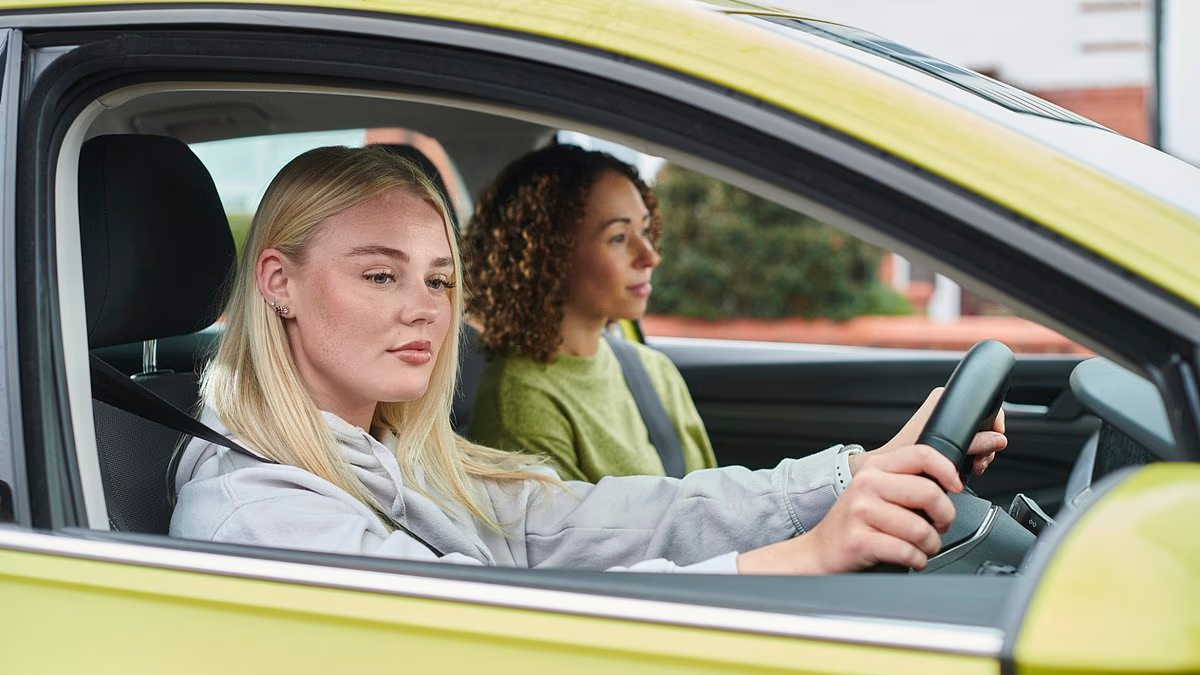
There was once a time when it was enough to give your child money for the bus or tell them to get on their bike. These days, expectations are a little higher. Even before they leave school, young adults are looking to get behind the wheel.If you’re a parent, that means you are likely to be on the hook for at least some of what will inevitably be a sizeable bill.To start with, a prospective driver must pass the theory test – which costs €45 and can be taken at one of 40 testing centres around the State. There can be backlogs so travelling a little may help get a quicker appointment.Many people swear by the official online app, which offers mock theory exams, but there are other free resources available online.If you fail the test, you will, alas, have to pay the €45 fee again. And whatever you do – don’t try to sneak in a mobile phone or earphones, as you won’t be allowed to continue.With the theory test passed, the next step is the relatively straightforward process of applying for a learner permit.This is done through the National Driver Licence Service and will set you back another €45. Eyesight or health issues may require extra supporting material.Now, it’s time to get behind the wheel and the first big cost: driving lessons.It is mandatory to do at least 12 but that’s the bare minimum and it will not be enough for every learner driver.Driving lessons will cost you between €50 and €60 per hour in Dublin but you could pay a little less in other parts of the State. It’s worth doing a bit of research here as not all driving teachers are created equal and the cheapest option isn’t always the best.Every year, the Road Safety Authority (RSA) receives dozens of complaints from learners unhappy with their experiences. Word-of-mouth recommendations from family, friends or neighbours might well be the best way of narrowing down the field of options, though someone’s “great” instructor may not always be the right choice for your child. A block of 12 lessons with two of the State’s largest driving schools costs between €540 and €590 at the moment. Higher rates will apply for an automatic car, with the fee jumping from €587.95 to €659.24 with one provider.Twelve lessons are rarely enough to train a fully competent driver so you should probably budget for more than a single block. And even that may not be enough for the learner who kangaroo jumps the car every time they try to change gears.That makes it difficult to budget for instructor costs: the only thing certain is that they will be significant. They will also likely be commandeering the family car on occasions for practice.When your offspring is finally ready to take their test, we run into yet another bill. This time, it’s €85 as you book the test directly through the RSA website.You will, no doubt, have seen the headlines lamenting the often-lengthy waits for a test, especially in high-demand areas. The RSA does offer an online estimator tool and sets a target of 10 weeks. The latest figures showing that four centres were below that. Raheny in Dublin had by far the longest waiting list when the data was published in June, at 25 weeks.Acing the test is not guaranteed, of course. The average pass rate is about 55 per cent, though rates do vary significantly between test centres.Once you pass the test, getting your licence is another cost to factor in: €65 for a standard 10-year licence.InsuranceAlongside all this is the really expensive element of the process – insurance. Your child will need to be insured before they ever step into a car – yours or the instructor’s. There are a couple of options here. You can add your son or daughter to your own motor policy or help them to buy and insure a small car in their own name. Neither is particularly cheap.The cost of adding your child as a named driver to an existing policy could, according to estimates, be anything from several hundred euro to far higher figures, depending on circumstances.Being under the age of 25 carries an obvious price penalty, as will the engine size of the car. Generally, the more powerful the vehicle, the worse it will be for your pocket. The age of the car needs to be considered too, especially if it is an old banger or brand new out of the showroom.The more expensive option is helping them buy a car of their own. With that option comes the double whammy of the cost of purchase and an even higher insurance bill as they will be the main driver with a policy in their own name.There are cars on sale on Carzone for less than €1,000 but they will usually be old, have colossal mileage or quite possibly a chequered history.At a €5,000 price point however, there is ample choice: a 1.2-litre Fiat, a diesel Citroen with 194,000km on the clock, or a Honda Jazz from 2015.Let’s set aside the cost of motor tax (€120 to a couple of thousand euro), a potential NCT (€60), fuel and servicing, and focus just on insurance.A check on Chill.ie for a 2016 Renault Captur with a hypothetical value of €7,000 for a fully qualified 21-year-old offered quotes of between €2,278 and an eye-watering €5,155.If the driver was only a learner, the bill was higher. An annual quote for the same car with a learner permit ran from €2,480 to €5,588. You might argue that the young driver is getting little credit for having actually passed the test based on those numbers.Those figures are for comprehensive insurance. In the same quote exercise, opting for third-party, fire and theft cover reduced the premium by about 15 per cent.One advantage of being personally insured is that a careful young driver will start to build up a no-claims bonus and their premium will drop more quickly over time.Whatever way you look at it, whether it is you funding the exercise or the young person themselves, it’s an expensive business.Getting the driving lessons and licence will cost about €800 at a minimum, more likely well over €1,000 when the final bill is tallied. If you add the cost of a decent car and a sizeable annual insurance bill, the figure inches closer to €10,000.But with the housing squeeze forcing so many young adults to commute long distances to college or work because they are living at home with their parents, it may still prove cheaper than trying to find them affordable accommodation.You can contact us at OnTheMoney@irishtimes.com with personal finance questions you would like to see us address. If you missed last week’s newsletter, you can read it here.
The true cost of teaching your child to drive
On the Money: Insurance and driving lessons will likely cost well over €1,000 before considering ancillary costs or their own car
1,127 words~5 min read