China’s semiconductor profits soar 18.5‑fold in Jan‑July amid ‘AI‑driven computing demand, self‑reliance push’
Integrated circuit profit surge highlights AI-driven shift in China’s industrial growth: expert
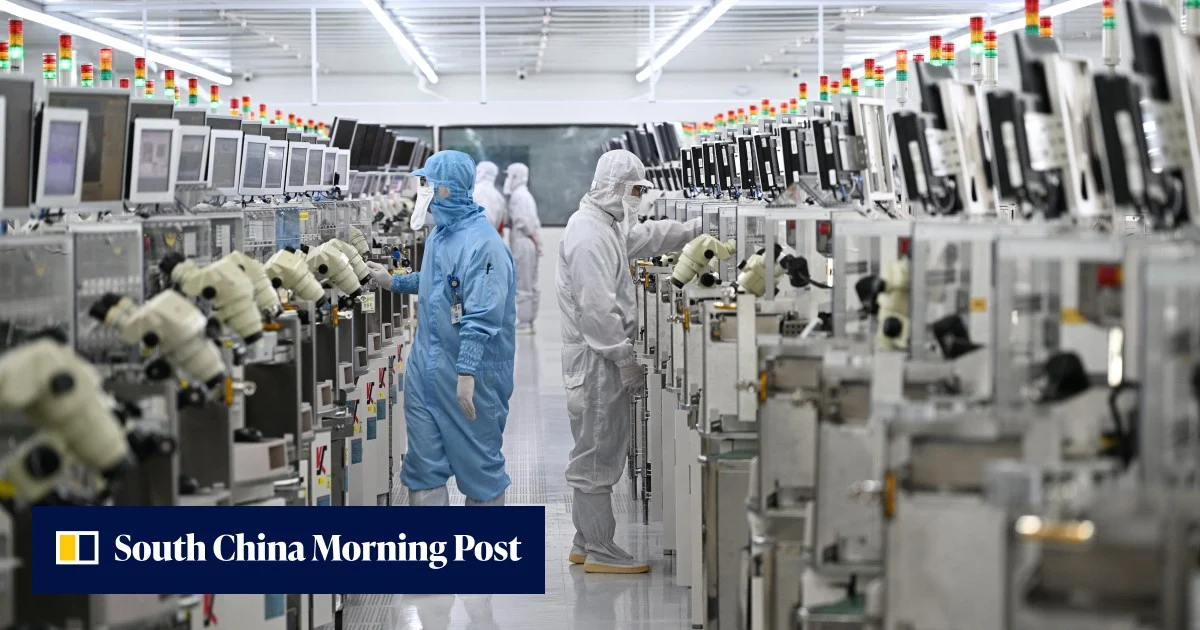
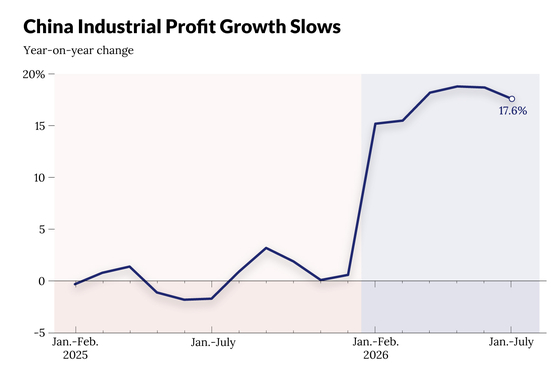
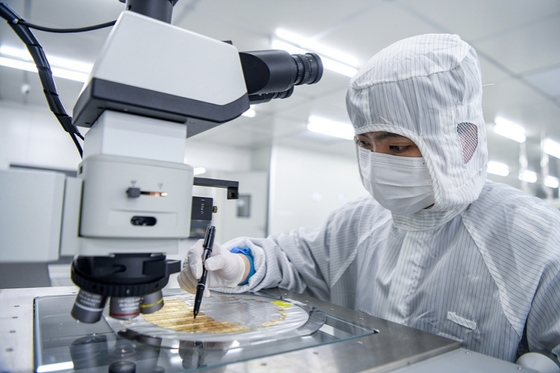
A technician conducts chip quality inspections in a factory in Yiwu, East China's Zhejiang Province, in March 2026. Photo: VCGProfits in China's integrated circuit industry surged 18.5-fold year-on-year in the first seven months of 2026, as the accelerated expansion of the "AI+" initiative and sustained growth in computing-power demand boosted demand for related products, pushing up prices and driving rapid profit growth in electronics industries linked to AI production and applications.The surge offers a glimpse of a broader shift under way in China's industrial economy: AI is moving beyond model development and becoming a source of demand for physical infrastructure and advanced manufacturing, with its impact increasingly visible in corporate earnings, Chinese experts said.Data from the National Bureau of Statistics (NBS) showed that profits at major industrial enterprises totaled 4.58206 trillion yuan($681.3 billion) in the first seven months, up 17.6 percent year-on-year. Operating revenue rose 6.5 percent, while profits increased 11.2 percent year-on-year in July alone. Industry observers said the more telling change lies in the composition of that growth. Electronics and high-tech manufacturing are emerging as major profit engines, as demand generated by AI spreads from chips and computing infrastructure into a much wider manufacturing ecosystem.AI demand spreadsIn the first seven months, the broader electronics sector as a whole saw profits more than double, rising 110 percent year-on-year and contributing 9.3 percentage points to total industrial profit growth. That made electronics the single largest driver of industrial profit growth, said Yu Weining, chief NBS statistician.The integrated circuit industry accounted for more than 80 percent of the increase in electronics-sector profits, with computing chips and memory chips among the main drivers. Elsewhere in the chain, profits in computer manufacturing, computer peripheral equipment and industrial control computers and systems rose 3.3 times, 2.5 times and 1.6 times, respectively, NBS data showed. Computing chips and high-bandwidth memory, or HBM, are key hardware for AI computing, as both the training and inference of large models require substantial computing power and memory bandwidth, Ma Jihua, a veteran telecom industry observer, told the Global Times."The rapid development of AI over the past two years has driven a sharp expansion in demand across both upstream and downstream industries," Ma said. Upgrades in large models and robotics are pushing up investment in chips, data centers and memory, while stronger industrial output is translating into faster revenue and profit growth for related companies.The spillover is also visible in communications infrastructure. Profits in optical-fiber manufacturing jumped 468.4 percent in the first seven months, while optical-cable manufacturing and communications-system equipment manufacturing posted increases of 62.6 percent and 55 percent, respectively. High-tech manufacturing profits overall rose 50.1 percent, contributing 9.6 percentage points to total industrial profit growth. Underlying those gains is a rapid expansion in computing infrastructure. China's intelligent computing capacity reached 2,185 EFLOPS on an FP16 basis(a commonly used measure of AI computing performance) in the first half of the year, up 177 percent year-on-year, according to the Ministry of Industry and Information Technology (MIIT). The country has built 52 intelligent-computing facilities each equipped with more than 10,000 accelerator cards. The same data showed that major electronic information manufacturers posted 12.15 trillion yuan in revenue in the first half, up 17.8 percent year-on-year, while profits surged 66 percent to 703.6 billion yuan. Integrated circuits, computer manufacturing and specialized electronic materials were the largest contributors to profit growth. Ma said the next layer of demand is coming from wider AI adoption itself. As user numbers, API calls and hardware installations rise, demand is no longer concentrated on model training but is increasingly being generated by inference and real-world applications."Large-model firms are generating robust revenue from token sales, while mass-produced humanoid robots are gaining traction in overseas export markets. All told, China's AI industry is witnessing vibrant high-growth momentum," Ma noted.Goldman Sachs on Monday forecast that China is set for another wave of semiconductor investment, driven by surging AI demand.It expects China's semiconductor capital spending to grow at double-digit annual rates through 2030, when it is projected to hit $82 billion, a 79 percent upward revision from its forecast a year ago.Goldman Sachs data also shows that measured by output volume, China's chip self‑sufficiency rate reached roughly 70 percent in June, compared with just 38 percent in January 2010.