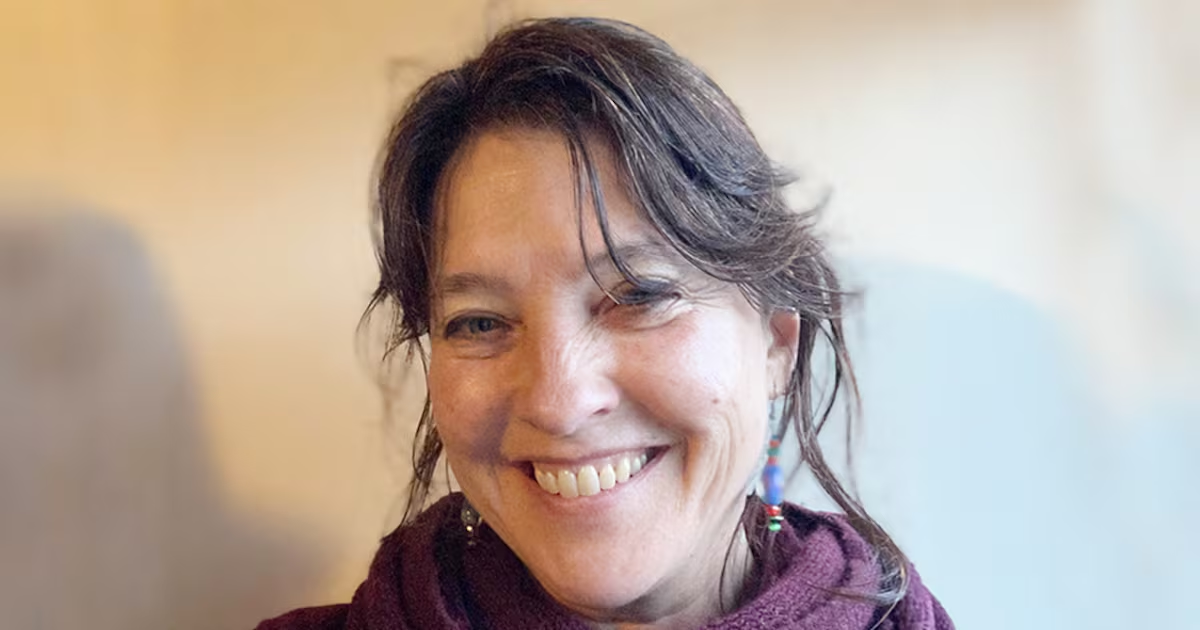
“Don’t leave me,” he said. But she did. Twelve years of marriage, her home, their dog. She left it all. She’d told him she was choosing herself. “It’s not that I don’t love you,” she said.“Don’t.” They were in their lounge room, facing each other from the kerb-gifted chairs they had dragged through the streets back in another lifetime when they made each other laugh and just to be near him was everything. “Don’t tell me we can be friends.”“I know it will take time, but—”“No. If you need to go, go.” He stood up, “But don’t ask me to be your friend.” The door closed behind him. The hospital doors were automatic. A sign yelled at her to clean her hands, warned of her potential to contaminate.She squirted disinfectant onto her palm, stood by the dispenser studying the superfluous instructions. The thick gel vanished beneath the rub of her fingers.A queue at the admissions desk dragged her forward. She gave his name, watched the clerk check his screen, heard only the first few words he spoke. There was no mistake. She had written to him a month after they separated: repeating her reasons, asking for understanding, seeking forgiveness. He hadn’t replied. A solicitor’s letter arrived. He wanted to sell the house. She agreed to the sale, the agent, the fees. Only her signature was required.The birthday card she sent that first year was returned to sender. Unopened. She seized on the rejection ‒ reminding herself of the fights, the disappointments, the petty cruelties. Old wounds grew sore again. She put her wedding ring, their photographs, his gifts in a box in the garage, changed the radio station if a song threatened sentimentality. It became her line to say she missed the dog more than him.He dropped contact with their friends, her family. She told herself he’d found someone else. That a middle-aged man, a handsome man, a man who was smart, who was funny, who was charming when it suited him ‒ that was a man who would not stay single for long. She could think of him as happy, she could sweeten her harm.Another year passed. She met men who were too young, too old, too married, too single. Her work filled his absence from her stories, television replaced his conversation over dinner. She rekindled old friendships, cooked meals he disliked, revelled in the snore-free silence of solitary sleep. If she drank too much, if she felt numb, if the life she had imagined was not the life she led ‒ it didn’t matter. Tomorrow, there was always tomorrow.But this. The wards were a labyrinth of white walls and harsh lighting with misery shuffling past in dressing-gown and slippers. An orderly deciphered the directions, patted her arm, pointed. She stiffened her shoulders to push open the door.He was lying on a bed, curled in a foetal position on top of the sheets. She tried not to stare at this body she had kissed and held, this body she had loved. To ignore the now mottled blue feet below swollen ankles, the loose-skinned limbs like withered asparagus. She swallowed, moved forward.He looked up at her, “Why are you here?” “I heard you were sick. I—”“You shouldn’t have come.” “I brought you some grapes.” She jiggled the bag, cringed at her false jollity as she circled the bed to place them on the locker. The gap at the back of his hospital gown exposed the juts of his spine. Her hand reached for his shoulder. Hovered. Withdrew. “Please,” she said. “If you’d called …" “That’s why I didn’t.” She pulled over a chair, sat with knees pressed together like a schoolgirl. Someone coughed, spat. She drove a nail into her palm. “So, what’s the food like in here then?” “What do you think?” “Crap?”She heard him sigh before he rolled over, “The Thursday stew might literally be crap.” “I could get you a takeaway, there’s—” “No.” He pushed himself up, shuffled back against the headboard. “The grapes are good. Thanks.” “Do you need some clothes?” “I’ll be going home soon.” “Yes, but you must be scaring the nurses in that outfit. Let me get you some pyjamas.” His expression shifted and she dropped her gaze. They’d always slept naked together. She looked around the room: two mounds beneath blankets, an old man snoring, a bald teenager attached to a drip. The stale air smelled of bleach. “Who told you?” he asked. “Does it matter?” He examined his sleeve, his head down as he tugged at a loose thread. “How much do you know?”“Enough.” She wasn’t sure which of them she was trying to protect.She returned the next morning. He was sitting up, glasses perched on his nose as he peered at a newspaper. She hadn’t known he needed glasses. He pulled them off, smiled at her. She’d married him for that smile. “Why aren’t you at work?” “Between jobs.” She shrugged, drew up a chair. “I got retrenched.” “Happens to the best of us, lass.” “I got you some pyjamas.” She rummaged in the bag, pulled out a red and white top. “Thought you’d appreciate these.”He laughed, “Must have hurt buying them. Especially after last week’s match.” “Let’s not discuss it.” “What do I owe you?” ‘They’re a gift.’ “No, seriously ...” “No,” she grinned. “Seriously.” Old banter. She hurried on, “Don’t make me tell you how cheap they were.” His eyes seemed too large for the skull-like face. She remembered watching him sleep, marvelling at his beauty. She gestured at the front-page headline: “So you still voting for these fools?”They talked of politics and gossip and the many faults of her ex-boss. The flow of topics ebbed, past and present rising to the surface like jagged rocks. A posse of white-coated doctors saved them: “Would you excuse us, please?” An intern started pulling around the curtains.She rose with a haste that shamed her, turned, saw the frightened child within the man. “I’ll go for a walk,” she said, “come back in a bit.” The curtains shut her out.She went to the cafeteria. Drank filtered mud disguised as coffee. Watched the revolving door swallow the anxious and spit out the relieved. He had always hated hospitals ‒ the fuss, the intrusiveness, the lack of control. She used to be irritated by his attitude, had scoffed at his fear. Her chair screeched against the floor as she pushed it back.The sun was shining. She walked from the grounds. A young couple argued by a parked car, a suited man snapped instructions into his phone, three girls in school uniforms laughed by a bus stop. A stout woman pushing a stroller smiled at her as their paths crossed. She looked away, quickened her pace.The block brought her full circle. Her march slowed. Outside the hospital entrance, she stopped. She could see her car parked at the back of the lot. The glint of sunlight on her bumper. She forced herself forward, longing for the ignorance he had tried to impose.He was slumped against the headboard, staring at the ceiling. “I need to be alone right now.”“What did they say?” “Please go.” “Tell me.”He closed his eyes. “They want me to move into the hospice. They say it’s time.”She climbed into the bed next to him, took him in her arms. He curved into her. And she rocked him in silence, her neck warm with his tears.It took most of the next day to get him discharged. She sat by his bed as they explained the medication. A month’s supply of opiates and steroids and supplements and creams. He nodded and asked questions. She was stupefied, grateful for the daily chart. They talked of palliative care and home visits, of social workers and counsellors, of air-beds and Zimmer-frames. He took the brochures, smiled, thanked them for their help. She was mute.He refused a wheelchair to take him outside. The white corridor stretched. He stared ahead as he gripped the rail, laboured step after laboured step. She had never been so aware of her own vigour. There was quick agreement at the exit that she would fetch the car. She hurried across the parking lot, hid behind a van to cry. His flat was on the other side of town. He apologised in advance for the mess, said he’d let things slide. She crunched the gears as they took off, waited for the comment that didn’t come. She wondered why his teasing used to annoy her so much. A red light forced them to linger at an empty intersection. “It’s not too late to change your mind,” he said. “I know. But if you’re sure, I’m sure.”“I’m sure.”She knew they were both lying, knew it didn’t matter. “Should we stop for supplies?”He looked out the passenger window, “I could do with a drink.” “Do you think that’s a good idea?” “Brandy, I reckon.” “But with the painkillers—” “Don’t.”The light changed. She stalled the car, lurched forward. “Sorry.”“It’s okay.” He glanced at her, “I want to celebrate being home.”She bought a bottle of cognac.She had to help him out of the car. He unlocked the door to his flat and the first thing she saw was their chairs, the faded leather now cracked with age. Over the mantelpiece hung the painting they had bought: a psychedelic landscape of jewelled hills and ribboned sky. They’d been at a festival. Had danced and drunk and giggled as they tried to have silent sex among a tented crowd. She remembered his arm around her shoulders as they admired the picture. They were young and broke and radiating happiness and the artist had knocked the price down to half. It was their first shared possession. She turned away, commented on the giant screen mounted on the wall.He sank onto the couch, “Let’s have a glass of that brandy.”The kitchen bin reeked. Smeared crockery smothered the draining board, encrusted pans lurked on the stove. The tea-towel was able to stand on its own. She cleaned two tumblers with her fingers before wiping them dry with her shirt. They used to argue about the washing up. She resented his complaints when her turn built up, was offended by his sneaky scrubbing of the sink. She never thought her heart could shatter over unwashed dishes.She poured them both a large measure, sat on the sofa next to him. They clinked glasses without meeting each other’s eyes. She thought about the children he had wanted, the ones she refused. Could it have made a difference? He would have been a good father. He should have been a father.“Are you hungry?” she asked.“You know what I’d like?” he said. “Pizza and a movie. We could order something in. See what’s on the box.”“Perfect.” She slugged back her brandy, stood up, “You sort that while I unload the car.”She carried his bag and her suitcase into the living room. He was flicking through the channels. “Can I put these away?”“If you’re going to stay here, lass, you better make yourself at home.” He pointed down the hall, “You’re on the side. I’m at the back. Best dump my stuff outside the door.”Her room was small. A lightbulb swung above the single mattress on the floor. She put her suitcase in a corner and went down the hall. His door was ajar, exposing the chaos within. She closed it, left his bag in the corridor.He was ordering a pizza when she walked back into the lounge, asking for the extra pepperoni she’d always favoured. She refilled their glasses, sat back down on the couch.“There’s a comedy on in fifteen minutes,” he said.“Great.” She took a large sip of brandy. “Is it a terrible liberty to make your bed?”“Yes.”“Even if I ask nicely?”“You did.”She glanced around the room. Three photographs gathered dust: his long-dead mother, the motorbike he fixed then crashed, their labrador Ben. She couldn’t bring herself to ask about Ben. She kept her tone light: “I won’t be able to sleep tonight knowing you’re not on clean sheets.”“How do you know I’m not?”“I did live with you for fifteen years.”He frowned at her, “I need some privacy.”“I know that.”“My bed is disgusting.”“I was guessing that. Come on, I promise I won’t look too closely.”“I don’t think there are clean sheets.”“I brought some.”“Then you use them.”“I brought two sets,” she lied. “And you can pay for the pizza.”He slugged back his drink, “Alright. Clean sheets would be nice. Thanks.” It frightened her that he accepted so easily.It was his independence that had first attracted her, his ability to rely only on himself. His strength was exciting, enticing. But she wanted him to rely on her. She was jealous of his lone ventures, threatened by his self-sufficient contentment. She fought to be needed, to be vital. And when she won, when she had stripped away his greatest asset, then she wondered where her respect had gone.She changed the sheets, pulled back the covers in a welcoming V. With a thief’s haste, she gathered mould-ringed mugs and scrunched-up tissues, bundled strewn clothing onto a chair. The stark walls pleaded. Tomorrow, she decided, tomorrow she’d buy roses. She couldn’t follow the movie. She wanted to ask him if he’d told his brother, his friends. But she stared at the screen, laughed on his cue. The credits came too soon. Half the pizza remained in the box.“Do you want to talk about it?” she asked.“No.” He swirled the brandy, watched it dance. “Not talking about it is what keeps me sane.” He drained his glass, “I think I’m done.”He tried to push himself up from the seat, rose to a half-stand, slipped back down. She reached out to help him. He grimaced, “Please don’t.” She turned her head away as he struggled with his legs, remembered how he used to sweep her from the ground and carry her to bed. He hobbled forwards.“Let’s do something nice tomorrow,” she said. “Go for a drive to the coast.”“Okay.” He steadied himself on the doorframe, turned to face her, “I never stopped loving you.”“I love you too,” she said. The rote reply rang hollow in her mind. She jumped up to hug him, holding him tight as though her body could compensate for the inadequacy of her words. He pulled back, his eyes glistening. “Thanks,” he said. “For everything.” He kissed her forehead, “Goodnight, lass.”She woke to dawn’s murky light and a momentary grace before memory swooped. She stared at the bare lightbulb, willed herself to rise. His door was shut. Tip-toeing down the hallway, she snuck from the flat. She drove to a garage, bought bacon and eggs and fresh bread, enough cleaning goods to fill the shopping basket. There were roses in a bucket in the forecourt. She bought five bunches.His door was still closed on her return. She set to work in the kitchen, scrubbing and washing and scouring and polishing. The transformation fired her. Doctors are not gods. She’d take him to a naturopath, a herbalist, a homeopath. She’d feed him carrot juice and bone broth and blueberry smoothies. They could change this, they could change this together.She lit a burner on the stove. She’d make him breakfast in bed. He had always loved breakfast in bed. They would go to the beach where the crash of the waves and the scent of the sea would charge his spirit. The ocean heals. Pleasure heals. He was strong, he had always been so strong. The scent of frying bacon filled the kitchen. She hummed to herself as she flipped the eggs.The chopping board became a tray with a folded paper towel beneath the shiny cutlery, a single rose artfully arranged. She had to put her load down to knock on his door. Her smile faltered. She knocked again. Her stomach clenched as she turned the handle.He was lying on his back, his eyes open, his jaw slack. Empty pill-packets littered the bedside table. A strange calm settled over her. She opened the window, some half-forgotten instruction from her grandmother about freeing the soul. She smoothed his lids shut, kissed his brow, took his cold hand in hers as she sat beside him. And she talked to him of the life they had shared.Tomorrow was awarded second prize in The Moth Short Story Prize 2026. “Now this is what I call a love story,” said judge, author Wendy Erskine. “Tomorrow is humane, adult and very affecting.”Ava Sedgwick lives in Cork and has an MA in Creative Writing from the University of Limerick. She won the 2024 Gemini Magazine Annual Short Story Prize and her stories have been published by Northern Gravy, Elegant Literature and Shooter Literary Magazine, as well as listed in numerous competitions including the Bridport Prize, Lorian Hemingway Short Story Contest and Bath Short Story Award. The novel she is working on was longlisted in the Mslexia Novel Competition and received an Honourable Mention in the Chapter One Prize. She is an Arts Council Agility Award recipient.
Tomorrow by Ava Sedgwick: second in The Moth Short Story Prize 2026
Prize judge Wendy Erskine: ‘Now this is what I call a love story. Tomorrow is humane, adult and very affecting’
2,828 words~13 min read