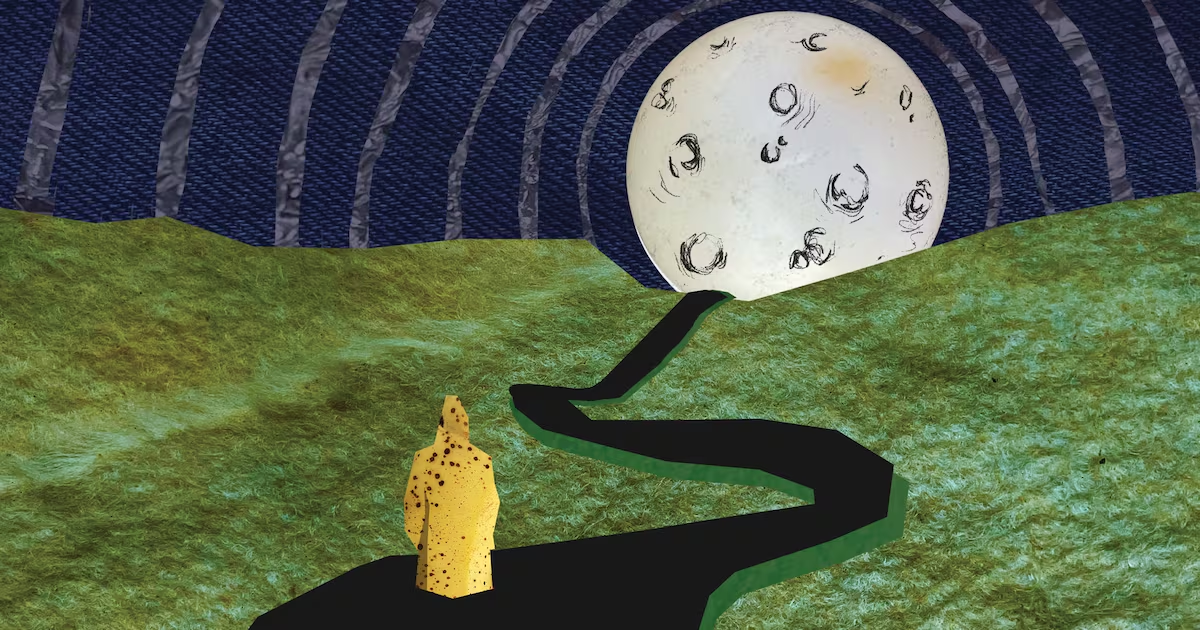
Judge Wendy Erskine chose The Shoulder as this year’s winner of the €3,000 Moth Short Story PrizeIllustration by Emily Thomas Jeffrey-Michael KaneWed Aug 26 2026 - 04:30 • 6 MIN READThe first dead thing I ever saw that someone claimed was sleeping was a horse.Not a whole horse. The back half was under a blue tarp behind the volunteer fire department in Nebo, and the front half was visible enough to make the lie unreasonable. Its eye had gone the colour of creek water. A man from the county stood smoking beside it while my aunt said to me quietly, don’t stare if you can help it. Then louder, for everyone else: poor thing’s exhausted.Afterward, for years, I thought exhaustion was a visible condition. I thought if you became tired enough your body would simply refuse further instruction.The horse had gotten loose in a storm and stepped wrong on the shoulder where the road gave way. That was the official version. But mountain people have a second version for every story and sometimes a third one they keep for themselves. By supper the Ingles cashier was telling customers the horse had thrown itself into the ditch because animals know weather before people do. By Wednesday somebody at church said it’d been running from something up on Hoppis Ridge. By Friday the children had improved it into certainty.There was a woman on the ridge road.Not a ghost. Nobody said ghost. Ghosts belonged to stories imported from elsewhere, all chains and vengeance and Victorian grief. This woman was local. She wore a yellow raincoat and stood in the middle of the road after storms with one hand lifted like she was trying to remember whether she’d meant to wave or warn.The first person to mention her to me was my cousin Dell, who lied with tremendous conviction.“If you pass her and don’t look in the mirror,” he said, “she stays where she is.”“And if you do?”He shrugged. “Then she rides home with you.”We were eleven and had just enough imagination to injure ourselves with it.When I was eight or nine, before any of this, my mother had driven these same roads with her left hand open on the wheel and her right hand pointing things out. Goldfinches in the chicory. A buck no bigger than a kitchen dog. The field where her grandfather had cut hay until the tractor took his hand. She had a way of saying look without taking her eyes off the road, and I learned to look in the direction her voice tilted. By eleven I could find a kingfisher on a wire before she’d finished the word.She sang Patsy Cline wrong her whole life. When I leaned in, I could almost taste the gravel in her voice. The second verse of Walkin’ After Midnight she never could get right, didn’t care, would not be corrected.*That autumn my mother started taking the long road back from Morganton after chemo because the curves kept her awake. She said the mountain roads required a conversation with the body that straight roads did not. The treatments made her sleep in fragments. Sometimes she’d wake at the kitchen table at two in the morning with both hands still around a cold cup of coffee like she’d only briefly stepped away from herself.She wore a scarf even indoors by then. Not because she’d lost all her hair yet, but because she knew she would.On Thursdays I went with her to treatment because my father worked swing shift at the furniture plant and my aunt had three boys already ruining her carpets. The cancer centre sat beside a dentist’s office and smelled faintly of powdered soup. Women slept in recliners under crocheted blankets while televisions mounted near the ceiling explained weather systems no one intended to travel through.Mama always carried a grocery sack with her Bible, peppermint candies and a little spiral notebook where she wrote down numbers.Not prayers. Counts.White blood cell count. Platelets. Temperature. Weight. Hours slept. Ounces of water. Number of times she’d thrown up that morning. She recorded herself the way men in flood country mark river heights on bridge pilings.One Thursday coming home, rain came down so hard the road disappeared except where the headlights rebuilt it.“You watching?” Mama asked.“Watching what.”“The shoulder.”“For deer?”“For people.”She said it flatly. Not teasing.I watched.Near the turnoff for Lake James, where the guardrail bent inward from an old collision, someone stood in the rain wearing yellow.Not bright yellow. The exhausted yellow of newspaper left in a window.My mother saw her too. I know she did because her hand tightened once on the wheel and then relaxed deliberately, finger by finger, like she was unclenching from prayer.We passed the woman at thirty miles an hour.She did not wave.She stood with her face turned slightly towards us, patient as mail.In the side mirror I saw only rain.Mama drove another two miles. She did not speak. I did not ask her to.At home she vomited blood into the sink while I stood behind her holding the scarf she’d taken off in the car. Afterwards she rinsed the basin clean before my father got home because illness in our family was treated as a kind of untidiness. Something to manage privately before guests arrived.The woman in yellow stayed with me though.I started watching roadsides after storms. I checked mirrors too quickly. I learned every reflector and mailbox between Marion and Glenwood so I could identify deviations instantly. If I could notice enough things in time, maybe nothing irreversible would happen.By November my mother no longer drove herself to treatment.By Christmas she had stopped writing numbers in the notebook.I found it months later in the drawer beside the telephone. The last page held only four entries:Temperature normal.Road clear.No woman tonight.Home safe.I carried the notebook for years after she died. Through college. Through my first apartment in Asheville with windows that leaked cold air straight onto the mattress. Through the year I married someone who believed all fear could be reasoned with if you loved a person steadily enough.*Last October, driving home from visiting my aunt in Marion, I took the ridge road by mistake. Or not by mistake.Rain had just passed through. The trees were still dripping. Halfway around the bend near the old guardrail I saw someone ahead on the shoulder in a faded yellow coat.Not standing.Walking.Head down against the weather.I slowed almost to nothing.For one impossible second I thought: Mama forgot something somewhere. Mama’s trying to get home.Then the woman turned enough for the headlights to catch her face and she was twenty years old at most, earbuds in, carrying a plastic grocery bag that bumped against her knee with every step.A local girl. Wet. Alive.She glanced at me politely as I passed.In the mirror behind me, for just a moment, the road held two yellow figures instead of one. Then rain moved across the glass and took the other one with it.Author Wendy Erskine chose The Shoulder as this year’s winner of The Moth Short Story Prize, worth €3,000. “This is a mesmerising story told in a tender, unhurried way by a poised and talented writer. It’s poetic and has a beautiful toughness.”Jeffrey-Michael Kane Jeffrey-Michael Kane, an environmental attorney living in New Orleans, is the author of Quiet Brilliance: What Employers Miss About Neurodivergent Talent and How to See It. His essay, Nomenclature of a Life, cataloguing his experience as someone with Level 1 Autism Spectrum Disorder, was awarded the 2026 Ellis Prize for Non-Fiction. IN THIS SECTION
The Shoulder: winner of The Moth Short Story Prize 2026
Judge Wendy Erskine chose The Shoulder as this year’s winner of the €3,000 Moth Short Story Prize
1,251 words~6 min read