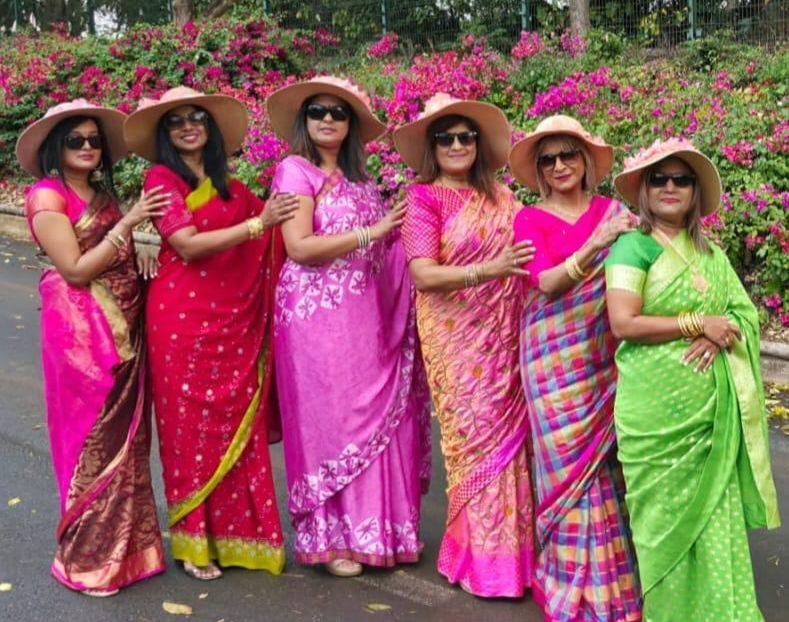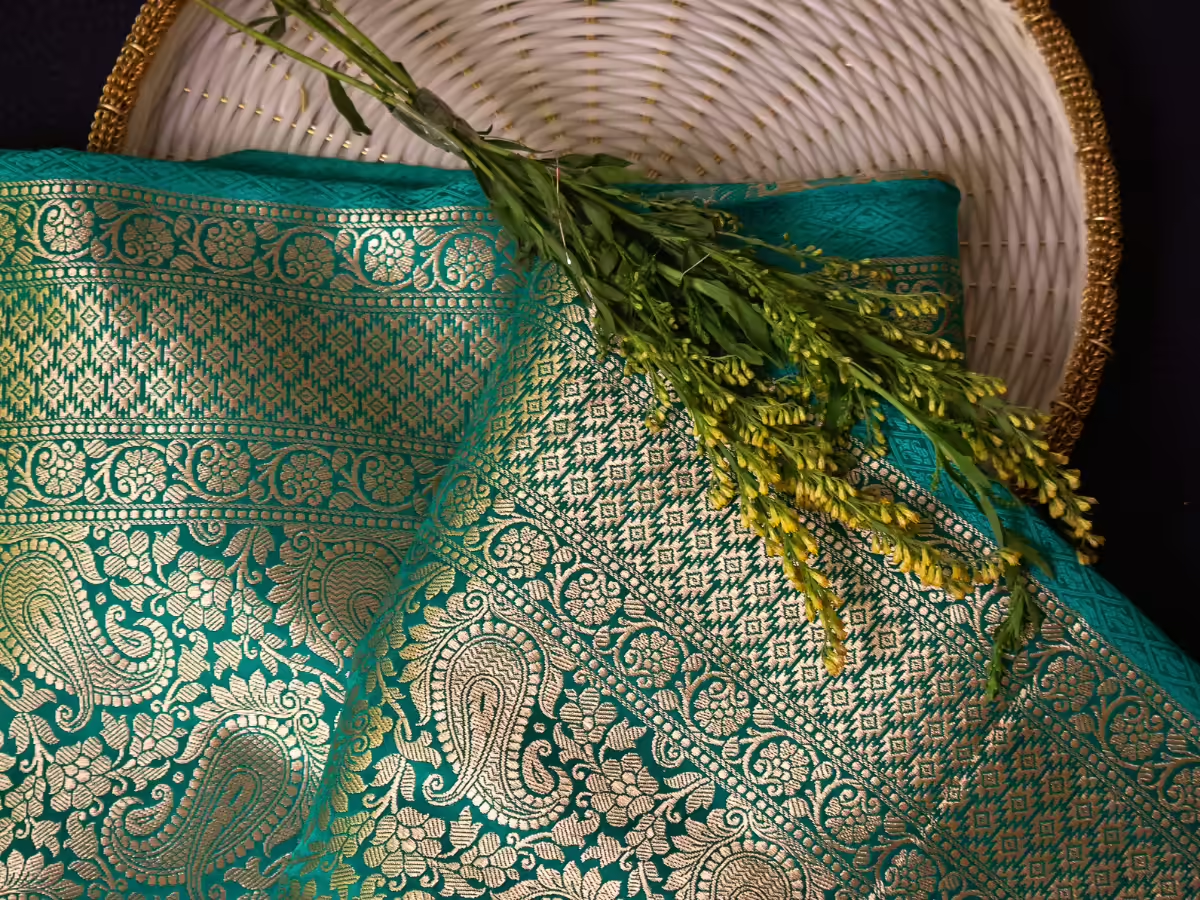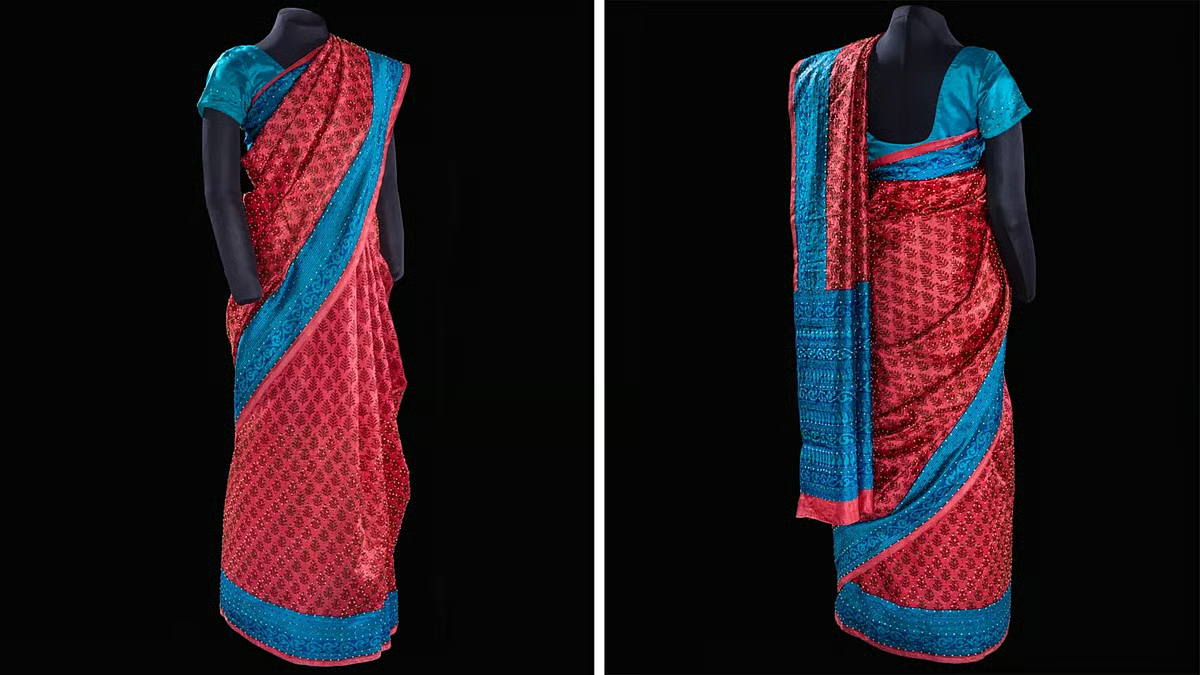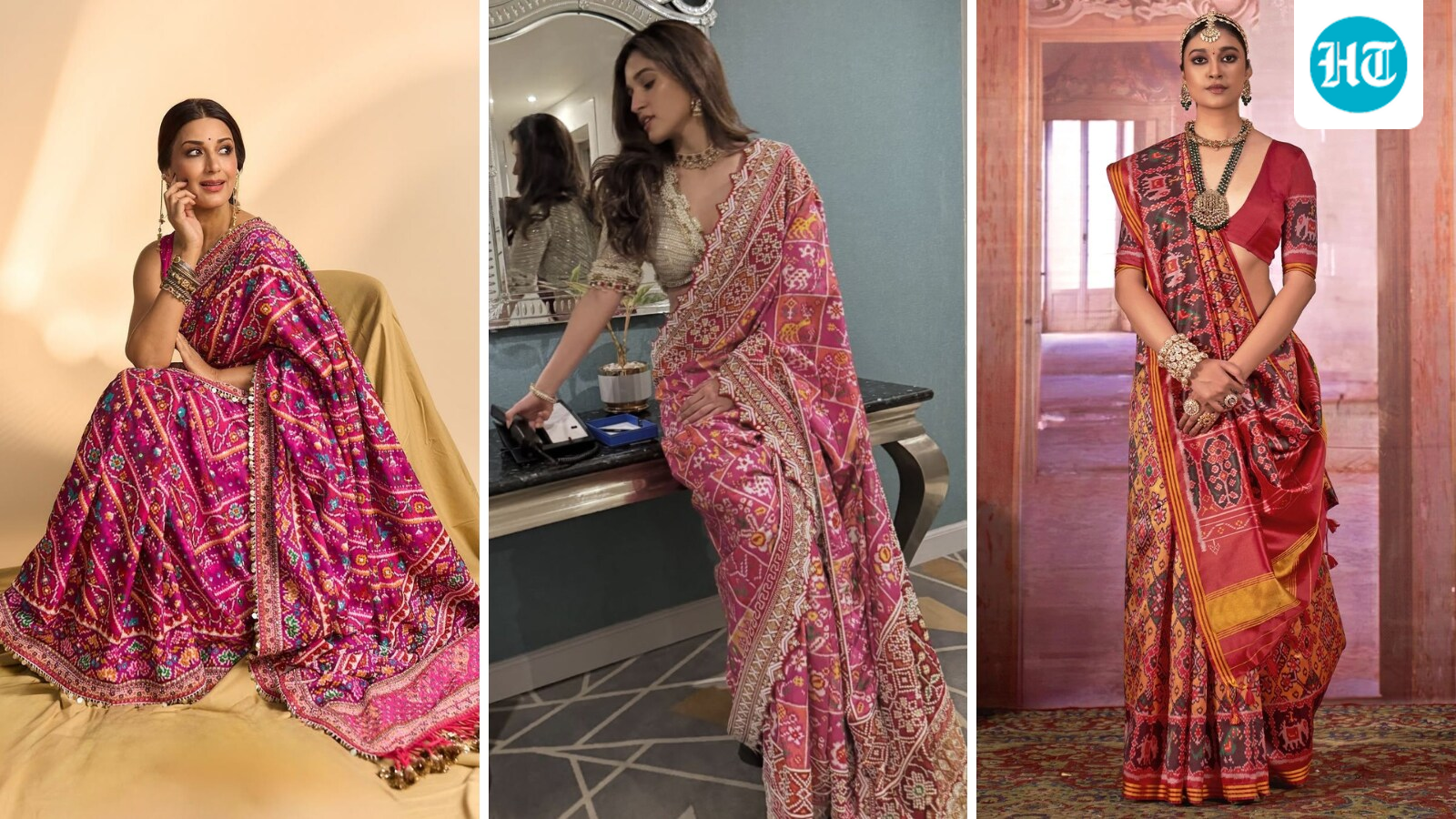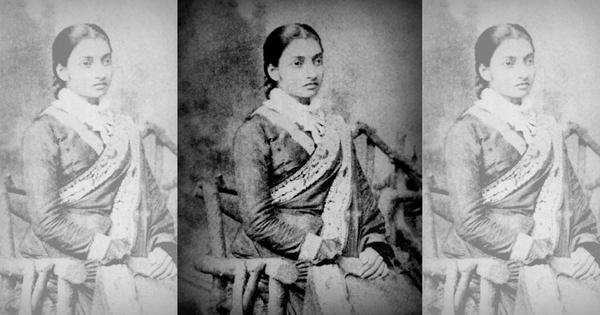
The deep involvement and complete sense of identity of the Indian woman with the sari, has made her resist the pressure to change her style of dress, inadvertently providing continuity in weaving traditions of every part of the country. The sari represents a culture in which the woven and textured-with-pattern garment; unpierced or intruded upon by the stitching needle; was considered not only more appropriate in terms of aesthetics and climate, but was also an act of greater purity and simplicity. It is difficult to historically ascertain the sari’s evolution as a single piece drape, though in many parts of India (Kerala, the six northeast states, Rajasthan and Gujarat), its possible preceding versions of two or three-piece drapes, continue to be worn.The sari allows us to go back at least a thousand years in terms of design. It is conceived on the loom as a three-dimensional garment with variables in pattern, weave and structure between its inner and outer end-pieces and its two borders, which provide drape, strength and weight, while the body enhances its drape. All these elements help maintain the form of the sari when it is worn. A process of awareness began with the Master Weavers Exhibition in 1982 and continued through a series of seven Visvakarma exhibitions, initiated by Martand Singh and supported by the Development Commissioner (Handlooms), Government of India, attempting to discover whether a level of excellence was still possible in the tradition of handcrafted textiles. It led to the recognition of a handful of craftsmen in different parts of the country, who were still capable of giving us a glimpse of the best of their inherited skills. They gave us the confidence to move beyond the museum masterpieces, to look for what could be achieved today. Though the experience of searching, finding and attempting to revitalise within a contemporary context was exhilarating in itself, it left one with a feeling of standing on thin ice. How little we know about the craftsman, his capabilities and the dire circumstances out of which “design” emerges. What exactly is possible within a specific area of skill? How can the range of handloom weaving, printing and dyeing be developed further without adequate knowledge of its specific capabilities, capacities, potential strength and limitations? This growing awareness and the realisation that too much had already been allowed to die out of sheer neglect, combined with a final assault by power looms and mills during the second half of the 20th century, brought a sense of urgency to this documentation project. Until the 19th century, weavers were considered the nation’s wealth. They were highly skilled minds who had explored infinite possibilities of the one plus one minus one in the realm of pure mathematics. Though this could be said of many a design medium, weaving is unique in that it involves the ingenious mapping of the mental conception within – what is literally – a physical grid. In more ancient times, weavers were taken from one kingdom to another as part of a dowry in marriage, or given as the price of conquest. At less fortunate times, they were conscripted as soldiers or were forced to migrate due to oppression, want, or famine. They carried the sapling of knowledge wherever they went, adding to the wealth of their newfound homeland. The sari has been a unifying feature, despite the variations in its wearing style, in different parts of India. The urban wearing style is a post-1870s phenomenon and is described as follows in Chitra Debi’s marvellous book from the 1970s, Thakur Barir Onder Mohal (translated from Bengali by Riten Mazumdar): It is said that Satyendranath (elder brother of Rabindranath) Tagore’s wife, Gyanodanandini, went with her civil servant husband to Bombay around the 1870s and adopted the Parsi way of wearing the sari, as at that time the local Bengali way was not considered elegant enough for outdoor wear. On her return to Calcutta we find that this style, now known in the Thakur Barir as the Bombay Dastur, was adopted by all the ladies of the Barir and other society ladies referred to it as the “Thakur Barir Sari”. In fact, when Gyanoda advertised her willingness to teach this style of wearing the sari – with a saya or petticoat, chemise blouse and jacket – it attracted a number of women. It seems to have been a time when a number of ladies were experimenting with supposedly more sophisticated ways of wearing the sari. The sari went through various stages of resembling the hobble skirt and the gown. At one stage the pallav (end-piece) was made so short that it could not cover the head and thus, a mukut (crown/tiara) was worn with a flowing backcloth. Suniti Devi, the Maharani of Cooch Behar, preferred to have a scarf over the head, worn like a Spanish mantilla. Eventually, the traditional way seemed to make a comeback with some alteration in the early twentieth century, for the pallav was brought back over the head by Gyanoda’s daughter, Indira Devi. We find that Suniti Devi’s sister Sucharu Devi, Maharani of Mayurbhanj, was seen at the Delhi Darbar in 1903 in this modern style of wearing the sari, though she said that this was her in-laws’ way of wearing it. Bengali ladies seem to have adopted this more convenient way, though they kept Gyanoda’s way of taking the pallav over the left shoulder.Although it is a fast-disappearing garment for everyday wear, the sari will survive as special occasion wear. More and more Indian women today prefer stitched garments and Western wear of easy-to-maintain and wash-and-wear fabrics. And yet, there was a time when they rode horses wearing saris in Jhansi, Uttar Pradesh and even swam in rivers and ponds with their sari tucked between the legs, much like an unstitched pair of shorts. Saris were even draped longer in pantaloon-like fashion, in places as far apart as Shajapur, Madhya Pradesh and Kothapalli in Andhra Pradesh. If the principles of these wearing styles were put into practice, many more could possibly be evolved for contemporary needs. Interestingly, the sari is asserting a growing presence in the boardrooms of multinational corporate organisations, in law chambers, courts, and among the new power professionals who are conscious of their identity and wish to draw strength from it.In the contemporary context, despite the growing compulsion to industrialise and globalise, there is also an increasing awareness of ecological viability and sound growth. With her rich resources of skilled hand-spinning and weaving, India is advantageously placed to show the way in balancing the slower but high-skilled production sectors with the mechanised, high-technology end. Though there has been a gradual exodus from these professions in the 20th century, what they are going through today is unprecedented. Weavers are losing a high-skill livelihood without alternative options, facing starvation-like conditions and joining the ranks of the unskilled.The patterned, coloured fabric and product range is India’s greatest asset and no matter how many cheap imports are dumped into the country, we have to compete with post-WTO; if we invested prudently, with design and market support from both private and government agencies, sustenance for at least a percentage of the artisans who are still active and capable of developing further could be found. However, India must retain at least a broad base of spinning and weaving, so that a pyramid of skills can be formed and the more capable weavers are able to transition to the finest level of skill.The sari is not only known by different names (lugda, dhoti, pata, seere, sadlo, kapad) in various parts of the country, but is also conceived differently in form and structure, in usage and custom. It is a stretch of fabric, long or short, wide or narrow – according to who wears it and the way in which it is worn. There is, in fact, no “one type of sari”.Despite 108 variations of the sari drape and wearing style being featured in this book, a personal variant is always possible. This distinguishes the sari as the most unique and versatile of garments. In constant play with the body, in stillness and in movement, allowing for adjustments at all times. Be it the vigour of working in the fields or squatting on the kitchen floor, it transforms itself according to need and function. In the manner of her carrying the sari, the wearer reveals her nature and demeanour. The bold and the shy, the silent but inquisitive, the athletic yet graceful – all manner of women hold their saris with characteristic ease, almost as if it were their second skin rather than a textile extraneous to themselves.The personal pleasure of draping the unstitched, fluid garment over and around the body, adjusting it with little tucks and pulls to suit one’s own particular form, is sensuous. It creates a picture of flowing grace that conceals as much as it reveals.This book has emerged from travel-based research conducted over three and a half months in each of the states described, except Goa and Kerala. Each state was initially mapped out according to weaver/printer settlements and products from gazettes and other records that went back a hundred years. The states were covered by my colleague Amba Sanyal and me, together or with the respective research team in the states. We travelled with the teams, at least for the initial six to eight districts, keeping diaries and swapping them with team members every night, just as we had kept them on our very first tour in 1984. The period of field travel was primarily from 1984 to 1991, though Andhra Pradesh was completed in 1997, and I had to undertake verification tours in 2002-03. We were looking out for what was traditionally woven in the area on the scale of living memory, and exploring design directories and fabric structures with the oldest weavers, in large gatherings of thirty to sixty weavers in each village. This helped initiate our researchers into the hectic process of listening, discussing, writing, travelling and photographing; at the pace of two to three villages, ten to 12 hours, traversing approximately 100 kilometres each day. Working on this project has been a rewarding experience, even though it has meant much more work for us, with the teams having spent over a year or more putting together the material on each state.When we first started our travel, the search for the who, what, why and how of the traditional design directory focused on the main production and trade centres of each state. During the first three months on the road, we realised that the clues and inspiration for several well-known textiles lay in lesser-known areas. It was a classic case of “one place leading to another”. Before we knew it, we were following the trail of weaver/printer/dyer settlements village by village, in almost every district of the state.We did not expect to find so much evidence of what lay beneath the surface of the pyramid, let alone meet weavers who had seen or woven the textiles that made up the grand symphony of the handloom tradition in India. Many were persuaded to weave them once again and we were soon embroiled in the production and post-production problems of the textiles themselves, rather than the documentation. Looking into their marketability today… Were they good enough? How do we develop design directories for each area? These were the questions before us. Weavers commonly said, “What use is the book to us now, when we need to make a living?” However, they conceded that it would be useful to them in the long run.The sari has been our means of finding a pathway through the labyrinth of India’s inherited material/ textile culture. The most fluid of worn garments, the sari reflects and communicates with all that we can see and touch, feel and experience. It takes us headlong into the intangible aesthetic, philosophy and technology from which it emerges. It is our roadmap for Bharat darshan – a visitation of this land. Often enough, the underlying linkages are not fully perceived as they are too far removed from the overwhelming reality of the present in which they exist. Yet, as this is not a historical account but one based on living memory, it is the practitioners who provide the clues, however faint, through colour and material associations, names and meanings of symbolic patterns and usage of particular saris. In retrospect, the sari’s significance becomes clearer.Excerpted with permission from Saris: Tradition and Beyond, Rta Kapur Chishti, Roli Books.
A new book looks at the history of the sari and all that it supports socially and economically
An excerpt from the Introduction to ‘Saris: Tradition and Beyond’, by Rta Kapur Chishti.
2,091 words~10 min read