Originally published on tamiz.pro.
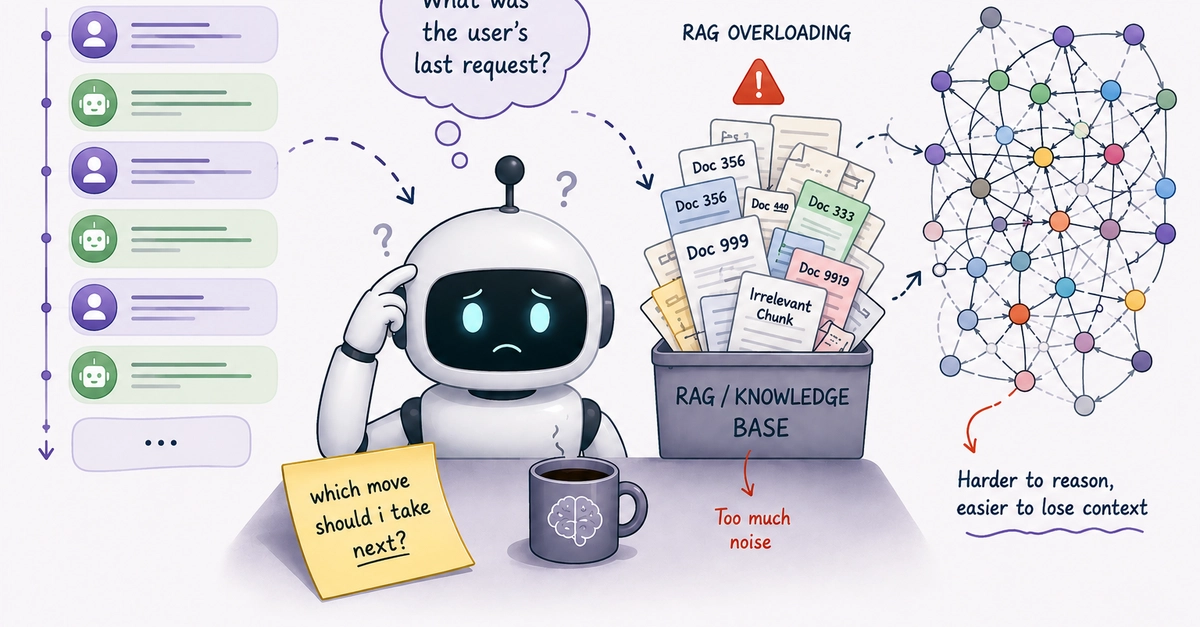
You've spent weeks tuning your system prompt. You've tried chain-of-thought, ReAct, and tree-of-thought prompting. You've benchmarked GPT-4o against Claude 3.5 Sonnet and nothing clicks. Your agent still loses context, contradicts itself across turns, and feels like it's starting fresh every time a user comes back.
Here's the uncomfortable truth: your agent doesn't have a reasoning problem. It has a memory problem.
The models available today are remarkably capable at reasoning within the context window they're given. The gap between a "smart" agent and a "breaks after three turns" agent almost never traces back to the model's logical capabilities. It traces back to what the agent remembers, how it remembers it, and whether that memory survives the transition from demo to production.
This is a deep-dive into production-grade agent state — the architecture, patterns, and trade-offs that separate prototypes from systems that handle real users across real sessions.