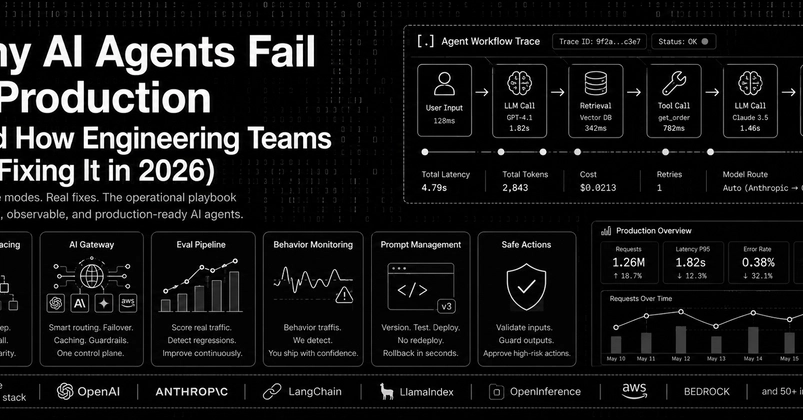
Originally published on tamiz.pro.
You spent weeks building an agentic workflow that works flawlessly on your local machine. It handles edge cases, calls APIs correctly, and follows the chain of thought precisely. Then you deploy it. Within hours, users report hallucinated tool calls, lost context after five turns, and infinite loops that drain your budget. You stare at the logs and realize the agent isn't broken—it’s just not engineered for production reality.
The gap between a prototype agent and a production-grade system is not complexity; it’s discipline. Most agents fail in production due to three specific engineering gaps: Memory Leakage (context drift and state management), Evaluation Blindness (lack of deterministic testing), and Tooling Fragility (unhandled error states and race conditions). This deep-dive dissects these failure modes and provides the architectural patterns to bridge them.
The Illusion of Statelessness
LLMs are stateless functions. Every token generated is conditioned entirely on the input history provided in the prompt. In production, this simplicity becomes a liability when the conversation exceeds the model’s context window or when “memory” is required across sessions.