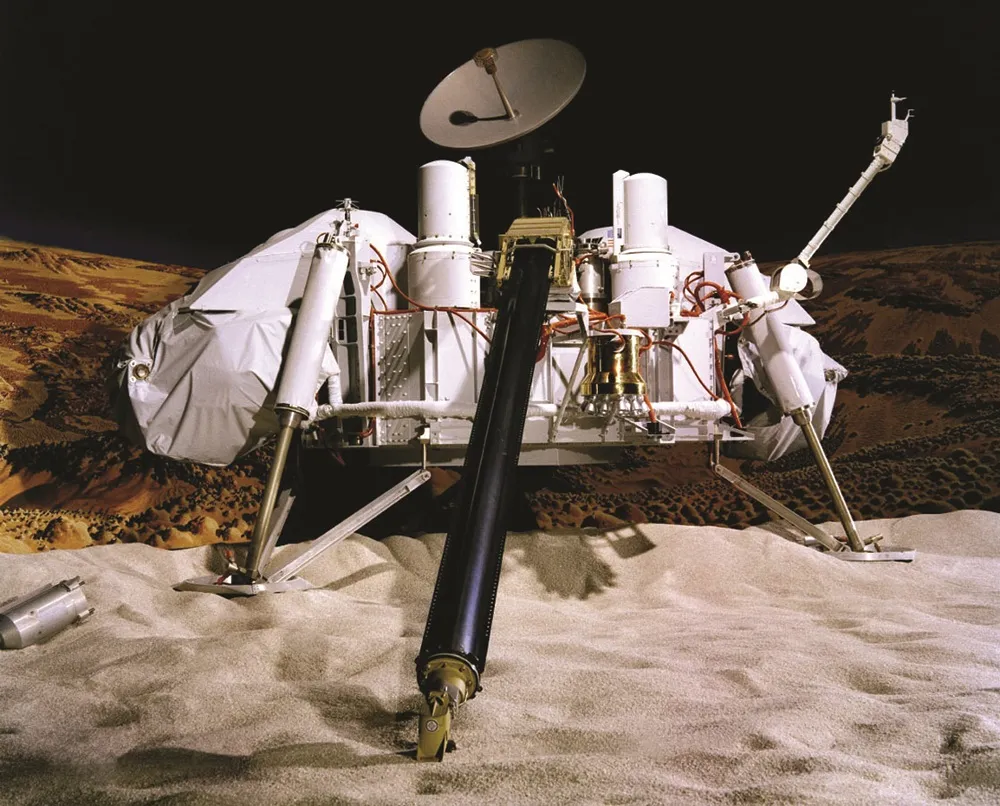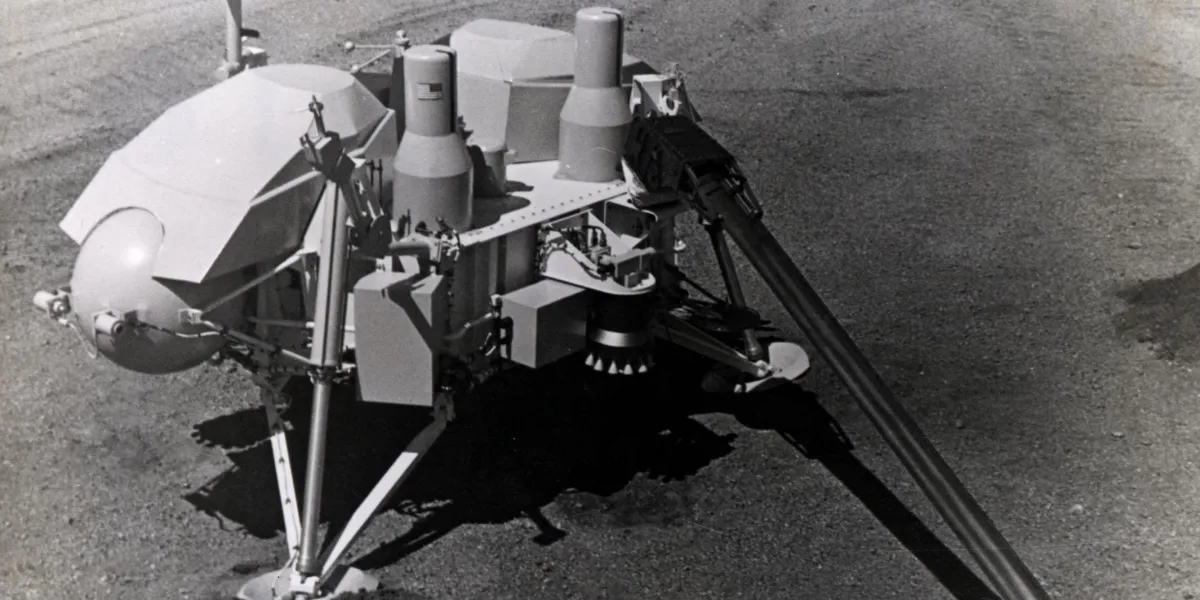
The tension was palpable at NASA’s Jet Propulsion Laboratory as Viking 1 entered the thin atmosphere of Mars on July 20, 1976. If its trajectory was on course—and all went according to plan—it would complete the first soft landing on the Red Planet. “Everything was functioning beautifully,” recalls Hans-Peter Biemann, who observed and photographed the landings and science operations as a 16-year-old NASA intern that summer. The Viking team—which included several MIT faculty members and alumni—knew that everything they had worked for over the past several years was on the line. As he waited with them, Biemann, the son of the Viking scientist and MIT chemistry professor Klaus Biemann, had his camera at the ready and the presence of mind to record his thoughts. “Viking is 300,000 feet away from victory … or disaster,” he wrote in his journal. “The room throbs with excitement. Every single person is totally caught up in the emotion.” Eight days earlier, the science team had used imagery from the Viking orbiter to identify a suitable landing site. “Viking is flying toward the orange plains of Chryse,” he wrote. “The biologists shout with joy at every announcement.” Gentry Lee (in striped tie at right), leader of the Viking science team Gerald Soffen (far right), and members of the Viking biology team react with joy as they get a report on the status of Viking 1’s descent to the surface of Mars on the morning of July 20, 1976. Moments after this photo was taken, it successfully landed.HANS-PETER BIEMANN Several minutes later, preliminary data showed that Viking had successfully landed. “Touchdown!! Everyone is shouting. Cheers can be heard over the net,” Biemann wrote, referring to the internal communications loop that connected scientists in different buildings at JPL. “We know Viking has landed, but has it survived?” Moments later, Viking’s data transmission rate increased to 16,000 bits per second, indicating that the spacecraft was healthy and ready to begin its science mission. “Champagne corks popped and cigars lit up,” Biemann wrote. “The thrill of victory was thumping in everyone’s hearts.” Viking 1’s successful landing at Chryse Planitia set off a wide range of scientific investigations, including the first search for extraterrestrial life on Mars. Just over six weeks later, on September 3, the twin Viking 2 lander touched down about 4,000 miles away, at Utopia Planitia. The landers were designed to operate for 90 days after reaching Mars, collecting images and data to relay back to Earth. Thomas Young, SM ’72, who had shepherded the project from its earliest stages, calls Viking one of NASA’s most ambitious missions, alongside Apollo and the James Webb Space Telescope. “You couldn’t land on Mars and do the kind of experiments that were done on Viking unless you reached too far,” he says.
Looking for life on Mars
A half-century after the Viking landers touched down on the Red Planet, the debate over whether they found signs of life continues.
2,197 words~10 min read