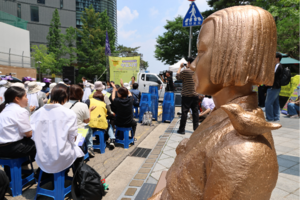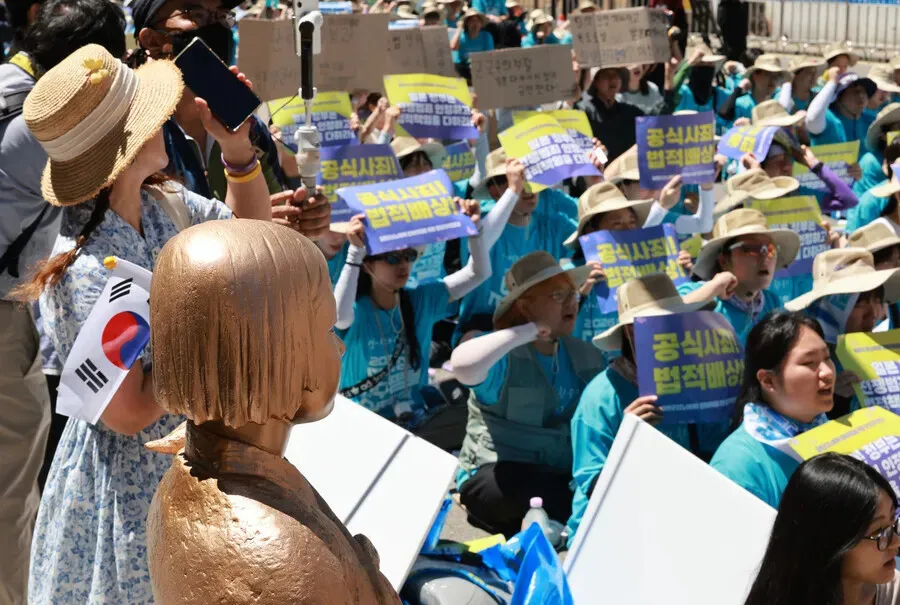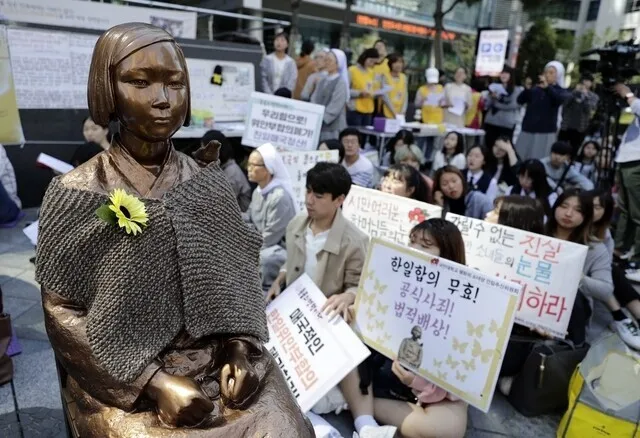
Protesters calling for reparations for victims of the “comfort women” system of sexual slavery employed by the Japanese military sit around the Statue of Peace memorial to comfort women outside the former Japanese Embassy in Seoul’s Jongno District. (Kim Myoung-jin/The Hankyoreh)
According to a decision reached by the Japanese government in April 2021, textbooks used by juniors and seniors in Japanese high schools will no longer specify that the comfort women served the Japanese military during World War II. These textbooks have also removed all mention of “forceful relocation,” a term that had been used to emphasize the compulsory nature of Koreans’ mobilization for Japan’s war effort.As the Japanese government blocks the use of such language in its textbooks, Japanese society has decisively broken with the promise it made in the 1993 Kono Statement to use historical education to ensure it does not repeat the atrocities of its past, such as the “comfort women” system of sexual slavery.On Tuesday, Japan’s Ministry of Education, Culture, Sports, Science and Technology released the results of its evaluation of 239 textbooks on such subjects as Japanese history, politics and economics, and geography that high school juniors and seniors will begin using next year.An analysis by the Asia Peace and History Education Network and the Asia Peace and History Institute found that the expression “comfort women for the Japanese military” has disappeared from all seven of the Japanese history textbooks that cleared the government’s review.Previously, the history textbook by progressive-leaning Jikkyo Shuppan had clearly identified the perpetrators by saying that “many women became comfort women for the Japanese military,” but the latest edition of the textbook omits the phrase “for the Japanese military.”Among the publishers of politics and economics textbooks, Tokyo Shoseki was forced to make a major change in the government review.