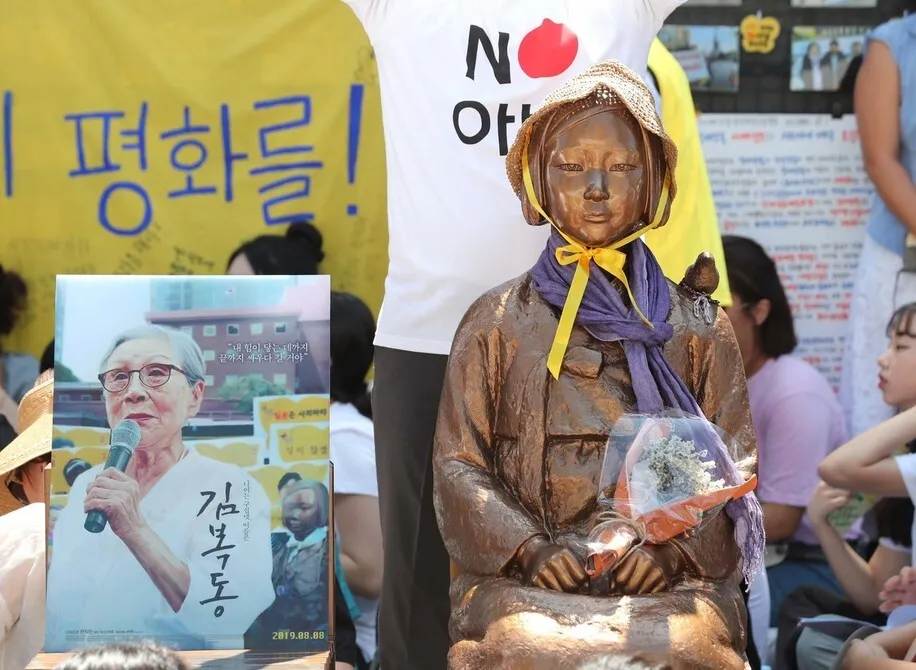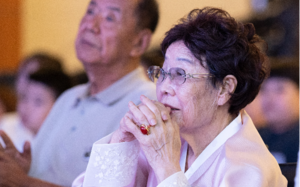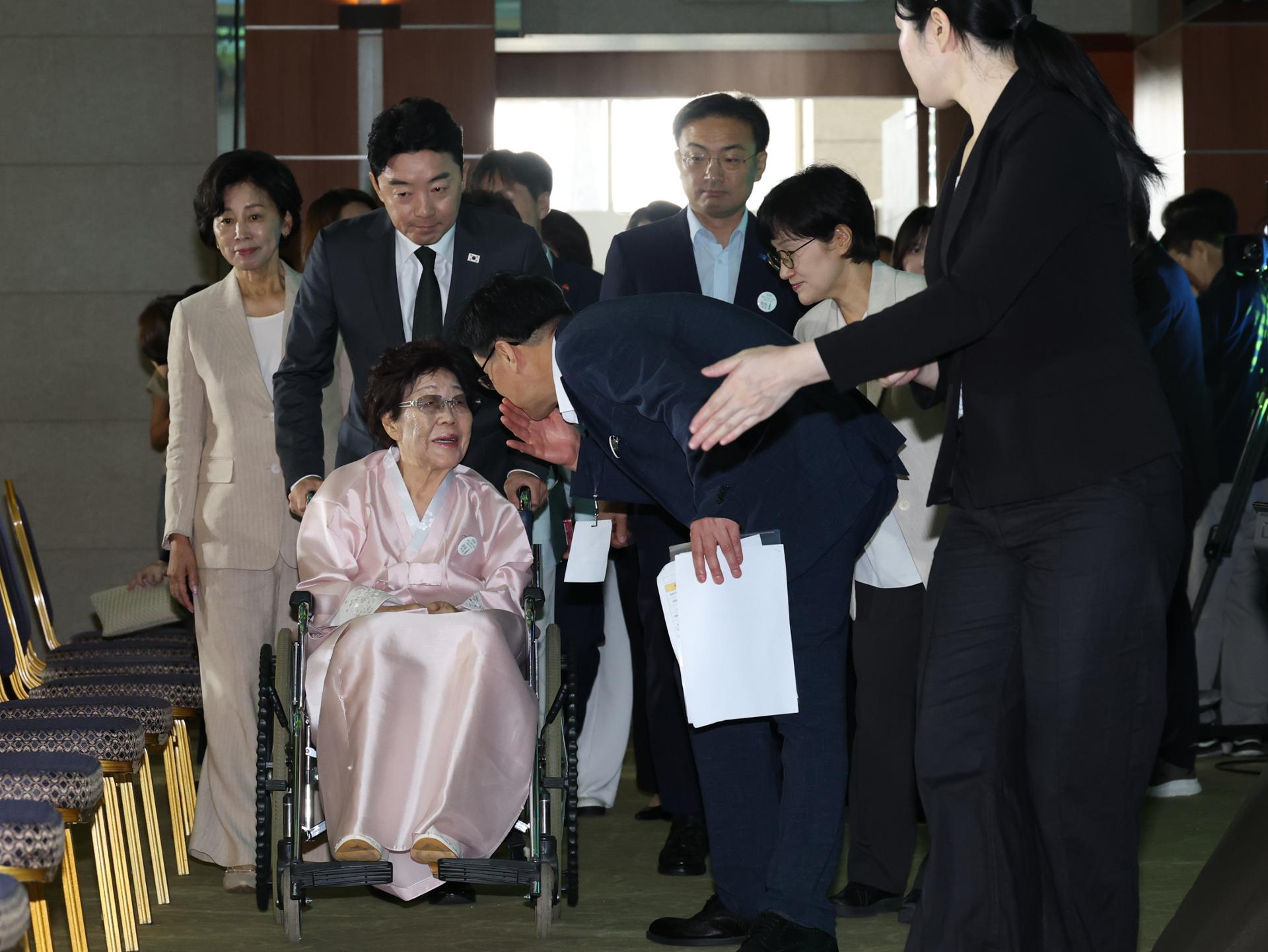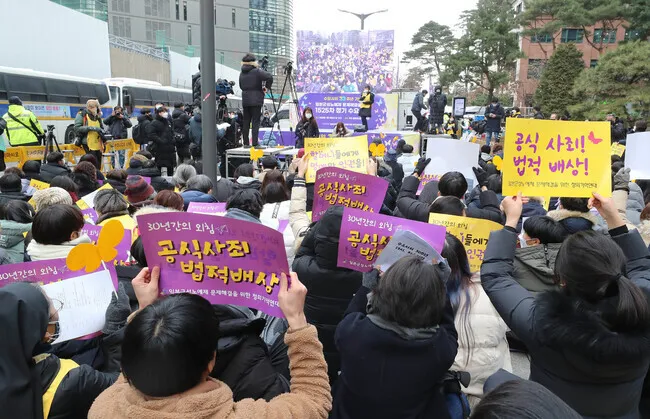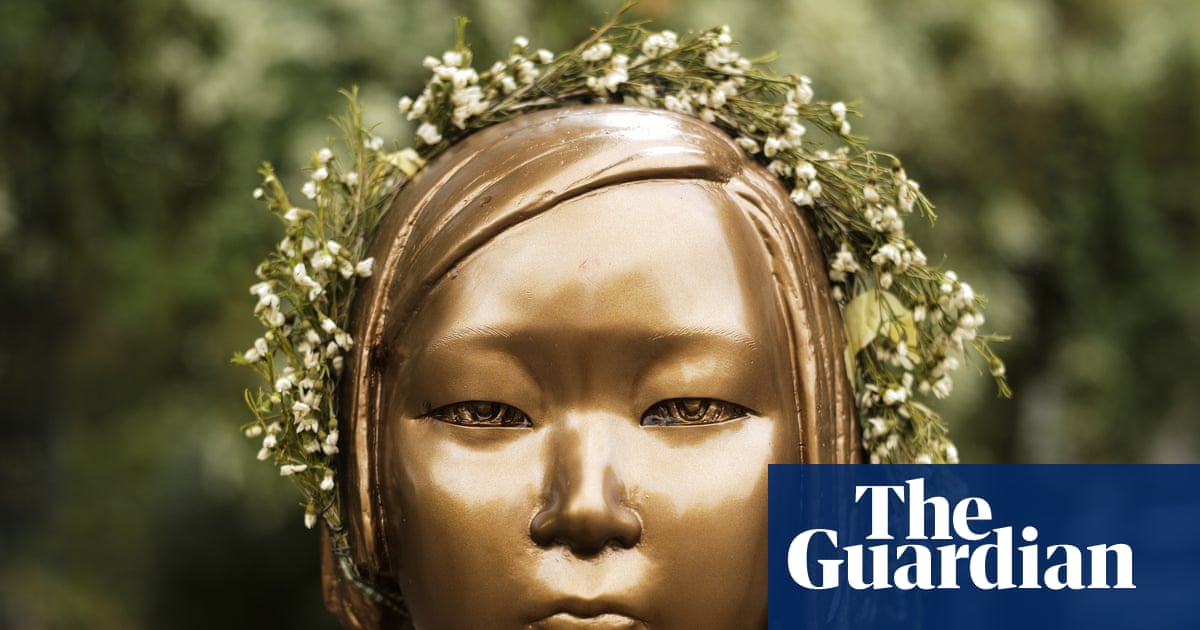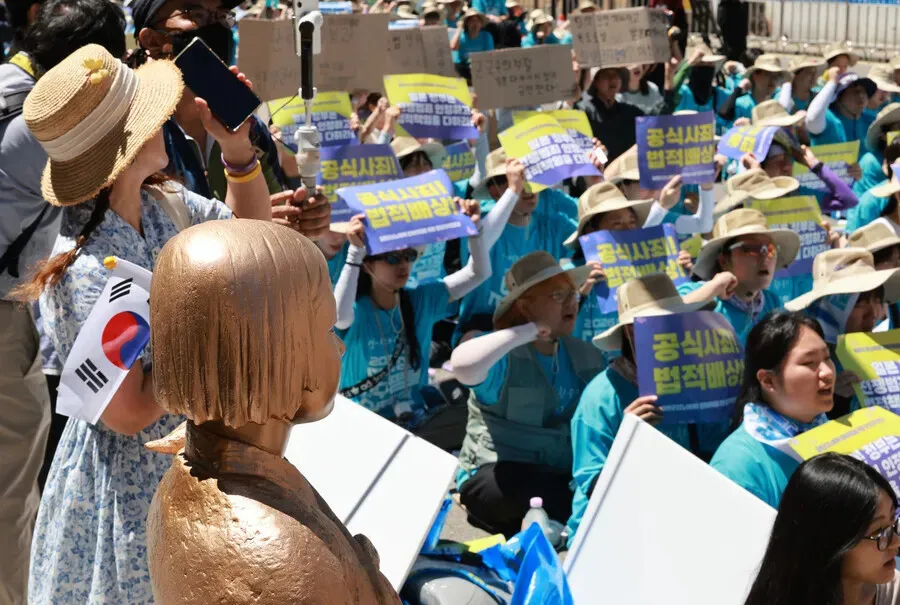
Participants in the 1,765th Wednesday Demonstration, a long-running peaceful protest demanding a resolution to the issue of the “comfort women” system of sexual slavery by Japan, outside the former Japanese Embassy in Jongno District, Seoul, on Aug. 12, 2026. (Kim Hye-yun/Hankyoreh)
Several posters were displayed in front of a statue of a young woman in Seoul’s Jongno District on Wednesday.“We will pray for a world in which women are no longer victimized,” one poster read.“The issue of sexual slavery for the Japanese army isn’t a matter of the past, but the present!”“Peace in this land, and honor and human rights for the former comfort women!”The posters rustling in the summer breeze conveyed Koreans’ ardent desires for a world without war and an official apology and compensation from the Japanese government on the “comfort women” issue.The statue of the young woman, one of a series installed in Korea and elsewhere, symbolizes the “comfort women” — women from Korea and other countries who were forced to serve as sex slaves for Japanese soldiers during World War II.The Korean Council for Justice and Remembrance for the Issues of Military Sexual Slavery by Japan was holding its 1,765th Wednesday Demonstration for resolving the comfort women issue ahead of the 14th International Memorial Day for Comfort Women in coordination with 222 other groups in 10 countries around the world.It was at the Asian Solidarity Conference, organized to tackle the comfort women issue, that Aug. 14 was chosen as a day to memorialize the comfort women. That was the day when the late Kim Hak-soon broke a long taboo by publicly speaking about the horrific things women like her had endured under Japan’s brutal system of sexual slavery.Kim’s testimony launched a movement to resolve the comfort women issue, which eventually expanded into a broader movement opposing war, hate and discrimination around the world.Wednesday’s demonstration was particularly significant because, with the barricades gone, demonstrators were able to stand close to the comfort woman statue. Barricades set up in 2020 for fear the statue would be defaced by far-right groups were taken down in May.Korean law was also revised to criminalize the dissemination of falsehoods about the comfort women. So in short, this memorial day was an encouraging one for activists, who see a gradual shift toward peace, despite continued stonewalling by the Japanese government and disrespect and disinformation peddled by certain groups in Korea.Han Kyung-hee, the secretary general of the Korean Council, captured the hopeful mood in a statement: “After years of work by civic society, the law to protect the former comfort women was revised, enabling the prosecution of those who spread falsehoods. Once trapped behind barricades, the comfort woman statue has been freed once more, and we’ve returned to the path toward peace, surmounting the obstacles of the deniers of history and thwarting their attacks on the Wednesday Demonstrations. Rejecting complacency, we will continue to march ahead.”Some demonstrators called on the Korean government to do its utmost to vindicate the victims and push Tokyo to take responsibility. Others advocated the hope for a peaceful world without hate or discrimination.Two survivors of the comfort women system, Park Pil-geun and Lee Yong-soo, expressed their gratitude to those who took part in Wednesday’s rally via video. The demonstration also featured calls for an end to hate and war crimes that are being perpetrated across the world. “We need a peace based not on the silence of the oppressed, but grounded in their dignity, freedom and rights,” said Saleh El-Rantisi, a Palestinian from Gaza who was recently granted refugee status by Korea’s Ministry of Justice. “There is no peace without justice, and there is no justice without truth,” he went on. “The memories of victims will never be erased.”By Cho Hae-young, staff reporterPlease direct questions or comments to [english@hani.co.kr]