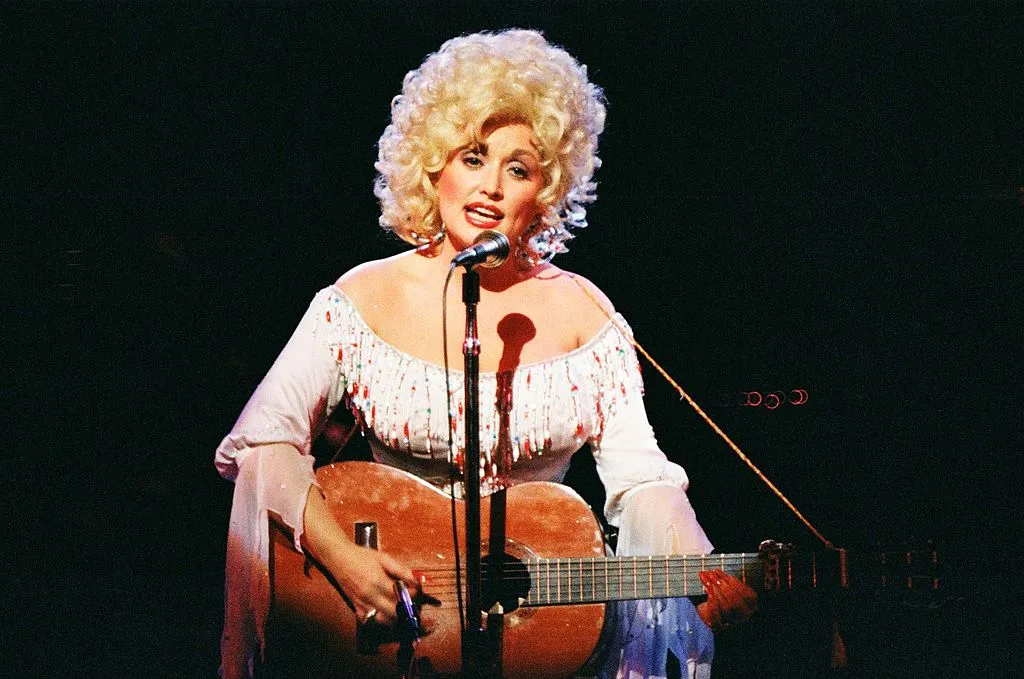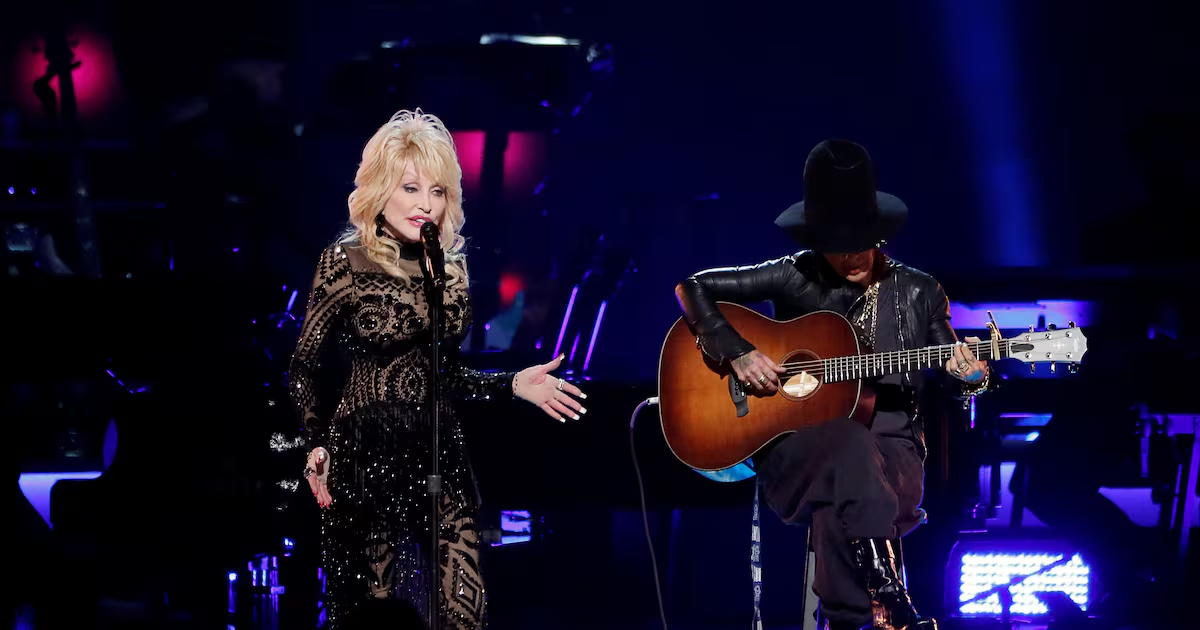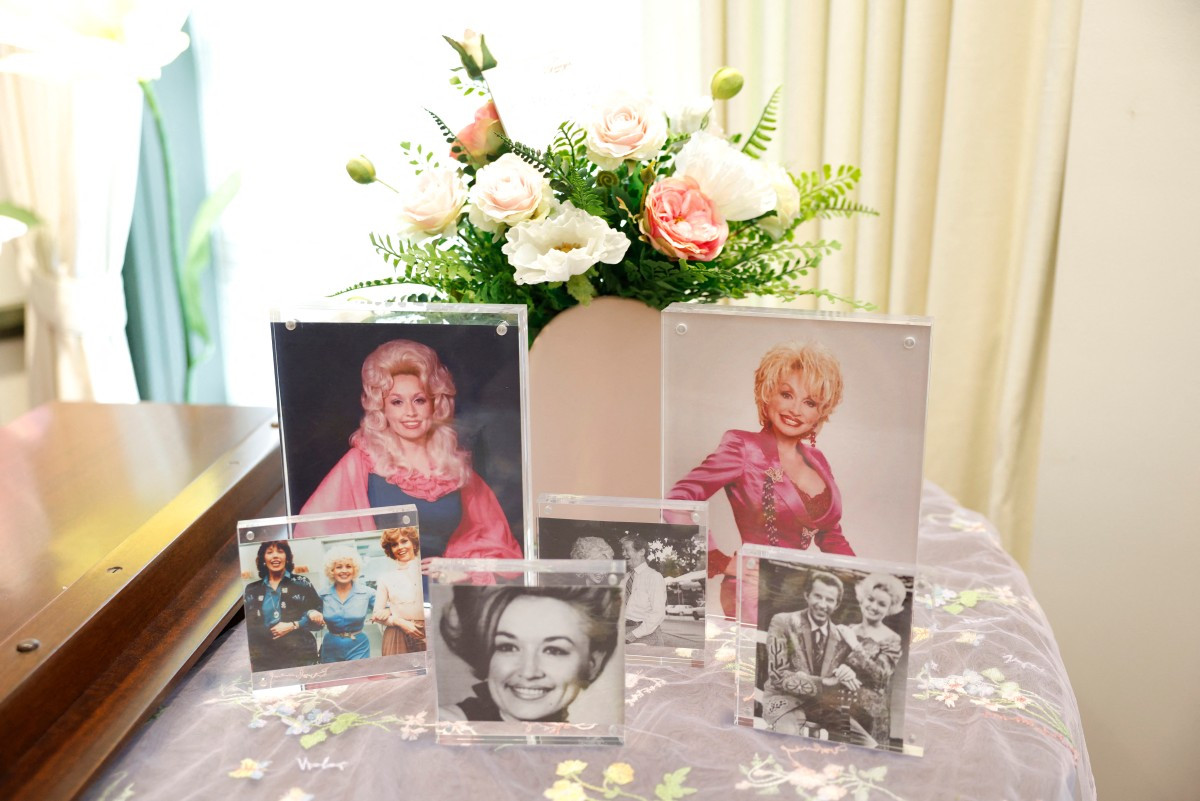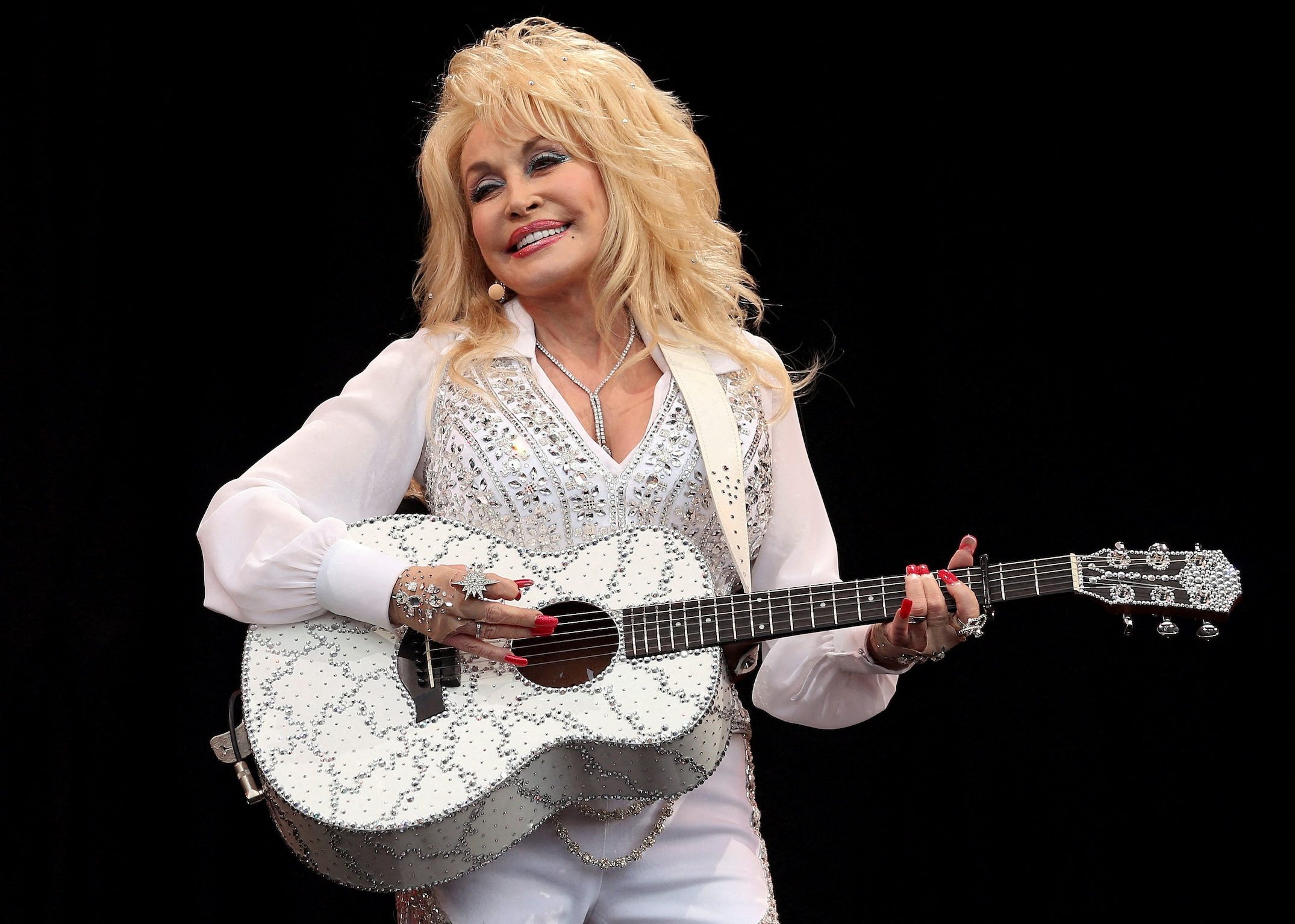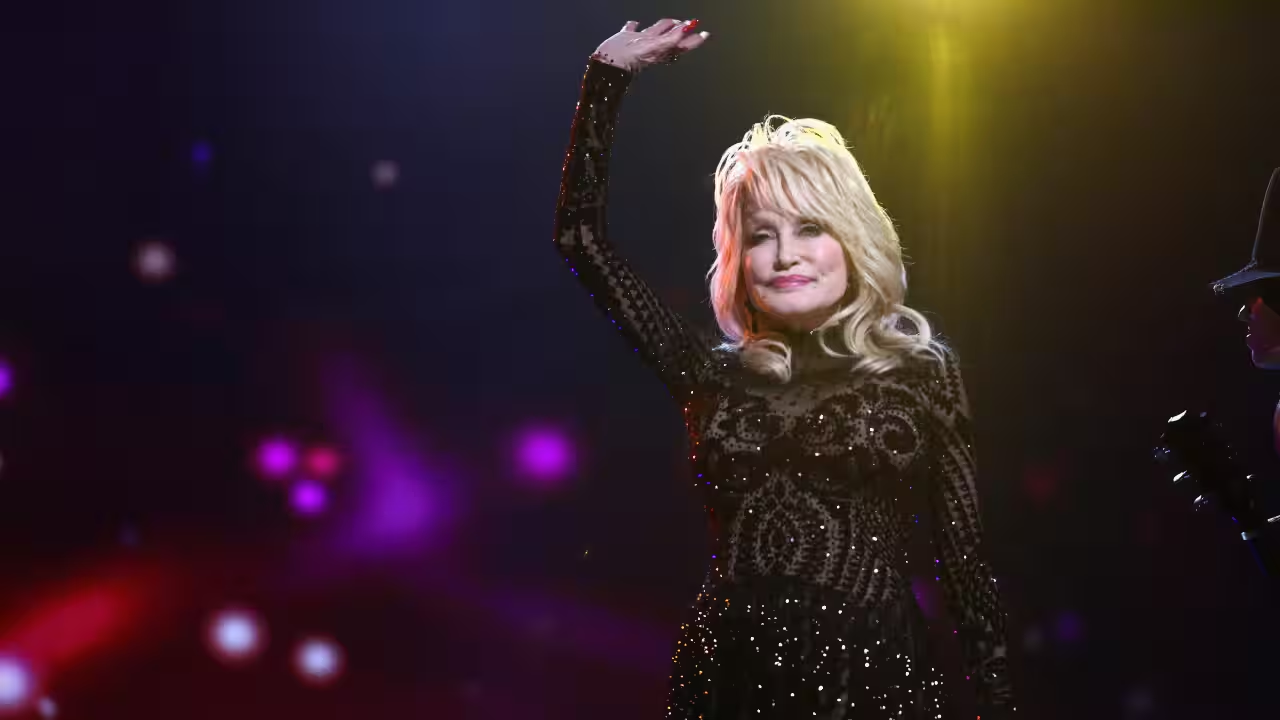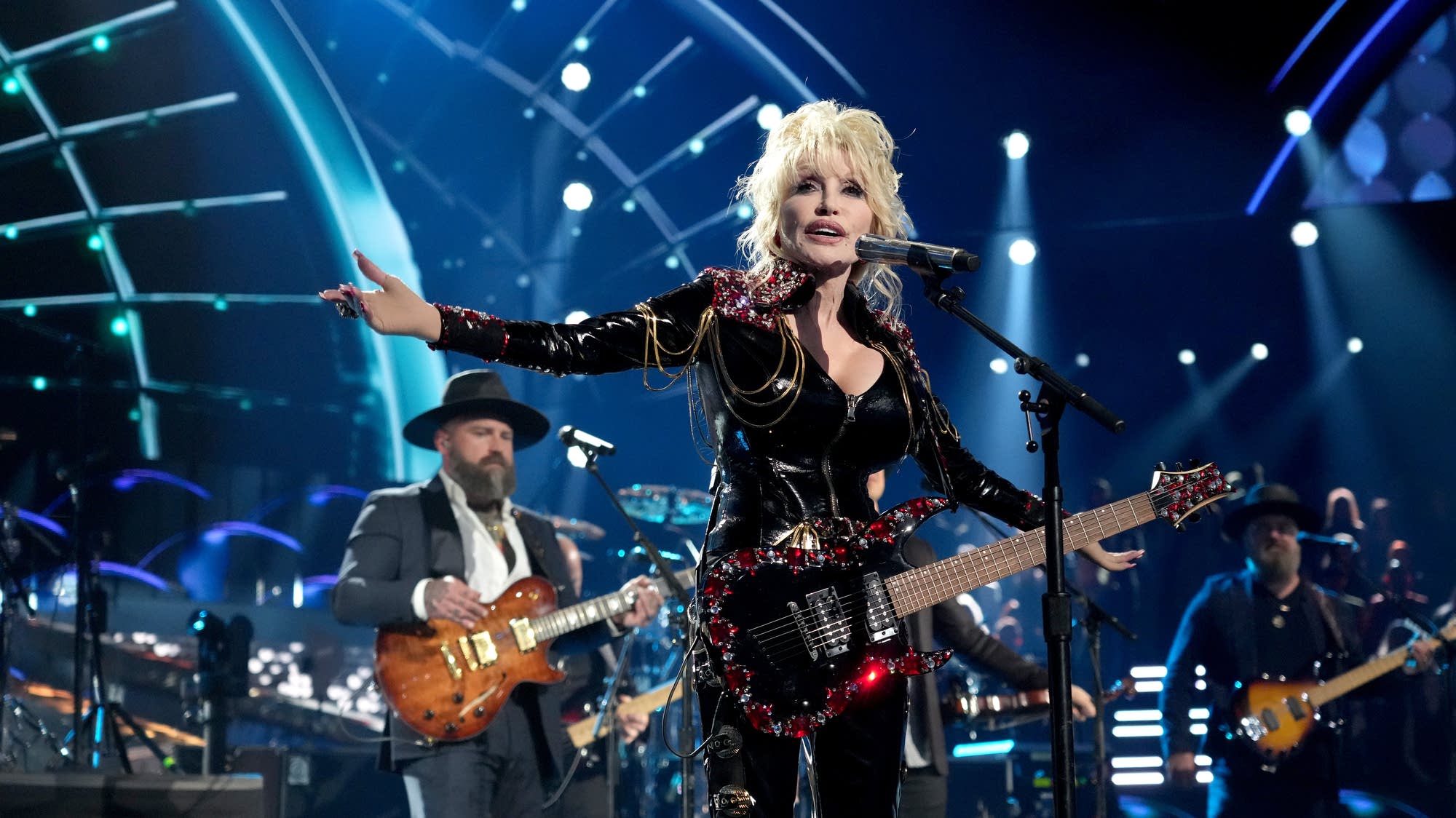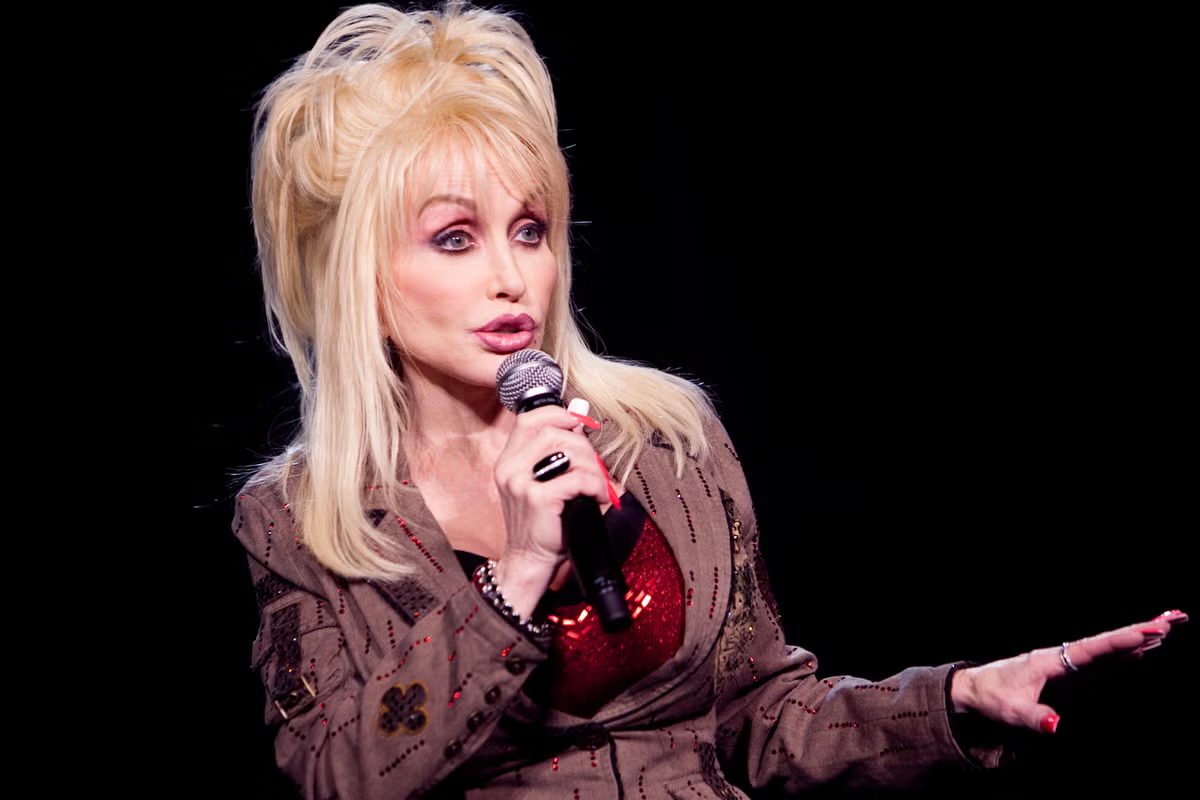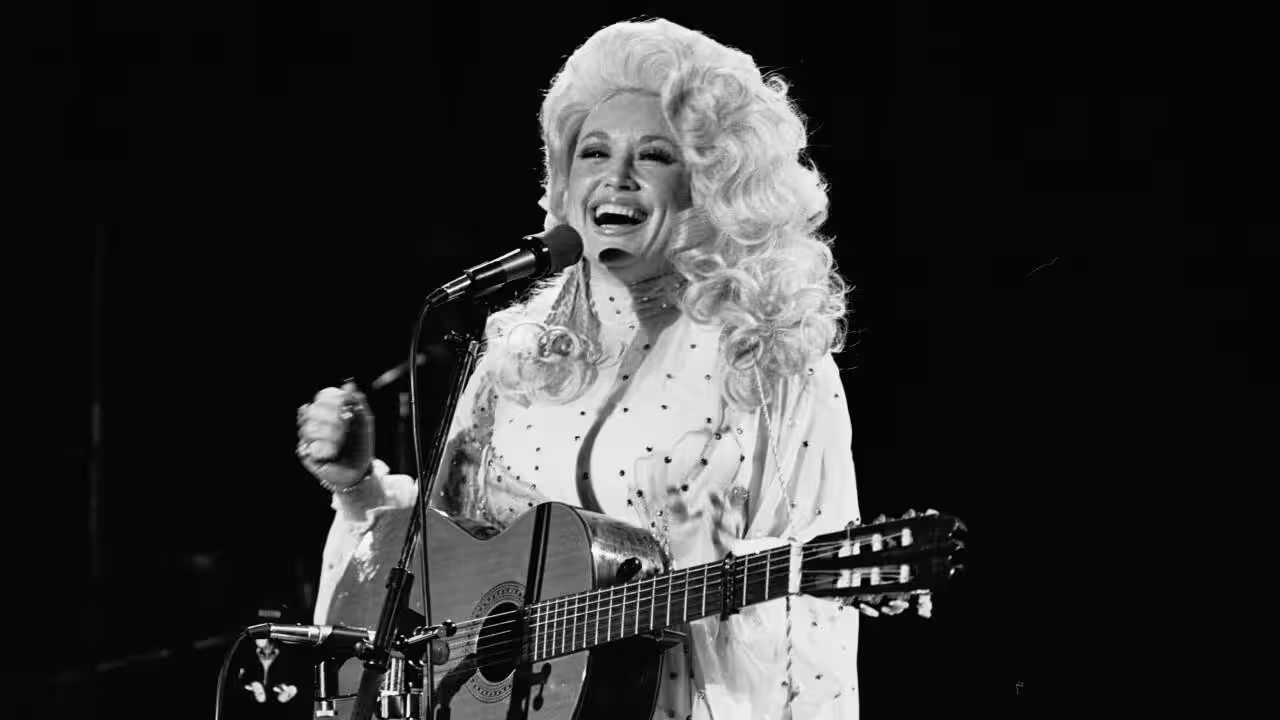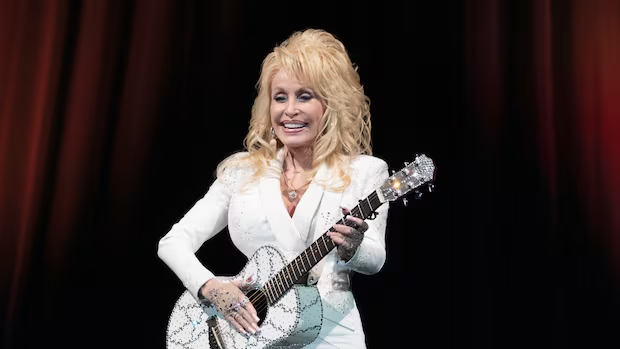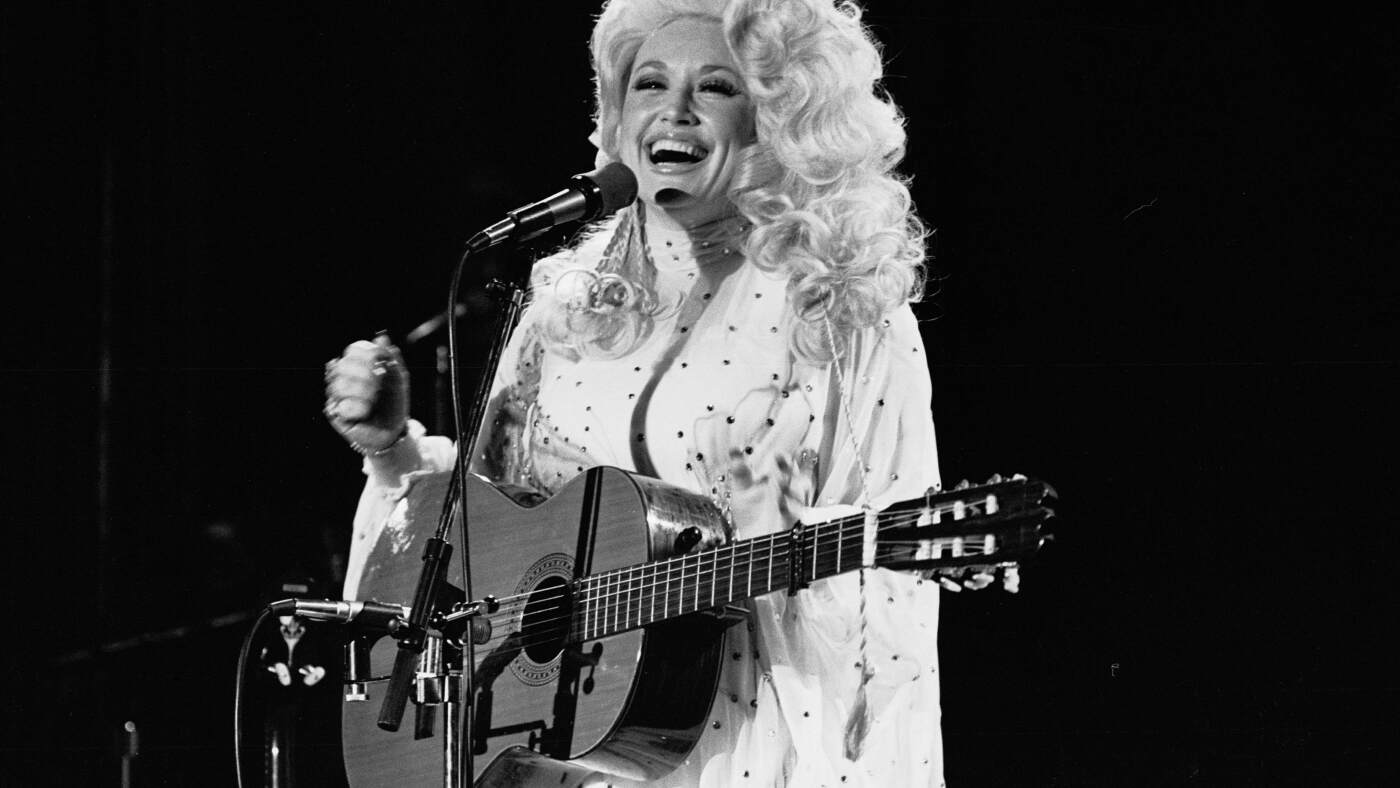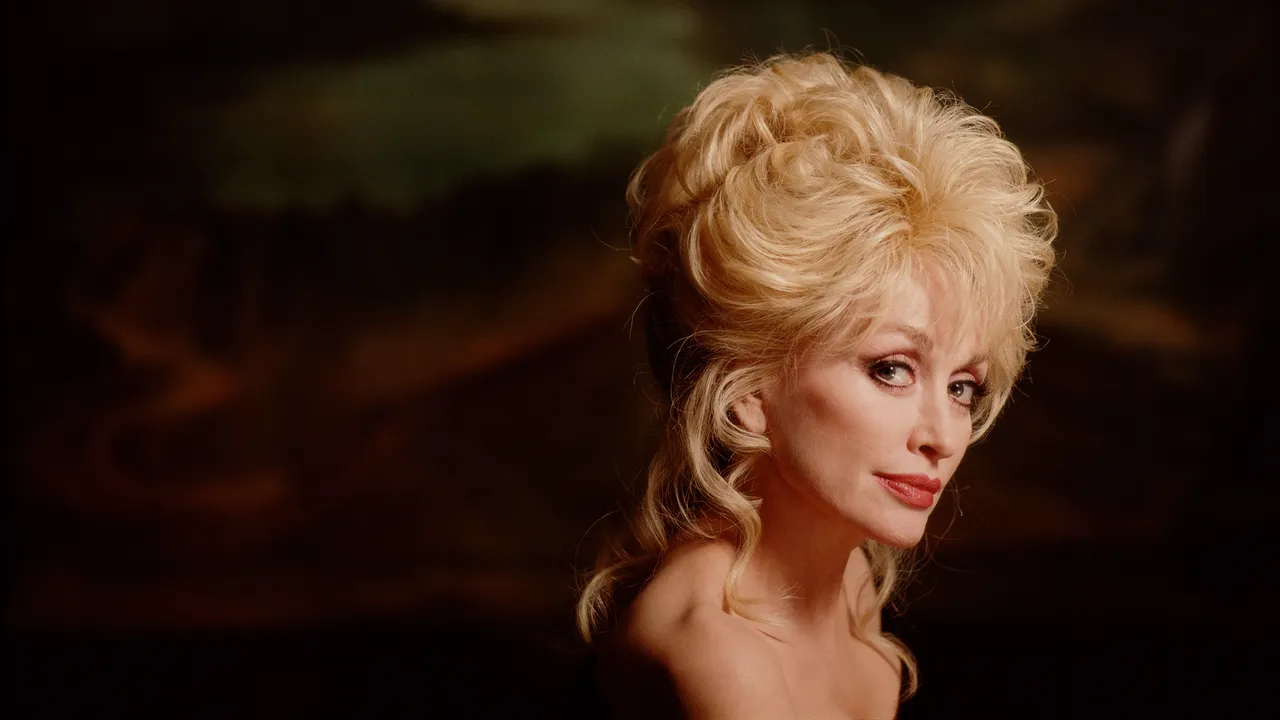
Four score and three thousand songs ago, in the middle of a whopping winter storm, a sharecropper and his young wife brought forth upon this continent a baby girl named Dolly Parton. If you know the rest of this story, you know that it never gets old. Her parents, Avie Lee and Robert Lee Parton, had married at the respective ages of fifteen and seventeen. Dolly was the fourth of their twelve children, born in a one-room cabin on the banks of the Little Pigeon River, in Sevier County, Tennessee, and also born into the kind of poverty that meant the doctor who delivered her got paid with a sack of cornmeal and the kids wore the elastic from old underwear as hairbands. At six, she started singing in the church where her grandfather was the preacher. At seven, she began playing a homemade guitar—later, also a jerry-rigged mandolin, constructed from the guts of an old piano she’d found in an abandoned chapel in the woods. By ten, she had landed a gig on the local radio station. Three years later, Johnny Cash strode onstage at the Grand Ole Opry and told the Saturday-night crowd, “We’ve got a little girl here from up in East Tennessee.”It was among the last introductions Dolly Parton would ever need. In the course of her long career, which was almost completely coextensive with her long but not long enough life, she produced some fifty studio albums, sold north of a hundred million records, won ten Country Music Association Awards and eleven Grammys, and got inducted into the Country Music Hall of Fame, the Gospel Music Hall of Fame, the Rock and Roll Hall of Fame, and the Songwriters Hall of Fame. If there were a Fame Hall of Fame, she would be in that, too.Dismayingly, for those of us who are perpetually stuck on item three of our to-do list, all that barely begins to describe how Dolly Parton spent her days. She also starred in several movies, at least three of which are good; wrote or co-wrote a handful of memoirs, several children’s books, a few cookbooks, and one novel; and created a sprawling business empire that made her into not only the most famous export of Sevier County but also its largest employer. To honor her father, who never learned to read, she started a charity, the Imagination Library, that sends a free book every month to roughly one in seven preschool-age American children. That would have been plenty; richer people usually do far less. But, when her home county was devastated by wildfires in 2016, she sent a thousand dollars a month for six months to every family that had lost a home, and when the coronavirus came around four years later, she donated a million dollars to help fund the development of a vaccine. As her fellow country-music stars Montgomery Gentry once sang, that’s a life you can hang your hat on.Still, for all this, songs were always the heart of it. Dolly never learned to read music, but she could play just about anything with strings, plus the recorder, the harmonica, the saxophone, and even her own fingernails, permanently recorded in all their ninety-words-a-minute acrylic glory in those driving opening measures of “9 to 5,” that national anthem for the nation of women. She always said that she didn’t have the greatest voice, and, since the competition included Patsy Cline, Wynonna Judd, and Reba McEntire, that was true; nonetheless, hers was somehow the most distinctive in the business. It was a little trembly, a little breathy, good at all the girly stuff, but with a girder of light-gauge steel beneath it, like you’d slink away real embarrassed if you tried to mess with her. She was a dead-center soprano, but her emotional range was ample: she could purr, she could plead, she could growl, she could yodel, she could croon. She could even sort of belt, although a little daintily; compared with Whitney Houston’s “I Will Always Love You,” Dolly’s version sounds as delicate and sweet as Queen Anne’s lace.Photograph from Bettmann / GettyAs for what she sang about: pretty much everything, at one point or another, but mostly hope, home, hardscrabble happiness, and the irresistible but absolutely exasperating nature of all men excepting Jesus. She sang true country-girl songs, where fishing poles rhymed with fishing holes; and seventies disco-pop, where the band bwaaaaa-chicka-bwaa-ed behind her vocals; and soaring gospel songs and boot-stomping bar tunes, and even, pretty creditably, “Purple Rain.” She sang the world’s most joyful heartbreak song (“Why’d You Come in Here Looking Like That”) and the world’s most upbeat lament for a vanishing way of life (“Applejack”) and the only Christmas song this Jew can tolerate come the December deluge of drummer boys: the achingly lovely “Hard Candy Christmas.” This is to say nothing of the aforementioned “I Will Always Love You,” in which, with meta magnificence, she turned her best career decision—splitting with Porter Wagoner, the collaborator who helped launch her to fame—into one of the world’s most enduring love songs. I hope and trust that about a billion people listened to it yesterday.Even more than she was a singer, Dolly Parton was a performer, and her longest-running show was herself. Right around age twelve, she became, as Johnny Carson understated in a 1977 interview, “rather zaftig.” Presented by the culture with many mediocre options for how to handle her particular combination of looks, ambition, and gender, she chose one that was not on the menu, stepping into every insult that could possibly be used against a woman like her—dumb blonde, bimbo, trailer trash, whore—and tailoring them perfectly to her 40-20-36 frame. It was impossible to make her the butt of a joke because she was always in on it, and her own quips were almost as famous as her songs: “It costs a lot of money to look this cheap”; “I’m not offended by dumb-blonde jokes because I know I’m not dumb. I also know I’m not blond.”All this was canned, of course, produced like a dazzling smile whenever the world demanded it. She knew both who she was and who she needed to be, and she played it all to a T, part Betty Boop, part Annie Oakley, part Abraham Lincoln. Those closest to her, including Carl Dean, her husband of nearly sixty years, presumably knew some other Dolly, less rehearsed and likely deeper. The rest of us just got the surface, but who could feel cheated? The surface of Dolly was the point, like the surface of diamonds. I don’t just mean her physical self-presentation—the wigs, the clothes, the precarious heels and plunging necklines—although all of that was fabulous; in her prime, she could have made the head of Tiffany buy rhinestones. (She could also make other people want to try on her style: she once entered a Dolly Parton look-alike contest on the sly and lost, to a man.) I mean that she understood, with canny acuity, that what she was selling was authenticity—that’s what all country music is selling—but that the best way to sell it was through artifice. We are talking about a woman who purchased and then walled off her childhood home while simultaneously creating a fake version for the public to visit.So, too, with herself. Dolly revealed everything, told anyone who asked about the wigs, the eyelashes, the boobs, the boob jobs. She had no shame and nothing to be ashamed of. She never tried to pass off everything ersatz about herself as the genuine article, which had the curious effect of making her seem entirely sincere. It helped that she embodied our national ideal of authenticity, from the one-room cabin on up to the self-made fortune; whatever phantasmagorical thing a Real American might be, there has never been one realer. The self she showed off was utterly armored and utterly disarming—and, boy, did the world go for it. I have never encountered anyone, of any age, race, class, gender, or taste in music, who didn’t at a minimum admire and more often adore her—her songs, her movies, her moxie, her morals, which seemed so loose yet proved so deep and durable. She was commonly called the Queen of Country Music, but that is exactly wrong: she was democratic to her bones, of the people and by the people and for the people, the duly elected President of the United States of Americans.Dolly always said that she wanted to die onstage, mid-song, but in the end she did herself one better. Her last public appearance was at the end of June, for the grand opening of a Tennessee truck stop newly named in her honor. Of all the musicians in the world—of all the people in the world—only Dolly could make that seem like the perfect way to bow out of the game. When I heard the news yesterday afternoon, I thought about a song she released at seventy, called “I’m Sixteen,” which isn’t about being that age but about feeling that age. It’s a classic Dolly number in that it brings to mind that gooey New York City street fare, the mozzarepa: it is corny, cheesy, delicious. Midway through, she sings, “It goes to show you’re never old unless you choose to be.” I believe it, or anyway I believe she believed it. In that sense, I am happy to report, the great Dolly Parton died young. ♦
Dolly Parton for the People
She was commonly called the Queen of Country Music, but that is exactly wrong: she was democratic to her bones.
1,572 words~7 min read